Hyundai KIA Santa Fe Sorento Hybrid Cars Comparisons Family Tests SUV
Hyundai Santa Fe vs KIA Sorento: which hybrid family SUV with seven seats offers more value in 2026
 Iván Navarro
24 September 2026
6 min.
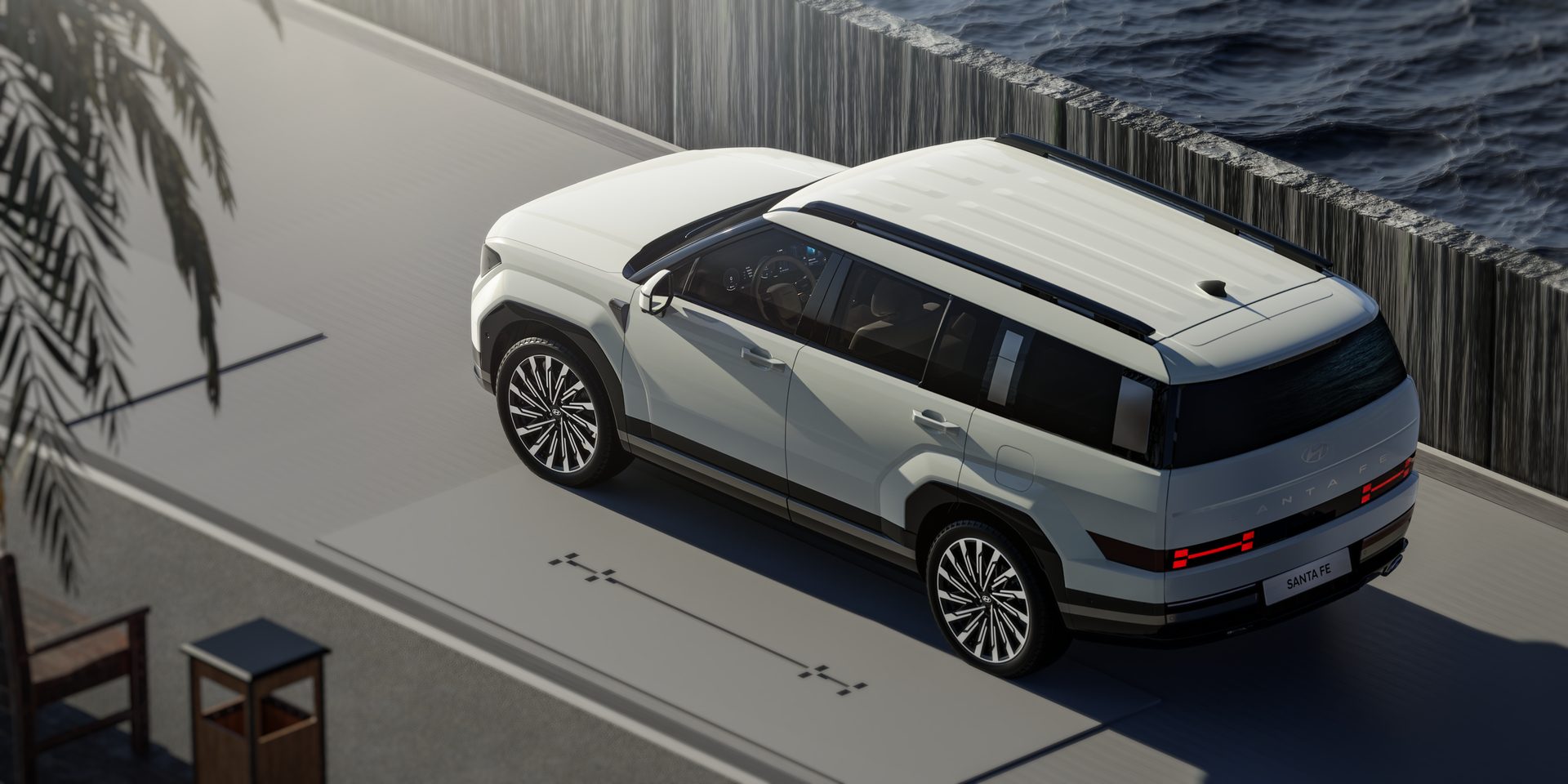
We compare the Hyundai Santa Fe HEV and the KIA Sorento PHEV, the two hybrid seven-seat SUVs from the Korean group in Spain, to find out which one makes more sense in 2026.
The Hyundai-KIA group has been left almost alone in a very specific niche of the Spanish market: large SUVs with three genuine rows of seats and electrified powertrains that don’t require a mandatory charging cable. Two cars, two philosophies. The Hyundai Santa Fe vs KIA Sorento is no longer so much a battle between siblings as a fundamental decision: conventional hybrid or plug-in hybrid. And that’s where budget, garage and real-world use of the car decide.
From the initial list of candidates we have ruled out two common names in the segment. The Nissan products are out because, in our view, in this particular range there are alternatives with a better balance between perceived quality and price. The same goes for BYD: although its arrival in Spain is moving forward steadily, we consider that in this format of hybrid seven-seat family SUV there are more rounded proposals within the Korean universe itself. With that clarified, let’s move on to the two that do make the cut.
Why the comparison comes down to these two cars
In the 2026 Spanish catalogue, if you look for a hybrid 7-seat SUV within the Hyundai-KIA group, the list runs out quickly. The Santa Fe with an ECO label and the Sorento with a CERO label cover two uses that barely overlap: one prioritises the simplicity of never plugging anything in, the other requires a garage with a socket but offers almost 60 km of official electric range. They don’t compete so much as complement each other.
Before getting into the figures, a mandatory notice: the prices we quote are the manufacturer’s recommended retail prices (PVP), without dealer discounts, one-off promotions or aid from the Plan Auto+. Treat them as indicative.
Hyundai Santa Fe HEV, from approximately €56,000
The new generation of the Santa Fe broke the aesthetic mould a year ago. Straight lines, vertical tailgate, an air of Land Rover that some people love and others find jarring. In our view, the design improves with the passing months, especially when you see it parked next to rivals with softer lines.
Under the bonnet, familiar mechanics: a 1.6 T-GDi petrol engine supported by an electric motor, a six-speed automatic gearbox and a small battery that recharges itself. No cables, no planning, no range anxiety. In practice, a large SUV that consumes what a compact diesel from ten years ago did and that is driven with the placidity one expects from a 4.83-metre family car.
| Power kW | Power CV | Top speed | Consumption | CO₂ emissions | Label | Fuel |
|---|---|---|---|---|---|---|
| 176 kW | 239 CV | 196 km/h | 6.4 l/100 km | 144 g/km | ECO | Petrol hybrid |
The third row is genuinely usable for adults on short journeys and for children without complaint. The boot, with all seven seats in place, is tight — as in the whole segment, it has to be said.
KIA Sorento PHEV, from €61,900
The Sorento plays in a different tax league. With its 13.8 kWh battery and almost 60 km (55-57 km) of homologated electric range, it joins the DGT’s CERO label club — with everything that entails in Madrid Central, Barcelona’s ZBE, regulated parking and future tolls. That badge is half of its commercial argument.
The other half is the full-time 4×4 traction fitted as standard on this version, something the base Santa Fe HEV does not offer. For families living in snowy areas or for anyone who occasionally tows a trailer, the nuance matters.
| Power kW | Power CV | Top speed | Electric range | Consumption | Battery | CO₂ emissions | Label | Fuel |
|---|---|---|---|---|---|---|---|---|
| 212 kW | 288 CV | 206 km/h | 55-57 km | 1.6 l/100 km | 13.8 kWh | 37 g/km | CERO | Plug-in hybrid (PHEV) |
That 1.6 l/100 km is, obviously, the homologated WLTP consumption figure on a combined cycle with a full battery. On a long journey with the battery depleted, the Sorento PHEV behaves like a heavy conventional hybrid — it hauls around an extra 200 kilos of batteries and you feel it on the scales.
Santa Fe vs Sorento comparison: where each one makes the difference
The starting price difference is around €6,500. It’s not small, but it isn’t the only factor either. If you have a garage with a socket and drive fewer than 50 km a day during the week, the Sorento PHEV can run in electric mode almost all the time. Without a garage, that price premium becomes dead weight and the logic reverses completely.
The Santa Fe HEV, on the other hand, asks nothing of its user. Fill it up, drive it, forget about it. For anyone who lives outside a major city and doesn’t travel through a ZBE, it is the most rational choice — and some €6,500 cheaper, which on the table is enough for a great deal. This dilemma between conventional and plug-in hybrid is the same one we analyse in greater depth in our guide on how to choose a hybrid family SUV in 2026.
Interior and equipment are almost identical in philosophy — they share a platform, after all — but the Santa Fe opts for a more daring dashboard with a 12.3-inch curved dual screen, while the Sorento keeps a more classic language. A matter of taste.
Summary table and editorial score
| Model | Power | Electric range | Consumption | Price from | Label | Score |
|---|---|---|---|---|---|---|
| Hyundai Santa Fe HEV | 239 CV | — | 6.4 l/100 km | ≈€56,000 | ECO | 8.4/10 |
| KIA Sorento PHEV | 288 CV | 55-57 km | 1.6 l/100 km | ≈€61,900 | CERO | 8.2/10 |
The Santa Fe HEV takes the slightly higher score for overall consistency§h197;: it delivers what it promises without conditions. The Sorento PHEV wins on tax and electric versatility, but only shines in its natural habitat — a garage with a socket and frequent urban driving.
Frequently asked questions
Which one consumes less on a long motorway journey?
The Santa Fe HEV, in practice. With the Sorento PHEV’s battery depleted, both consume similar figures — around 7-8 l/100 km in real conditions — but the Santa Fe doesn’t haul the extra weight of the large battery and usually ends up a few tenths below.
Does the KIA Sorento PHEV keep the CERO label indefinitely?
Yes, the environmental label depends on the vehicle’s homologation at the time of registration and does not expire over time. It offers the 55-57 km of homologated electric range required to belong to that category.
Can I buy either of them with the Plan Auto+?
The national aid framework applies to plug-in hybrids with a CERO label, not to conventional HEVs. In other words, the Sorento PHEV qualifies; the Santa Fe HEV does not. Check the current amounts on the official website before signing.
Which one has the more habitable third row?
Very evenly matched, with a slight advantage in dimensions for the Santa Fe thanks to its more boxy design and vertical tailgate, which improves usable headroom in the third row. In any case, neither is a people carrier — for long trips with seven adults, both are tight.
Technical specifications of the cars in this article


 Kia offers an electric range of 10 models, 50 versions and 400 possible combinations
 The seven finalists for the 2027 European Car of the Year (COTY) are exclusively electric
 Peugeot E-208 GTi: a battery-powered toy that revives the spirit of the 1980s sports cars
Deja un comentario