Hyundai KIA Santa Fe Sorento Hybrid Cars Comparisons Family Tests SUV
Hyundai Santa Fe vs KIA Sorento: Which Korean hybrid family SUV offers more value in 2026?
 Iván Navarro
8 November 2026
6 min.
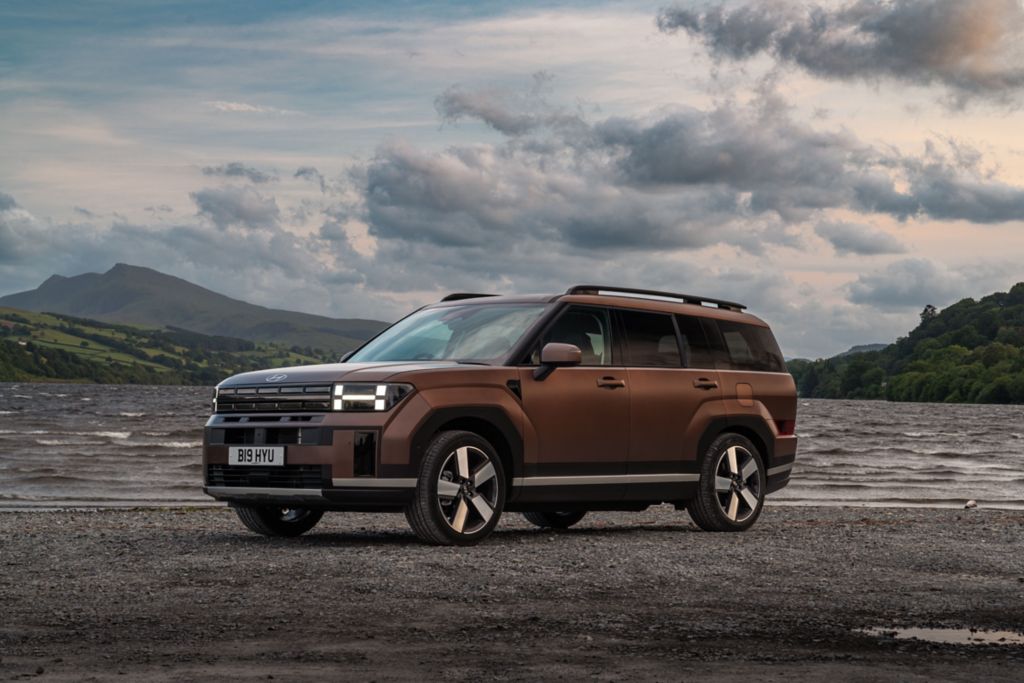
We compare the Hyundai Santa Fe HEV and the KIA Sorento PHEV, two Korean 7-seat mid-size SUVs with opposite electrification philosophies. Power, consumption, environmental label and indicative price to decide which one offers more value in 2026.
Choosing between a conventional hybrid and a plug-in one is no longer just a matter of budget. It is, above all, a matter of how each family lives. Hyundai and KIA, sister companies within the same group but with very different personalities, resolve this in opposite ways with their seven-seat mid-size SUVs. The result is one of the most interesting duels in the Korean family segment in 2026.
Hyundai Santa Fe vs KIA Sorento: two different ways of understanding the hybrid family mid-size SUV
The Santa Fe opts for simplicity: get in, start, drive. No cables, no plugs, no planning the charge. The Sorento, on the other hand, plays the plug-in card, with real electric range for everyday use and a CERO environmental label that weighs heavily in cities with traffic restrictions. Neither is better in the abstract — it depends on what kind of kilometres you drive.
Hyundai Santa Fe HEV, from €56,020: the self-charging hybrid without complications
The HEV 1.6 TGDi 239 Maxx version of the Santa Fe combines a turbocharged four-cylinder with electric assistance to deliver 239 CV. It needs no wallbox or charging planning, which for a family without a private garage is not a minor detail. Its homologated mixed consumption is around 6.4 l/100 km, a reasonable figure for an SUV of this size, though far from the efficiency of a well-managed plug-in.
| Model | Power | Top speed | Consumption | CO₂ | Fuel |
|---|---|---|---|---|---|
| Hyundai Santa Fe HEV 239 Maxx | 176 kW / 239 CV | 196 km/h | 6.4 l/100 km | 144 g/km | Hybrid (petrol/electric) |
KIA Sorento PHEV, from €61,445: the plug-in for driving around the city on electric power
The Sorento Hybrid PHEV 1.6 T-GDi 252 Drive 4×4 raises the stakes: 252 CV, all-wheel drive and a 13.8 kWh battery that allows 55 km on electricity alone. For a daily commute to the office or school, that can mean entire weeks without visiting a petrol station. That said, it demands charging discipline — if you don’t plug it in, the extra weight of the battery works against consumption.
| Model | Power | Top speed | Electric range | Consumption | CO₂ | Fuel |
|---|---|---|---|---|---|---|
| KIA Sorento Hybrid PHEV 252 Drive | 185 kW / 252 CV | 183 km/h | 55 km | 1.6 l/100 km | 37 g/km | PHEV (petrol/plug-in) |
Power and mechanics: 239 CV vs 252 CV
On paper the difference is minimal, just 13 CV in favour of the plug-in Korean. In practice, the Sorento feels somewhat more forceful off the line thanks to the constant electric assistance and its standard 4×4 traction, while the Santa Fe prioritises smoothness of delivery over punch. Neither aims to be sporty — they are family SUVs, and they behave as such.
Electric range and environmental label: ECO vs CERO
Here is the difference that truly affects day-to-day life. The Santa Fe HEV carries an ECO label, enough to avoid most current urban restrictions. The Sorento PHEV, thanks to its battery and electric range, qualifies for the CERO label, with parking and circulation advantages that in Madrid or Barcelona are felt in the wallet every month.
Real consumption and cost per kilometre
On paper the PHEV wins with a homologated consumption of 1.6 l/100 km versus the 6.4 l/100 km of the HEV. But that figure only holds if you charge regularly. A driver who never plugs in the Sorento will probably end up consuming more than with the Santa Fe, due to the battery’s extra weight. It is debatable whether the PHEV pays off for someone without a wallbox or garage — there the HEV regains all its sense.
Interior space, 7 seats and family life
Both offer a seven-seat configuration, although the third row remains the domain of children or short trips in both cases — this is the norm in the segment, not a Korean exception. The Sorento PHEV’s boot loses some capacity compared with versions without a battery, a nuance worth considering if you regularly travel with bulky luggage. If your main use is a large family with luggage for long journeys, it is also worth reviewing our guide to choosing a large MPV or SUV for long trips, where seat and rear climate-control criteria weigh as much as the mechanics.
Price, Plan Auto+ and total cost of ownership
The Santa Fe HEV starts at €56,020 RRP, versus €61,445 for the Sorento PHEV. That €5,425 difference can be recovered over time thanks to the CERO label and the Plan Auto+ aid, whose exact amount should be checked on the official website before signing, as it varies and may expire. Remember that both figures are manufacturer’s recommended retail prices, without dealer discounts or one-off promotions.
Comparison table: Hyundai Santa Fe vs KIA Sorento
| Model | Power | Electric range | Label | RRP from | Highmotor score |
|---|---|---|---|---|---|
| Hyundai Santa Fe HEV 239 Maxx | 239 CV | Not applicable | ECO | €56,020 | 7.8/10 |
| KIA Sorento Hybrid PHEV 252 | 252 CV | 55 km | CERO | €61,445 | 8.2/10 |
Highmotor verdict: which Korean hybrid family SUV offers more value in 2026?
In my view, the answer depends entirely on the wallbox. If you have somewhere to charge daily, the KIA Sorento PHEV offers more: CERO label, much lower consumption in real use and slightly higher power. If you never charge, or will do so irregularly, the Hyundai Santa Fe HEV is the most honest option and, incidentally, the cheapest to get into. Neither is a panacea in either case — both are solid mid-size SUVs, free of flashiness, designed to last. And perhaps that is, in the end, the greatest Korean virtue in the segment. If your priority is exclusively electric range within the plug-in segment, it is also worth reviewing our ranking of plug-in hybrid SUVs with the best range-to-price ratio before deciding.
Frequently asked questions
What is the main difference between the Hyundai Santa Fe HEV and the KIA Sorento PHEV?
The Santa Fe is a self-charging hybrid that requires no charging, with an ECO label and RRP from €56,020. The Sorento is a plug-in hybrid with 55 km of electric range, a CERO label and RRP from €61,445.
What environmental label does each model have?
The Hyundai Santa Fe HEV carries an ECO label. The KIA Sorento PHEV, with a homologated electric range of 55 km, qualifies for the CERO label.
Is it worth paying more for the KIA Sorento PHEV if I don’t have a wallbox at home?
It is debatable. Without regular charging, the Sorento loses much of its consumption advantage over the Santa Fe, so the HEV makes more sense for someone who cannot plug in daily.
Do both SUVs offer a 7-seat configuration?
Yes, both the Hyundai Santa Fe HEV and the KIA Sorento PHEV are sold in Spain with a seven-seat layout, although the third row is mainly intended for children or short trips.
Technical specifications of the cars in this article


 Kia offers an electric range of 10 models, 50 versions and 400 possible combinations
 The seven finalists for the 2027 European Car of the Year (COTY) are exclusively electric
 Peugeot E-208 GTi: a battery-powered toy that revives the spirit of the 1980s sports cars
Deja un comentario