Lexus IS 250 F-Sport, road test (Engine and performance)
 Diego G. Moreira
7 November 2012
5 min.
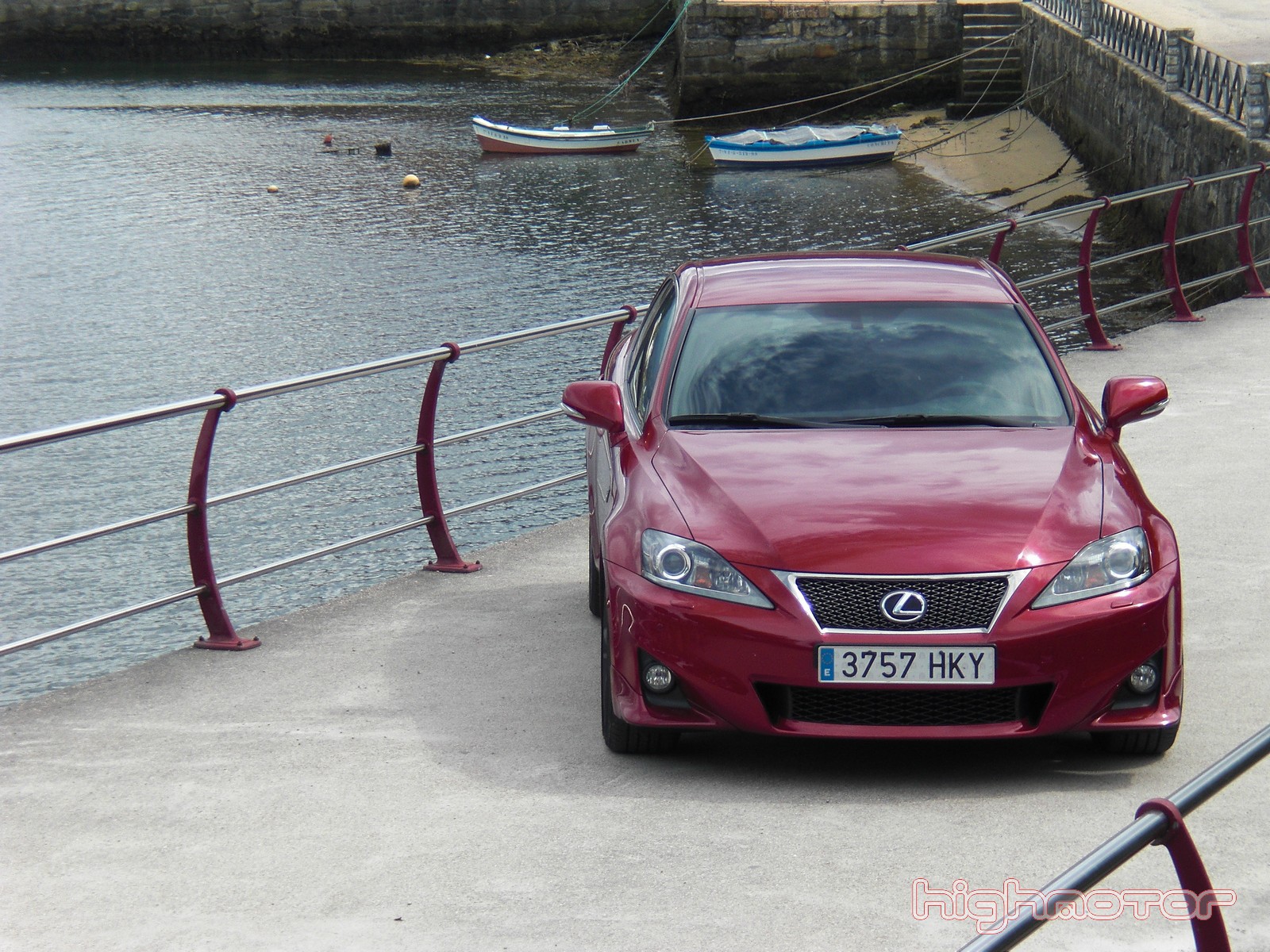
Behind the wheel of the Lexus IS 250 F-Sport with a 208 CV petrol engine. In this first part of the test we assess the engine, performance, handling and consumption of the Japanese car.
We live in times when rationality takes precedence: being thrifty, saving money, keeping track of spending and controlling enjoyment so that it doesn’t mean an extra outlay. In cars, the most logical choice is diesel because of the savings it brings… But does everything have to be measured by economy? Does passion count for nothing?
Today we are testing a Lexus with an engine that is a long-standing acquaintance of the Japanese manufacturer. We are talking about the Lexus IS 250 F-Sport, with a 2.5-litre V6 petrol engine and a power output of 208 CV. It has no turbo, it is completely impractical, and it is a powerplant built in the old-fashioned way. That said, it is highly addictive.
Before we continue with the test, we invite you to another review of the same model, but this time with a more economical engine: the Lexus IS 200d F-Sport, which keeps the same sportiness that the F-Sport pack provides. Externally there are no differences between the two versions, but if you want to find a car that makes you enjoy driving, don’t miss this test.
Engine and performance
As I mentioned at the start, the engine in this IS is a long-standing acquaintance within the Lexus brand. Its genius lies in the simplicity of a familiar engine, without a turbo, not pushed to the limit, and above all with the smoothness provided by its six cylinders in V and power that is more than sufficient at 208 CV.
As soon as the car starts, a gentle “purr” adds an acoustic note to the sporty design highlighted by the F-Sport pack. You can tell there are horses under the bonnet and that they are only waiting for us to press the accelerator to respond with their ferocity.
When we decide to pull away and press the accelerator, progressiveness is the defining trait: we will not feel a sudden surge of power, and at all times it is a smooth engine that climbs happily through the revs and responds forcefully to our commands.
That said, like any petrol engine, we have to climb to 2,500 rpm for all the horses to wake up, and they stay available up to 6,000 r.p.m. Below these figures, it is a very calm engine that does not seem to have as much power as its specification sheet suggests.
There are two driving modes, PWR and SNOW: the first makes the engine’s response to the accelerator quicker, while the second is for snow, reducing the torque sent to the wheels to prevent wheelspin.
Paired with this engine is a six-speed automatic gearbox. It is not the most modern gearbox, but it fulfils its role correctly. It has a Sport function to keep the car higher in the rev range, and also paddle shifters, although the speed of gear changes can be improved in sequential mode.
One thing we liked is the response when we need an extra boost of power for whatever reason. We are overtaking, we need more force, we press the accelerator hard, and at that moment the engine climbs to 5,000 rpm and quite literally propels the IS forward.
Handling
The first thing to point out is that the Lexus IS is not a sports car, that is, it has a powerful, very performance-oriented engine, but its purpose is aimed at interior comfort rather than pure sportiness. At least that is what we notice as soon as we sit behind the wheel, since the smoothness of the powertrain is complemented by excellent interior soundproofing and a suspension setup that perfectly isolates the occupants from the imperfections of the road surface.
This comfort is beyond doubt, especially when we look at the wheels: 18-inch alloys with a low-profile tyre, something that would normally reduce interior comfort, and yet it remains very effective in this respect. The suspension strikes a good middle ground between firmness and comfort.
Dynamically speaking, it is a car that holds its own on demanding roads such as a mountain pass or fast bends with constant changes of load, but, it does not leave much room for the driver, because at the slightest provocation the stability control intervenes to keep the IS always under control.
The only personal complaint in this regard is how intrusive the ESP can be. It is good that the car stays controlled, but it leaves practically no margin for the driver: it intervenes at the slightest hint, something we notice especially on a road with fast bends.
Finally, the steering and the brakes perform their role correctly, without any particular highlights.
That said, in today’s era where everything is about engines that are as efficient as possible and loaded with turbos to squeeze out every last horsepower, it is an absolute pleasure to get behind the wheel of this V6 powerplant, which stands out for its power, smoothness and the comfort the car offers on the open road.
Consumption
It is common knowledge that horses have to be fed, watered, and of course, with 208 CV arranged in the traditional way, consumption is not exactly low. Even so, the figures remain within normal parameters and are not excessively high for this output from a petrol engine.
On the open road, the IS 250 consumes between 8.5 and 9 litres per 100 km, while on the motorway it drops to 7.3 litres over our usual 1,200 km route (Madrid > Vigo > Madrid).
In the city the figures rise slightly to 12 litres per 100 km, which is entirely normal. But I must stress again that for a 2.5-litre V6 petrol engine, these are not very high figures.
In the second part of the test we will focus on summarising, since we have already covered them, the design and interior space of the IS, as well as prices and equipment, before concluding with our overall assessment of the model. And if you want to keep reading more about the Lexus IS, we recommend our test of the IS 200d F-Sport.
Photos | Diego G. Moreira
Locations: Illa de Arousa, Pontevedra and Nigrán


 The seven finalists for the 2027 European Car of the Year (COTY) are exclusively electric
 Peugeot E-208 GTi: a battery-powered toy that revives the spirit of the 1980s sports cars
 New Lexus ES: luxury grows and goes electric
Deja un comentario