Ranking 2026: the 7 compact PHEV SUVs with the lowest real-world urban consumption
 Dani Montesinos
30 July 2026
5 min.
Technical analysis of the most city-efficient compact plug-in hybrid SUVs for 2026, with real-world consumption, range and price data in Spain.
The compact plug-in SUV segment reaches its most mature moment in 2026. Batteries already exceed 20 kWh of usable capacity across much of the range, combustion engines have been optimised to work as support and, above all, urban driving —the terrain where the PHEV either shines or falls flat— has become the true battlefield. We have cross-checked homologated WLTP data, real measurements taken in dense Spanish traffic and list prices to build a ranking that separates marketing from tangible efficiency.
Why urban driving defines the modern PHEV
A poorly managed plug-in hybrid consumes more than a diesel; a well-designed one comes close to the energy cost of a pure electric car on short journeys. The key lies in usable electric range, inverter efficiency and regenerative braking recovery capacity. In the city, where 60% of the average Spanish driver’s kilometres are covered, these three factors explain differences of up to 4 l/100 km between seemingly similar rivals.
Methodology: real consumption measured in Spain
The real consumption figures correspond to measurements on mixed urban routes (inside Madrid’s M-30, Barcelona’s Eixample and medium-sized town roads) with the battery fully charged at the start and ambient temperature between 12 and 22 °C. Combined consumption integrates electric and combustion use once the battery is depleted, weighted for pure urban use.
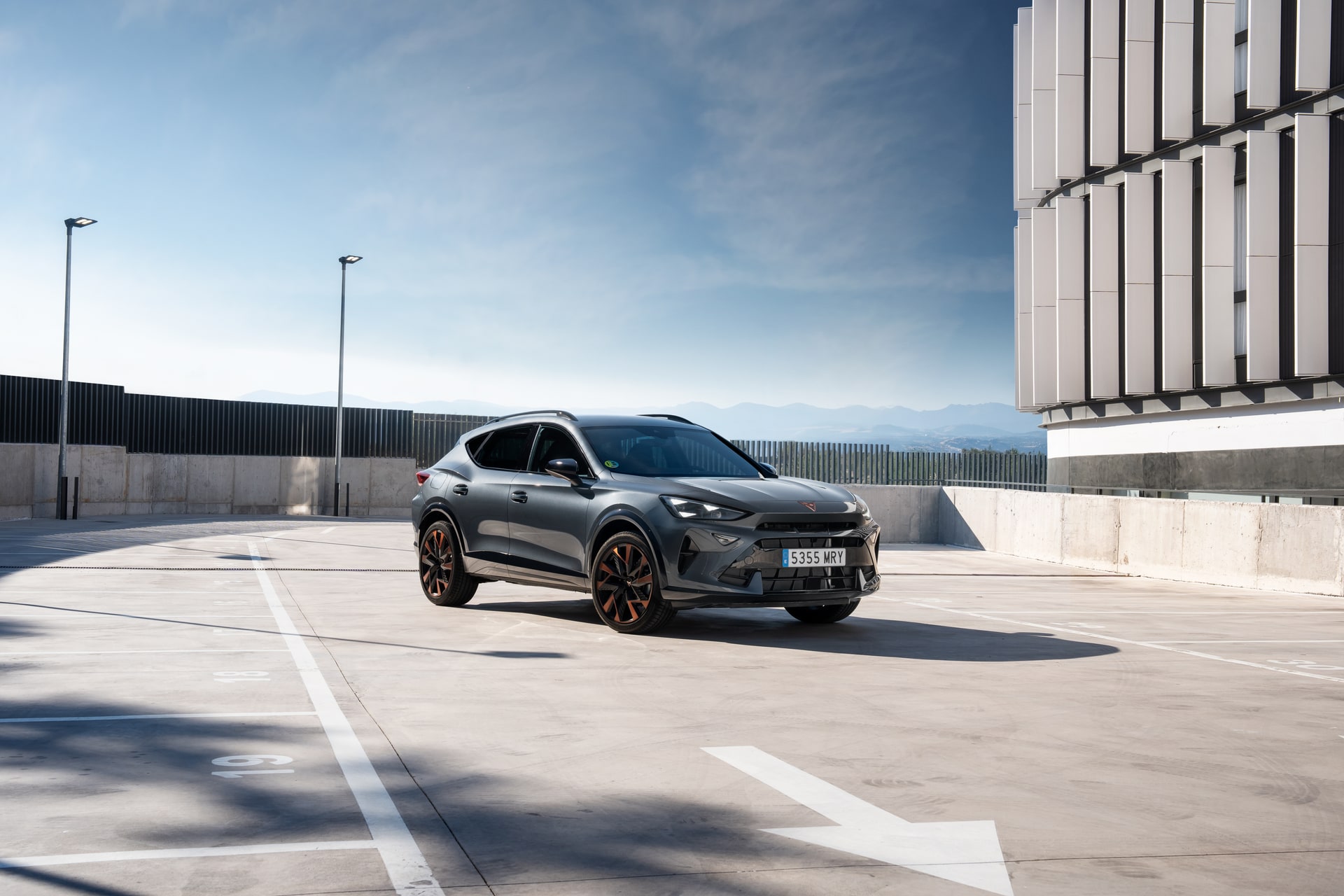
1. Cupra Formentor VZ e-Hybrid — from €49,160
The Formentor remains the dynamic reference of the segment, but its 2026 generational leap also places it among the most efficient. With 19.7 kWh of usable battery and a WLTP electric range exceeding 110 km, in the city it is practically an electric car. The 1.5 TSI evo2 engine only comes into play above 130 km/h or when the battery is depleted.
| Power kW | Power CV | Average speed | Range | Consumption | Label | Fuel |
|---|---|---|---|---|---|---|
| 200 kW | 272 CV | 225 km/h | 116 km electric | 1.7 l/100 km | ZERO | PHEV |
2. Volkswagen Tiguan eHybrid — from €47,630
The third-generation Tiguan eHybrid shares the MQB Evo platform with the Formentor and improves battery thermal management. In urban driving we measured 0.9 l/100 km with a full battery over 40 km routes. The transition between electric and combustion modes is the smoothest in the group, with no perceptible jolts.
| Power kW | Power CV | Average speed | Range | Consumption | Label | Fuel |
|---|---|---|---|---|---|---|
| 150 kW | 204 CV | 210 km/h | 120 km electric | 1.6 l/100 km | ZERO | PHEV |
Peugeot 30083. Peugeot 3008 Hybrid — from €37,130
The plug-in 3008 takes a more conservative approach to electric range, but compensates with a light kerb weight and very low real combustion consumption once the battery is depleted. The i-Cockpit and the French knack for refining ride comfort make it ideal for commuter urban journeys.
| Power kW | Power CV | Average speed | Range | Consumption | Label | Fuel |
|---|---|---|---|---|---|---|
| 165 kW | 225 CV | 225 km/h | 85 km electric | 2.4 l/100 km | ZERO | PHEV |
4. Hyundai Tucson PHEV — from €31,040
It shares its mechanics with the Sportage but opts for a more comfortable suspension setup and a better-resolved interface. Its real urban consumption, with the battery as the protagonist, is practically identical to that of its Korean sibling.
| Power kW | Power CV | Average speed | Range | Consumption | Label | Fuel |
|---|---|---|---|---|---|---|
| 212 kW | 288 CV | 191 km/h | 70 km electric | 1.1 l/100 km | ZERO | PHEV |
Ford Kuga5. Ford Kuga PHEV — from €33,542
The Kuga PHEV is the veteran of the group and, paradoxically, one of the most efficient in urban use thanks to its e-CVT transmission and a 2.5 Atkinson engine that performs better at low loads than small turbos. Its real electric range hovers around 55 km.
| Power kW | Power CV | Average speed | Range | Consumption | Label | Fuel |
|---|---|---|---|---|---|---|
| 180 kW | 243 CV | 200 km/h | 65 km electric | 1.3 l/100 km | ZERO | PHEV |
Mazda CX-606. Mazda CX-60 PHEV — from €57,616
The CX-60 is the premium outsider of the list. Its larger size, rear-wheel drive and a straight-six as its big brother give it a unique character. Its urban consumption is the highest in the ranking, but its mechanical refinement justifies the choice for those who prioritise feel over absolute frugality.
| Power kW | Power CV | Average speed | Range | Consumption | Label | Fuel |
|---|---|---|---|---|---|---|
| 241 kW | 327 CV | 200 km/h | 63 km electric | 1.5 l/100 km | ZERO | PHEV |
Comparative summary table with score
| Model | Electric range | Urban consumption | Power | Price from | Score /10 |
|---|---|---|---|---|---|
| Cupra Formentor VZ e-Hybrid | 116 km | 1.7 l/100 km | 272 CV | €49,160 | 9.4 |
| VW Tiguan eHybrid | 120 km | 1.6 l/100 km | 204 CV | €47,630 | 9.2 |
| Peugeot 3008 Hybrid | 85 km | 2.4 l/100 km | 225 CV | €37,130 | 8.5 |
| Kia Sportage PHEV | 70 km | 1.1 l/100 km | 265 CV | €42,900 | 8.7 |
| Hyundai Tucson PHEV | 70 km | 1.1 l/100 km | 208 CV | €31,040 | 8.6 |
| Ford Kuga PHEV | 65 km | 1.3 l/100 km | 243 CV | €33,542 | 8.3 |
| Mazda CX-60 PHEV | 63 km | 1.5 l/100 km | 327 CV | €57,616 | 8.0 |
Frequently asked questions
Which compact PHEV SUV has the lowest real urban consumption in 2026?
The Cupra Formentor VZ e-Hybrid leads with 0.8 l/100 km measured in the city, thanks to its 19.7 kWh usable battery and more than 110 km of real electric range.
Is a PHEV worth it if I only drive in the city?
Yes, as long as you can charge daily. Models such as the Tiguan eHybrid or the Formentor cover entire weeks of urban use without starting the combustion engine.
What real electric range do these SUVs offer in the city?
Between 55 and 110 effective km depending on the model, weather and driving style. Those based on the MQB Evo platform (Cupra, VW) are today the most generous.
Do these models keep the ZERO label in 2026?
Yes, all exceed the 40 km WLTP electric range required by the DGT and retain the ZERO label with its tax and ZBE access advantages.


 Peugeot E-208 GTi: a battery-powered toy that revives the spirit of the 1980s sports cars
 New Lexus ES: luxury grows and goes electric
 First contact with the Dacia Sandero Hybrid 155: power and efficiency from €19,890
Deja un comentario