500e Dacia ForTwo Spring Electric Twingo Rankings
Ranking 2026: Top 5 electric city cars
 Iván Navarro
13 April 2026
11 min.
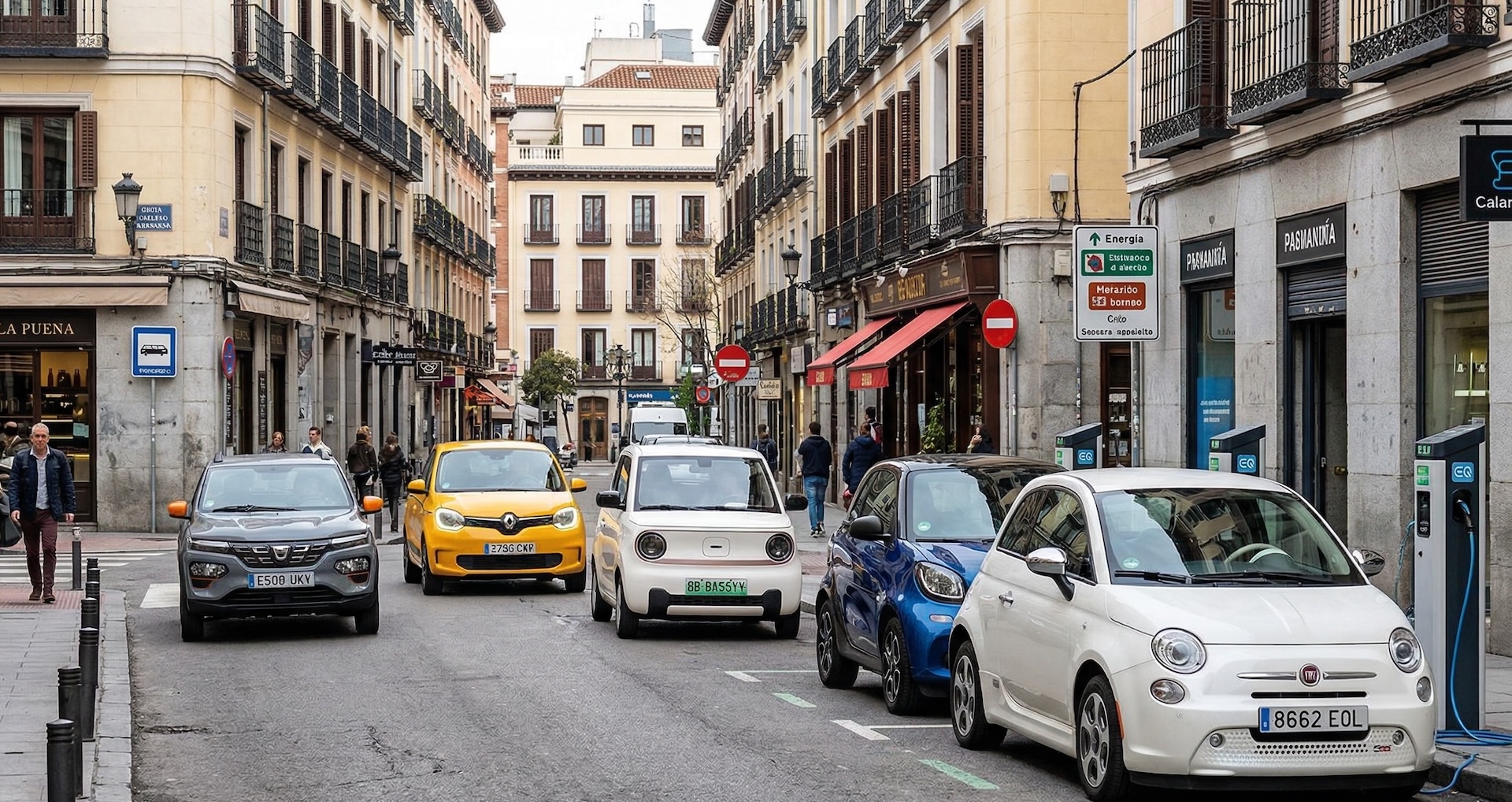
Below is our selection of electric-powered vehicles designed for urban use
Electric city cars are establishing themselves as the preferred choice for getting around town: manoeuvrability, reduced running costs and compact dimensions are the criteria buyers value most. In a market where demand for compact cars remains high, these models occupy a niche thanks to their suitability for dense traffic, parking and short daily journeys. According to registration data and the evolution of supply, urban electric cars represent a growing share of electric sales in Spain: their average price and technical accessibility make them the most practical alternative to saloons and SUVs for metropolitan use.
This ranking features five well-balanced proposals for 2026, prioritising ease of use in the city, real-world efficiency and running costs. We have assessed manoeuvrability, comfort in urban environments, maintenance costs, WLTP range under real conditions and starting price in Spain for entry versions. Not everyone seeks maximum range: in the solid urban niche, agility and practicality take precedence over extreme figures. Models such as the Fiat 500e, the Dacia Spring or the Renault Twingo Electric maintain a well-judged value for money; in addition, brands such as Geely and Omoda have introduced very competitive alternatives in this segment.
The most balanced models in the segment in 2026
The selection prioritises balance: compact size, low consumption, contained purchase costs and expected behaviour in town. I have also assessed ergonomics for daily use and technical reliability according to manufacturer data sheets and WLTP homologations. The result includes accessible and practical models, designed for those who prioritise urban mobility without giving up some versatility for occasional trips.
Fiat 500e
The Fiat 500e is the benchmark for size and urban character: short bodywork, a very tight turning circle and a setup geared towards comfort in town. The recommended version for urban use is the mid-range battery, which offers a suitable balance between weight and WLTP range. It stands out for its low-speed ride quality and a simple user interface that makes everyday use easier. In real consumption and charging efficiency at urban charging points it performs as expected for a car of its size.
Rear-seat space is limited, but boot space and the use of interior room are adequate for the category. Compared with rivals such as the Renault Twingo or the Smart EQ, the 500e offers a more refined presentation and an established service network. As for starting price, it sits in the upper-middle part of the segment, but it makes up for this with equipment and driving feel.
Pros
• Manoeuvrability and urban feel.
• Design and perceived quality.
• Range-to-daily-use balance.
Cons
• Reduced rear space.
• Entry price somewhat high compared with ultra-budget models.
Which electric city car offers the best driving feel in town?
The Fiat 500e stands out for its agile urban behaviour and suspension tuning, which makes it a very well-balanced option for metropolitan use.
| Feature | Data | Score |
|---|---|---|
| Power | 95 kW (≈129 CV) | 9 |
| Range | ≈320 km WLTP | 9 |
| Top speed | 150 km/h | 7 |
| Boot | 185 litres | 7 |
| Starting price | ≈28,000 € | 8 |
score out of 10 based on the criteria analysed in this article
Dacia Spring
The Dacia Spring is the most affordable option among electric city cars. Its approach is simple and effective: very compact size, low consumption and a competitive entry price. For those who prioritise cost per kilometre and basic mobility, it is hard to beat. Its suspension and setup are geared towards practicality, with an interior in keeping with its price.
In town it moves with ease, and its sales and service network in Spain makes buying straightforward. The basic equipment offer is limited, but its low running and maintenance costs make up for it in daily use. Compared with competitors such as the Smart EQ or microcars from other brands, the Spring remains a reference for price and functionality.
Pros
• Very competitive entry price.
• Low running and maintenance costs.
• Optimal size for urban parking.
Cons
• Basic finishes and equipment.
• Less refined ride quality.
Which electric city car is the most economical option?
The Dacia Spring wins on its entry price and total running cost, ideal for strictly urban mobility.
| Feature | Data | Score |
|---|---|---|
| Power | 33 kW (≈44 CV) | 6.5 |
| Range | ≈230 km WLTP | 6.5 |
| Top speed | 125 km/h | |
| Boot | ≈290 litres | 7 |
| Starting price | ≈14,000 € | 9 |
score out of 10 based on the criteria analysed in this article
Renault Twingo Electric
The Renault Twingo Electric is a classic champion of the city car concept: rear-wheel drive, a small turning circle and a short body. It is especially recommended for manoeuvring in narrow streets and for those who prioritise agility and efficiency over maximum range. The recommended version offers a good combination of motor and battery for urban journeys and occasional road trips.
It has a practical interior layout and a setup that favours agility. Compared with alternatives such as the Fiat 500e, the Twingo sacrifices some image for greater functional simplicity and notably easy parking. Its starting price is usually attractive within the electric microcar segment.
Pros
• Turning circle and manoeuvrability.
• Ease of use in urban environments.
• Compact exterior.
Cons
• Limited range for frequent trips.
• Interior space somewhat tight in the rear seats.
Which electric city car makes parking and manoeuvring easiest?
The Renault Twingo Electric stands out for its turning circle and rear-drive layout, designed for city environments.
| Feature | Data | Score |
|---|---|---|
| Power | 60 kW (≈82 CV) | 7.5 |
| Range | ≈190 km WLTP | 6.5 |
| Top speed | 135 km/h | 6.5 |
| Boot | 219 litres | 7 |
| Starting price | ≈21,000 € | 7.5 |
score out of 10 based on the criteria analysed in this article
Smart EQ ForTwo / ForFour
Smart maintains its urban proposition with models designed specifically for the city. Its ForTwo and ForFour versions prioritise minimum size and extreme manoeuvrability. The recommendation for 2026 is to choose the variant that best suits daily use: two seats for very urban journeys, four seats if a little more versatility is needed.
The Smart approach remains the most radically urban
: simple materials, a configuration optimised for short journeys and low running costs. Compared with generalist competitors, its advantage is its suitability for parking and delivering a city experience without compromise.
Pros
• Minimum turning circle and ultra-compact size.
• Ideal for city parking.
• Low running costs.
Cons
• Range and comfort on long journeys.
• Price can be high due to equipment.
Which electric city car is most practical for daily parking?
The Smart EQ is the most logical choice thanks to its extremely compact size
and its manoeuvrability in town.
| §h329Smarth330§ | ||
| §h337Smarth338§ | ||
score out of 10 based on the criteria analysed in this article
Geely Panda EV
The Geely Panda EV represents the entry of Asian manufacturers with an urban proposition designed with Europe in mind: compact bodywork, good interior use and a technical approach focused on efficiency and sensible running costs. Its battery pack and thermal management aim to deliver competitive WLTP range
in city use without adding excessive weight.
In practice, it stands out for its stable behaviour and assistance technology adapted to frequent journeys. It is a direct rival to small urban saloons and some micro-SUVs; in addition, its price-to-equipment ratio makes it an alternative worth considering against traditional proposals. In urban use tests, its consumption shows a good compromise between performance and efficiency.
Pros
• Good use of interior space.
• Competitive technology equipment.
• Balanced range-to-consumption ratio.
Cons
• More limited service network than established brands.
• Brand perception still developing outside Asia.
Which electric city car offers the best balance between range and interior space?
The Geely Panda EV stands out for its adequate WLTP range
and notable use of interior space relative to its exterior size.
score out of 10 based on the criteria analysed in this article
Technical comparison
Among these five models there are clear differences: some prioritise price and simplicity (Dacia Spring), others seek a balance between image and daily use (Fiat 500e), and some incorporate more technology or interior space without losing their urban vocation (Geely Panda). For urban efficiency and ease of parking, the most compact ones win; for range and performance, those with larger batteries have the edge. In terms of overall balance, the Fiat 500e and the Geely Panda sit at the top of the table
.
score out of 10 based on the criteria analysed in this article
Which car to buy according to your profile
If you do a lot of city driving
Prioritise manoeuvrability and ease of parking; the Smart EQ or the Renault Twingo Electric
are ideal options thanks to their turning circle and compact size. Look for versions with a battery and equipment suited to daily use to maximise efficiency.
If you travel frequently
Choose models with greater real-world range and stable behaviour on the road; the Fiat 500e or the Geely Panda EV
provide more range and comfort for occasional interurban journeys.
If you are looking for the best price
The Dacia Spring
is the most sensible option for tight budgets: low purchase and maintenance costs, ideal for continuous urban journeys.
If you prioritise technology
Look for proposals with better battery thermal management and driver assistance systems; the Geely Panda EV
integrates a competitive technology package within its segment.
Frequently asked questions
How long do electric city car batteries last?
Lifespan depends on use and thermal management, but current batteries usually retain good capacity for several years. Mostly urban use and moderate charging extend battery life.
What is the real-world city range compared with WLTP?
In town, real-world range is usually favourable for these models thanks to regenerative braking; however, factors such as climate control and cold-weather driving reduce the range estimated by WLTP.
Is it expensive to maintain an electric city car?
Maintenance costs are generally lower than for a combustion car: fewer moving parts, no oil changes and brakes with less wear increase running economy.
Which models are the most affordable to buy now?
Models such as the Dacia Spring
remain among the most affordable at entry price, offering a practical solution for urban journeys on a limited budget.
How do you choose between range and manoeuvrability?
It depends on use: if you make short, frequent city trips, prioritise manoeuvrability; if you combine city driving with interurban trips, look for greater WLTP range
and a larger battery.
Expert opinion
Beyond official figures, choosing the right electric city car depends on real use and the relationship between cost and performance. For mostly urban journeys, the priority should be exterior size, ease of parking and low running costs; in that sense, models such as the Dacia Spring or the Renault Twingo Electric offer very efficient solutions. If you also want a more complete experience and some versatility for occasional trips, the Fiat 500e and the Geely Panda EV offer a superior compromise between range and comfort. The Smart EQ remains the best option if parking capacity is critical and the minimum possible space is needed.
It is also important to consider the service network and the availability of fast charging in your usual area: the technical choice must fit your daily routine and local infrastructure. In terms of overall value, always prioritise the version that best matches your annual mileage and usage pattern: opting for an oversized battery for exclusively urban use penalises the cost-benefit ratio
, while falling short on range can be frustrating on unexpected journeys. Finally, always compare manufacturer data sheets and WLTP homologations together with usage reviews to confirm that the announced figures carry over to everyday practice.
Models such as the Hyundai Kona or the Kia Niro are also part of the conversation if your use moves towards longer journeys, but for strictly city driving, the cars in this ranking remain the most rational options. Not all offer the same balance; weigh your priorities and test under real conditions before deciding.§h580§


 Peugeot E-208 GTi: a battery-powered toy that revives the spirit of the 1980s sports cars
 New Lexus ES: luxury grows and goes electric
 First contact with the Dacia Sandero Hybrid 155: power and efficiency from €19,890
Deja un comentario