KIA Sportage Hybrid Cars Tests Review SUV
Review KIA Sportage plug-in hybrid: why the Korean compact SUV still sets the value-for-money benchmark in 2026
 Iván Navarro
27 September 2026
5 min.
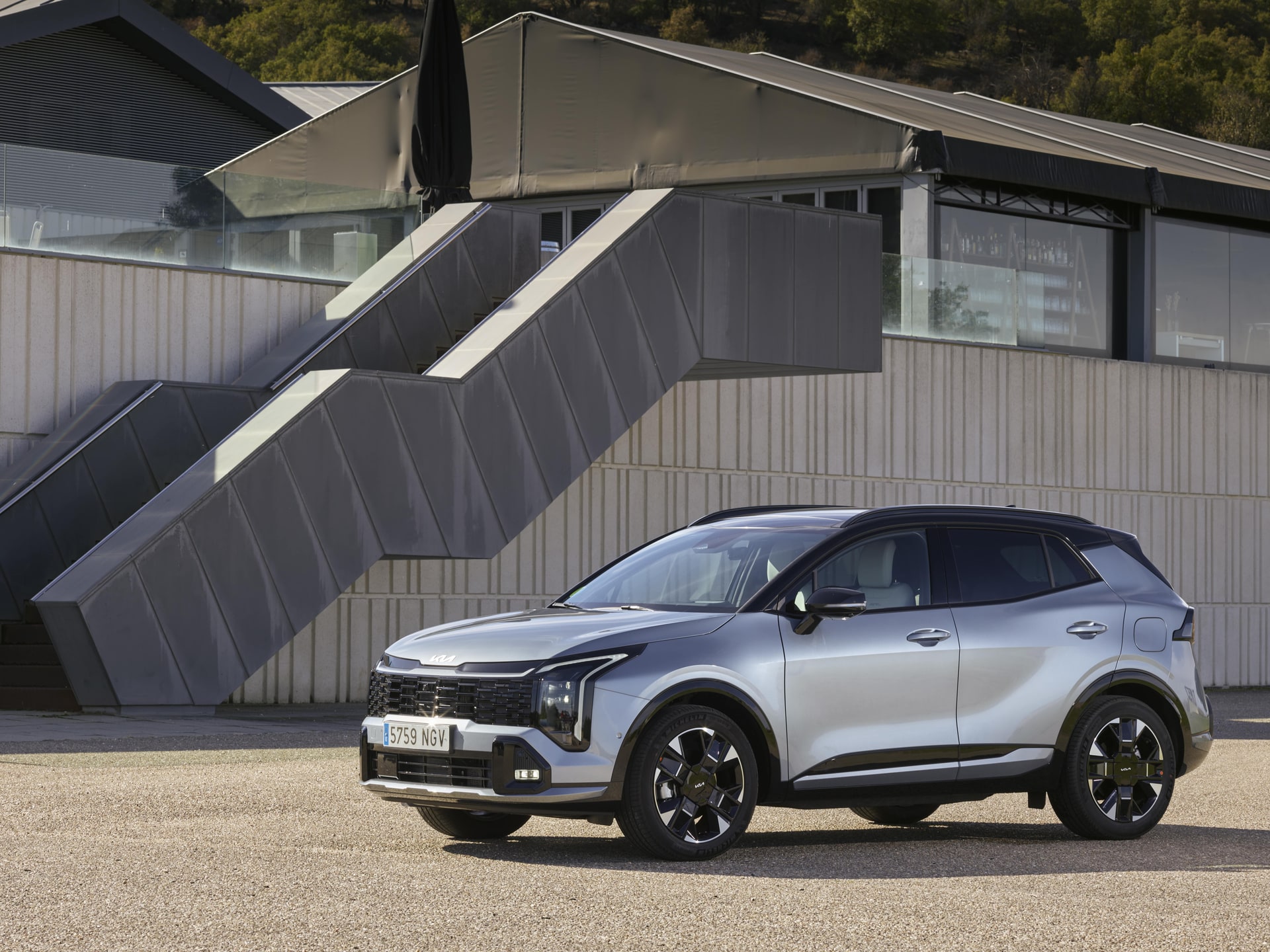
We test the 2026 KIA Sportage PHEV with 252 CV, all-wheel drive and 70 km of electric range to explain why it remains the value-for-money reference in Spain’s plug-in hybrid compact SUV segment.
The plug-in hybrid compact SUV segment has become the main battleground of the Spanish market. Among premium Germans, conservative Japanese brands and a wave of Chinese newcomers that can no longer be ignored, there is one car that has been doing the same thing for years with an almost irritating consistency: the KIA Sportage. And in its 2026 iteration, with the 1.6 T-GDi PHEV producing 252 CV and all-wheel drive, the Korean brand once again puts a difficult equation on the table.
From the initial list of rivals we have discarded two names on editorial grounds. In our view, both Nissan and BYD offer, within this price range, proposals that are less well-rounded than the Korean package — other alternatives in the segment strike a better balance in equipment, technology, electric range and perceived quality for an equivalent budget. With that clarified, let’s get into it.
Context: the plug-in hybrid compact SUV in Spain in 2026
The PHEV is going through an unusual moment. It has stopped being the regulatory fashion of 2021 and has settled as a sensible choice for those who drive between 40 and 80 km a day and want to keep plugging in at home without giving up long journeys. Within this framework, the Sportage PHEV competes with the Cupra Formentor, the Peugeot 3008 Hybrid, the Ford Kuga PHEV and a second wave of Asian rivals. And it does so from a comfortable position: restrained pricing, a 7-year warranty and a technical sheet that needs no asterisks.
KIA Sportage PHEV 1.6 T-GDi 252 CV 4×4 — from ≈47,500 €
Mechanics and plug-in hybrid architecture
The 1.6 T-GDi four-cylinder engine is combined with an electric motor integrated into the six-speed automatic gearbox and a ≈14 kWh battery. The system delivers 252 CV (185 kW) and drive is all-wheel, with an electrically driven rear axle managed by electronics — no mechanical driveshaft running through the cabin.
On paper, the result is 66 km of homologated electric range and a combined consumption that the official figures put at around 1.1 l/100 km, with emissions of 26 g/km CO₂. Top speed stands at 186 km/h, which is hardly relevant in real-world use for a family SUV.
| Power kW | Power CV | Top speed | Electric range | Consumption | Battery | CO₂ | Fuel |
|---|---|---|---|---|---|---|---|
| 185 kW | 252 CV | 186 km/h | 66 km | 1.1 l/100 km | ≈14 kWh | 26 g/km | PHEV (petrol + plug-in) |
Exterior design: the “Opposites United” language already established
The current generation of the Sportage remains, in our opinion, one of the boldest designs in the segment without tipping into excess. The boomerang light signatures, the grille integrated with the headlights and the taut side lines give it a presence that a Tucson — its platform sibling — achieves with more restraint. It’s a matter of taste, yes, but the Sportage ages well.
Interior, technology and ergonomics
Inside is where the generational leap is evident. The dual 12.3-inch curved screen dominates the dashboard, and the touch panel that switches between climate control and quick shortcuts is one of those details that seem trivial until you use them every day. The materials sit a step above what was expected from the brand five years ago — it is not a German premium car, nor does it pretend to be, but the perceived quality is solid.
That said, the interface relies quite heavily on touch, and some functions — such as fine-tuning the climate — would benefit from a physical control. A matter of philosophy.
Dynamic behaviour and real-world consumption
In pure electric mode the Sportage PHEV moves with ease up to motorway speeds. The official range figures are optimistic, as with any PHEV: in real mixed use, expecting 50–55 km on a full charge is a more honest estimate. With an empty battery and in hybrid mode, consumption settles between 6.5 and 7.5 l/100 km depending on load and pace — nothing especially brilliant, but consistent with the segment.
All-wheel drive provides reassurance on wet surfaces and minor tracks. It is not an off-roader by vocation, but it is a useful ally in northern climates.
Price, warranty and running costs
The ≈47,500 € starting price is the manufacturer’s recommended retail price, without dealer discounts, occasional campaigns or aid from the Plan Auto+ scheme, which can significantly reduce the final figure. The 7-year or 150,000 km warranty remains a weighty argument — few European rivals match it.
Comparison with the segment
Against a Cupra Formentor PHEV or a Peugeot 3008 Hybrid, the Sportage plays the complete-package card: 252 CV, all-wheel drive, 66 km of homologated electric range and a long warranty, at a price that in this segment usually stays at the mid-level versions of the competition. It is the definition of a balanced package.
Summary table and editorial verdict
| Model | Power | Electric range | Price from | Score |
|---|---|---|---|---|
| KIA Sportage PHEV 1.6 T-GDi 252 4×4 | 252 CV | 66 km | ≈47,500 € | 9.1 / 10 |
Frequently asked questions
What is the real electric range of the 2026 KIA Sportage PHEV?
The official figure is 66 km on the WLTP cycle. In real mixed use, with normal driving and climate control active, a reasonable range is between 50 and 55 km per full charge of the 14 kWh battery.
How much does the KIA Sportage plug-in hybrid cost in Spain?
It starts at approximately 47,500 € in its 1.6 T-GDi 252 CV 4×4 Drive version. This is the recommended retail price, excluding commercial discounts or Plan Auto+ aid.
Does the Sportage PHEV have the DGT CERO label?
Yes. By offering more than 40 km of homologated electric range, it qualifies for the CERO label, with the tax and circulation advantages in low-emission zones that this entails.
Is it better to buy the Sportage plug-in hybrid or the conventional hybrid?
It depends on use. If you charge at home and make daily trips of less than 60 km, the PHEV is clearly more efficient. If there is no option to plug in, the conventional HEV makes more sense and is cheaper to buy.
Technical specifications of this car


 Kia offers an electric range of 10 models, 50 versions and 400 possible combinations
 The seven finalists for the 2027 European Car of the Year (COTY) are exclusively electric
 Peugeot E-208 GTi: a battery-powered toy that revives the spirit of the 1980s sports cars
Deja un comentario