Hyundai Santa Fe Hybrid Cars Family Tests Review SUV
Review of the Hyundai Santa Fe: why the Korean family SUV redefines space and comfort in 2026
 Iván Navarro
27 September 2026
6 min.

Technical analysis of the Hyundai Santa Fe HEV 2026: bold design, seven real seats and 239 CV hybrid powertrain from approximately €56,000.
Few family SUVs have stirred as much visual debate in recent years as the Hyundai Santa Fe. The fifth generation arrived with a design language somewhere between the Land Rover Defender and an architect’s console, and by 2026 the proposal has settled into the Spanish market with the hybrid powertrain as its entry point. This review of the Hyundai Santa Fe 2026 examines whether the Korean model deserves to be the reference in the seven-seat D-segment, or whether its starting price —from approximately €56,000— is beginning to sit too close to German premium territory.
A clarification before the analysis: we have left two rivals out of this piece, though on paper they could fit. The Nissan X-Trail e-Power is ruled out because, in our view, there are options in the segment that offer a better balance between perceived quality and starting price. The BYD Sealion 7, meanwhile, is not part of the analysis either: we believe other models in the segment currently offer a value for money better suited to the family use we are evaluating. With that settled, let’s move on to those that do make the cut.
Exterior design: pure geometry and crossover presence
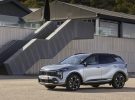
The Santa Fe is a car that divides opinion. And in 2026, that is already an achievement. The silhouette favours straight lines, squared wheel arches and a vertical rear with the rear glass reduced to a minimum. The H-Light front, with LED lights in a split “H” shape, works as an unmistakable night-time signature. In my view, the overall look will age better than many SUVs with organic lines that flood the segment today.
Cabin: when space stops being marketing
The interior is where the Santa Fe truly justifies its price. The centre console wraps around the driver with two 12.3-inch screens fused under a single panoramic glass panel, and the use of materials —Nappa leather, real aluminium, roof anchor hooks— lifts the perceived quality several notches above the previous generation.
Seven real seats, not seven emergency seats
This is where many rivals in the segment fall short. The Santa Fe’s third row accommodates adults up to 1.75 metres on short journeys with dignity, something French rivals in the same segment manage with less grace. Access, thanks to the unusually rectangular rear door opening, is notably comfortable.
Boot and modularity
With all seven seats in use there are around 200 useful litres; with the third row folded, the figure exceeds 600 litres. In two-seat configuration, the volume approaches 2,000 litres. Not bad for an SUV measuring 4.83 metres.
HEV 1.6 TGDi powertrain: 239 CV with no cable
The most popular engine in Spain is the hybrid —although the 288 CV PHEV is also sold. It is a 1.6 TGDi four-cylinder paired with an electric motor integrated into a six-speed automatic gearbox. Combined output of approximately 239 CV / 176 kW. It is not a PHEV — there is no need to plug it in or worry about its state of charge.
| Power kW | Power CV | Top speed | Consumption | Fuel |
|---|---|---|---|---|
| 176 kW | 239 CV | 196 km/h | 6.4 l/100 km | Petrol/electric hybrid |
Real-world consumption: between the claimed and the reasonable
Hyundai homologates around 6.4 l/100 km. In real mixed use, with all seven seats occupied and air conditioning running, the figure rises to the 7.5–8 l/100 km range. On the motorway at 120 km/h, the hybrid system loses some of its advantage over a conventional diesel, which is to be expected of any HEV of this size. In town and on inter-urban routes below 90 km/h, however, is where the system shines — the electric motor takes care of a surprising share of the journey.
Dynamic behaviour: comfort before sportiness
The Santa Fe does not aim to be a nimble SUV. Its suspension is calibrated to absorb rather than attack corners, and that approach suits what a family expects. Light steering, excellent filtering of urban potholes and soundproofing that approaches premium levels at cruising speeds.
Technology and ADAS as standard
The Hyundai SmartSense package is comprehensive: adaptive cruise control with sign recognition, active lane keeping, emergency braking with pedestrian detection, 360º camera and remote parking. In practice, it produces fewer false positives than many European systems in the same range.
Direct rivals in the Spanish market
The Santa Fe competes against a limited handful of seven-seat hybrid family SUVs available in Spain. Each takes a different approach: some prioritise rationality, others brand prestige. If you are interested in a deeper look at the direct duel with its Korean cousin, there is a specific comparison between Santa Fe and Sorento that addresses the differences row by row.
Price and positioning
From approximately €56,000 in its Maxx version. This figure is the manufacturer’s recommended retail price, excluding dealer offers, one-off campaigns or aid from the Plan Auto+. It is an ambitious price, yes, but consistent with the finish level and standard equipment.
Comparative summary table
| Model | Power CV | Consumption | Price from | Score /10 |
|---|---|---|---|---|
| Hyundai Santa Fe HEV | 239 CV | 6.4 l/100 | ≈€56,000 | 8.7 |
| Kia Sorento HEV | 239 CV | 6.9 l/100 | ≈€52,000 | 8.4 |
| Skoda Kodiaq | 150 CV (mild-hybrid) | 6.0 l/100 | ≈€45,000 | 7.9 |
| Peugeot 5008 Hybrid | 145 CV | 5.8 l/100 | ≈€42,000 | 7.6 |
If your doubt lies between this segment and cheaper options, it is also worth reviewing the ranking of seven-seat family SUVs with the best value for money below €55,000.
Editorial verdict
Does the Santa Fe redefine the segment? In our view, yes — not through mechanical revolution, but through the combination of bold design, honest interior space and a hybrid powertrain that covers 90% of family use cases without forcing the buyer to install a home charger. Its price is its main obstacle; its proposition is its strongest argument.
Frequently asked questions
How much does the Hyundai Santa Fe HEV really consume in mixed use?
It homologates 6.4 l/100 km. In real mixed use, the figure usually sits between 7 and 8 l/100 km depending on load, route and driving style.
Is the Hyundai Santa Fe 2026 available as a plug-in hybrid in Spain?
At present, the commercial offer in Spain focuses on the 1.6 TGDi HEV (hybrid) version of approximately 239 CV; a 288 CV PHEV is also available. For specific variants, it is advisable to check the current configuration at the official dealer.
How many adults can actually fit in the third row?
Adults up to 1.75 metres can travel with reasonable comfort on short and medium journeys. For long trips, the second row remains the optimal space for adults.
What is the starting price of the Hyundai Santa Fe HEV in Spain?
From approximately €56,000 recommended retail price, without dealer discounts or official aid applied. The final figure depends on the finish and current campaigns at any given time.
Technical specifications of this car

 Kia offers an electric range of 10 models, 50 versions and 400 possible combinations
 The seven finalists for the 2027 European Car of the Year (COTY) are exclusively electric
 Peugeot E-208 GTi: a battery-powered toy that revives the spirit of the 1980s sports cars
Deja un comentario