Hyundai Staria Hybrid Cars Family Minivans Tests Review
Review of the Hyundai Staria: why the Korean people carrier redefines family comfort on long journeys
 Iván Navarro
29 November 2026
6 min.

We analyse the Hyundai Staria hybrid with 230 CV, its interior space and its price from €55,500 to find out whether it is the most complete family people carrier for long trips in Spain.
There are cars you buy with your head, and others you buy because the family no longer fits in anything else. The Hyundai Staria clearly belongs to the second category, although that does not mean the decision is any less rational. We have spent weeks living with it, taking it onto motorways, village roundabouts and the occasional traffic jam on the way back from holidays, and the conclusion is taking shape on its own: this Korean people carrier is not trying to be the most eye-catching vehicle in the car park, it is trying to be the one that best handles the long journey with six or eight people on board.
Design and road presence
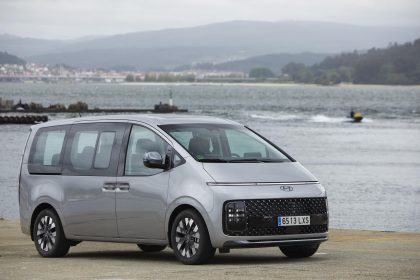
The Staria does not go unnoticed. That low-nosed body with its glazed dome looks more like a space van than a conventional people carrier, and it divides opinion. For us, once the first impact has passed, it wins you over. The opinions circulating among owners agree on one point: the exterior design polarises, but nobody complains once they are inside. The design here is functional before it is aesthetic: that roof height allows an elevated driving position, almost panoramic visibility and access to the rear seats without anyone having to stoop as they would in a conventional seven-seat SUV.
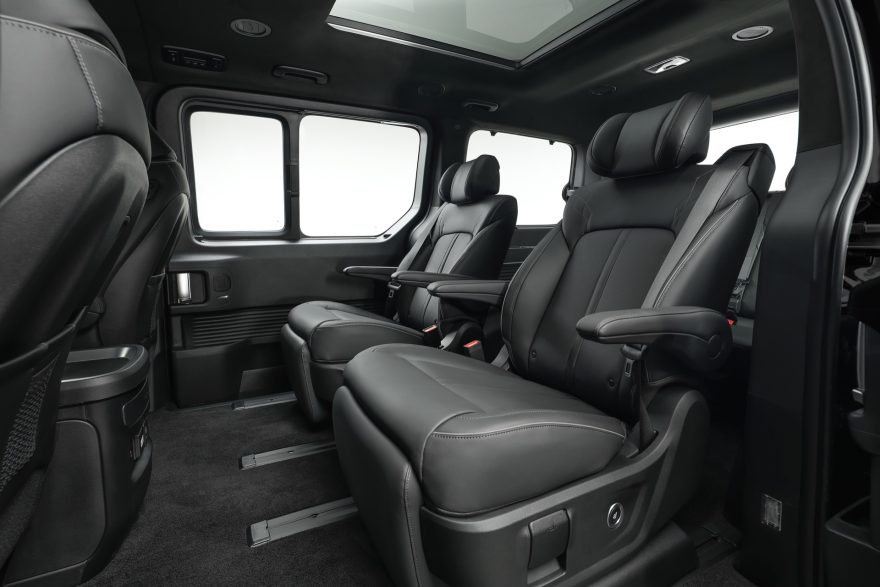
Interior space: the Staria’s main selling point
Here lies the key to the whole car. The Staria offers one of the most generous interior space configurations we have tested in a family people carrier of up to 9 seats sold in Spain. The middle seats slide, swivel and leave a clear path to the third row without any contortions, something that on journeys of more than three hours is appreciated in a way only those who have made that trip with small children understand. The boot, even with the seven-seat configuration deployed, still accommodates family luggage without resorting to the typical last-minute Tetris.
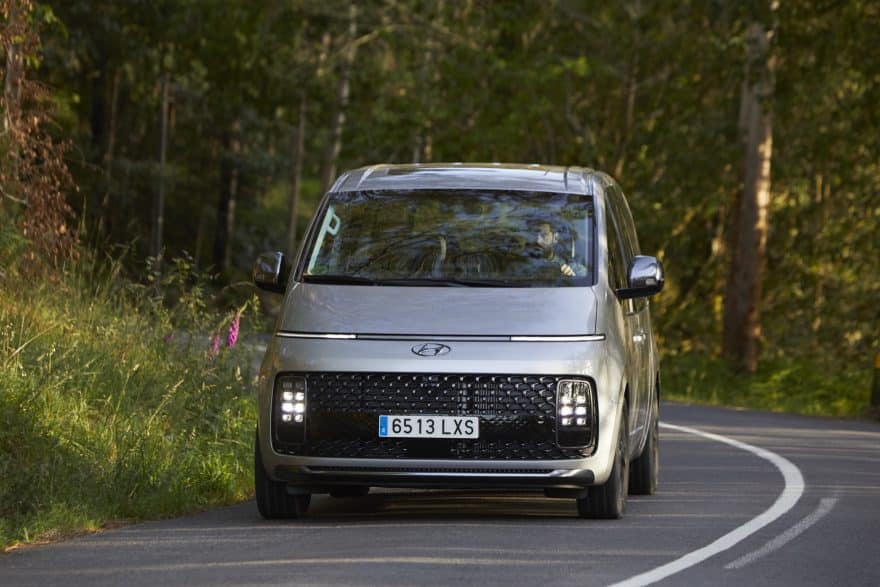
Hyundai Staria hybrid: technical specifications and behaviour behind the wheel
The version we tested is the Hyundai Staria hybrid HEV 1.6 TGDi 225 Maxx, with a petrol-electric combination delivering 225 CV. On paper that sounds tight for a vehicle of this size; in practice, the torque available from low revs disguises the weight of the set well, especially when overtaking on motorways, where there is neither too much nor too little thrust.
| Power (kW) | Power (CV) | Top speed | Consumption | CO₂ emissions | Fuel | Price from |
|---|---|---|---|---|---|---|
| 165 kW | 225 CV | 167 km/h | 7.6 l/100 km | 172 g/km | Hybrid (petrol/electric) | €55,670 |
The automatic gearbox reacts smoothly, without the jerks that can still be noticed in some diesel rivals in the segment. It is not an agile car in the sporting sense of the word, and it does not pretend to be, but the steering is precise for its size and the front axle filters the imperfections of Spanish asphalt well, which does not always forgive.
Hyundai Staria consumption: what to expect on long journeys
The homologated figure stands at 7.6 l/100 km, a reasonable number for a vehicle of over five metres and almost two and a quarter tonnes kerb weight. On our motorway routes, with the air conditioning working and four adults on board, real consumption ran in a slightly higher range, as tends to happen with almost any non-plug-in hybrid held at a constant cruising speed. Even so, for a family people carrier designed for long journeys, the result is competitive against diesel alternatives of similar size.
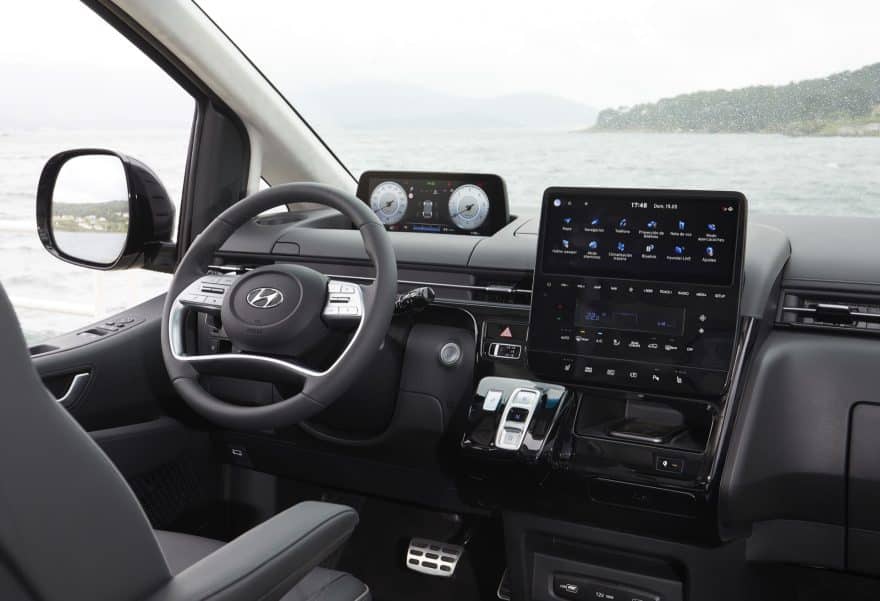
Equipment and safety on board
The Maxx trim we tested includes the driver assistance systems usual in the high end of the Hyundai range: autonomous emergency braking, adaptive cruise control and lane change warning, among others. In practice, the set works without jolts and without the hyperactive alert barrage that burdens some European rivals. The driving position is clear, with a well-integrated central screen and materials that, without being luxurious, convey solidity, which in a car designed to accumulate mileage matters more than the finish of the dashboard.
Hyundai Staria price in Spain: what do you pay and what do you get?
Its price in Spain starts at €55,670 for the Maxx hybrid version. It is worth remembering that this figure is the manufacturer’s recommended RRP, without dealer discounts or specific financing offers (as a non-plug-in hybrid with an ECO label, it cannot access the Plan Auto+ aid reserved for vehicles with a CERO label). Compared with premium rivals in the segment, the Staria comes with standard equipment that does not force you to add extras to feel “complete”, something that does not always happen in this segment.

The competition: Volkswagen Multivan, Kia Carnival and Mercedes-Benz V-Class
The Volkswagen Multivan remains the European benchmark for modular versatility, although its offer comes across as a step more expensive in some configurations. The Kia Carnival, a close cousin of the Staria within the same group (though already withdrawn from Spanish dealerships), leaned towards a more conventional SUV-people-carrier image for those who prioritised a less risky design. The Mercedes-Benz V-Class, meanwhile, is the most premium option in the group, with a price jump that is questionable if it is worth it for purely family use compared with what the Korean offers.
| Model | Powertrain | Seats | Highmotor score (1-10) |
|---|---|---|---|
| Hyundai Staria | Hybrid | 7-9 | 8.5 |
| Volkswagen Multivan | Petrol/Diesel/PHEV | 6-8 | 8 |
| Kia Carnival (discontinued in Spain) | Diesel/Hybrid | 7-8 | 7.8 |
| Mercedes-Benz V-Class | Diesel/Petrol | 6-8 | 7.5 |
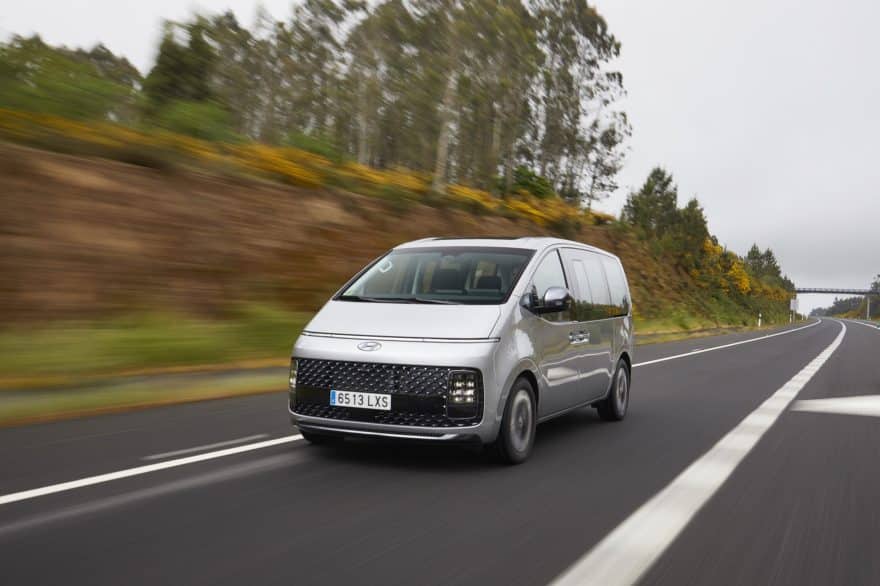
Verdict: is it the best family people carrier for long journeys?
In our view, the Staria achieves something not all its rivals manage: making the long journey stop being a sacrifice. It is not the most refined, nor the most luxurious, but its combination of space, reasonable consumption and a price that is sensible within the segment places it among the most solid options on the Spanish market for large people carriers. Whether Hyundai keeps this price-to-equipment ratio as the range evolves remains to be seen, but for now the Staria answers with authority to anyone looking for the best people carrier for long journeys without paying the full premium label. Those who also want the all-electric version can take a look at the Hyundai Staria electric, with up to nine seats and a range designed for the same long routes.
Frequently asked questions
How much does the Hyundai Staria hybrid consume on long journeys?
The homologated consumption stands at 7.6 l/100 km, although on the motorway with a full load it can rise slightly, which is common for non-plug-in hybrids of this size.
What is the price of the Hyundai Staria in Spain?
The Hyundai Staria hybrid Maxx starts from €55,670 RRP, excluding dealer discounts, offers or financing.
Is the Hyundai Staria hybrid worth it compared with a diesel?
In practice yes, especially for those who combine urban and road journeys: consumption is competitive and the engine’s response is smoother than that of many diesels of equivalent power.
Is the Hyundai Staria the best family people carrier for long journeys in Spain?
Among the large people carriers available on the Spanish market, the Staria stands out for its interior space and its price-to-equipment ratio, positioning it as one of the most objective references in the category, although rivals such as the Volkswagen Multivan remain alternatives to consider depending on each family’s priorities.
Technical specifications of this car
 Kia offers an electric range of 10 models, 50 versions and 400 possible combinations
 The seven finalists for the 2027 European Car of the Year (COTY) are exclusively electric
 Peugeot E-208 GTi: a battery-powered toy that revives the spirit of the 1980s sports cars
Deja un comentario