Seat Exeo 2.0 TDI 143 CV, road test (part II)
 Javi Vicente @javivicente
3 August 2009
4 min.
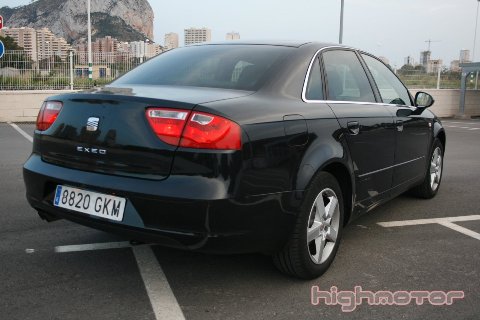
Taking the wheel of an Exeo is like sitting in a Audi (we discussed this in the previous part), there is no doubt about that, and I say it as a compliment. We have always associated the brand with the four rings with a level above the Spanish one, so now that they offer a very similar interior at a much lower price, we should applaud it.
But despite inheriting a design from a few years ago, its most notable feature is the technological improvements to the diesel engines. I can’t see myself driving an Exeo with a 100 CV diesel engine from 2003 (although a 1.6 petrol with 102 CV is also sold), nor presenting swivelling bixenon headlights or a two-zone air conditioner as a novelty, to name a few examples. We could say it is a new model adapted to new technologies with a profile design whose lines are not so modern, but the front and rear are.
Interior and exterior space
The exterior and interior styling is always what makes us choose one car over another (considering price and equipment, of course), because, just like a shirt, it identifies us as people. The lines of the Exeo are elegant, and it inherits practically everything from the previous version of its German counterpart, though with slight differences.
The Exeo has a drag coefficient of 0.29 and measures 4.67 metres long and 1.77 wide, with a kerb weight approaching one and a half tonnes (1,430 kg), which is not excessive for a saloon of this type. At first glance it does not look very large, and inside it is not either, although it can comfortably seat five adults; it would not be very pleasant to keep them for several hours of travel without moving. The rear space is not very generous. The boot, however, can boast of its 460 litres of capacity, more than enough for suitcases and other luggage. A detail when you open the rear armrest is the cover that extends almost to the front seats (see detail), which lets you store skis (or any other object of similar size) without fear of damaging the upholstery.
The mirrors it includes come from the new Seat range, rounder, as do the headlights and rear lights, which are unique to this model. The latter are slightly reminiscent of the A4, but they are not identical. The appearance of the front grille, with both main and fog lights, clearly recalls the León or the Ibiza, but is less aggressive and sporty. Besides the profile, a dark-coloured or almost mandatory silver trim on the doors, offered as standard on the Style trim but as an option on the Sport.
The Dante 16” alloy wheels did not look any sportier, although as far as driving is concerned, with 205/55 tyre sizes they offered maximum comfort on the road while also being cheaper to replace. This, together with the comfort and ergonomics of the seats, means long journeys are assured, as long as all five seats are not occupied and the passengers are not very heavy.
The materials covering both the centre console and the door armrests are identical to those in Audi. At first glance they are very attractive and give an elegant look, but after a few years, deterioration becomes evident and the fabric (which is not fabric) begins to peel away and white dots and spots appear, something nobody likes. This is especially noticeable on the window switches, where the edges make them easy to peel, and on the air conditioning and radio controls. Therefore, the quality in this respect is not very good. We cannot say the same about the dashboard, however, which on the contrary uses a quality material that resists continuous exposure to the sun.
The beige colour of the lower part of the interior, from the glovebox and the steering wheel, which also matches the seats on the doors, together with the aluminium outer trim of the three air vents on the central dashboard give a touch of distinction and elegance worthy of the higher ranges. However, the front centre armrest only gets in the way, whether when changing gear or when applying the handbrake, where you can see it even touches it (see detail).
In the third and final part we will cover the rest of the equipment we have not touched on in this part and discuss the fuel consumption obtained in the dynamic test.
Photos | Javi Vicente


 Peugeot E-208 GTi: a battery-powered toy that revives the spirit of the 1980s sports cars
 New Lexus ES: luxury grows and goes electric
 First contact with the Dacia Sandero Hybrid 155: power and efficiency from €19,890
2 comentarios
Deja un comentario
A la primera parte me la perdi pero la verdad que viendo esta segunda parte me enamore de este modelo es un lujo, saludos
Vamos es igual que el A4 lo unico qe habra que ver si la diferencia esta en su precio, y claro esta que no afecte a sus prestaciones y mas aun que le hayan solucionado el problema que tienen los A4 con el caudalimetro.