Taxis vs VTC, the conflict that could flare up again next week
 Guillermo Lopez
7 September 2018
9 min.
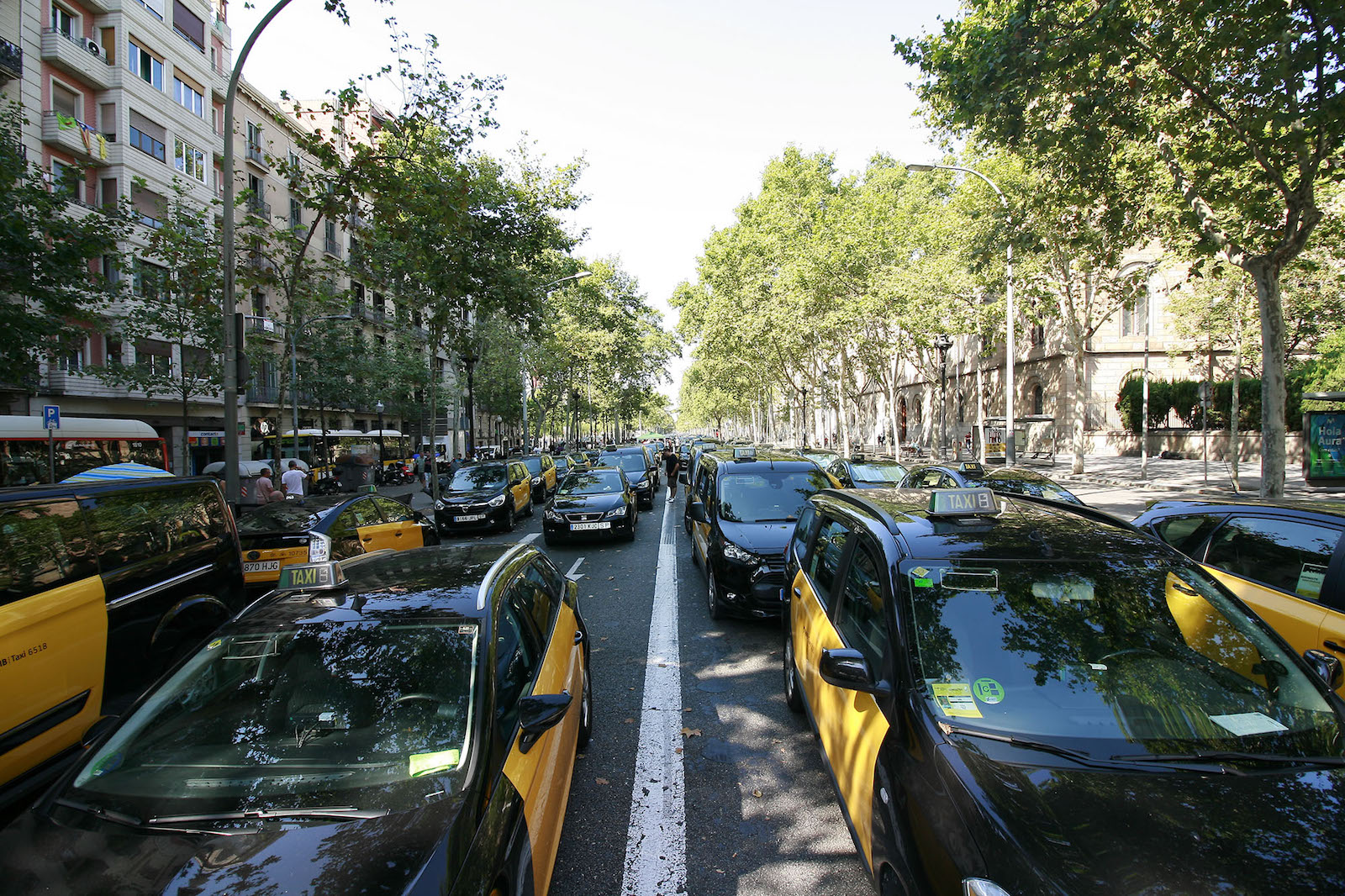
The Government has the final say: taxi drivers sharpen their arms to defend their rights and VTC operators begin to set out their reasons to avoid an unfair decision
“Spanish transport regulations do not state that there can only be one VTC for every 30 taxis. What they say is that the Autonomous Communities may refuse to grant new authorisations if there is already one VTC for every 30 taxis“. Unauto VTC, the association that groups together the companies holding VTC licences, has finally taken action to defend its rights and those of all VTC customers in the face of the demands and claims of the taxi drivers.
In an attempt to prevent the expansion of Uber and Cabify, taxi drivers are demanding that the legal ratio be enforced, which the Land Transport Act theoretically sets at 1 VTC licence for every 30 existing taxi licences on the market. In Spain there are currently some 65,000 taxi licences, compared with the just over 10,700 VTC licences already granted, meaning that the national average currently stands at a ratio of almost 1/7, although there are notable differences depending on the Autonomous Community in question. In addition, another 8,000 VTC licences are pending activation following a court ruling.
Madrid (4,995), Barcelona (1,813) and Málaga (1,066) are where the most VTC licences are concentrated. Three out of every four licences granted are there, while in the rest of the provinces only two (the Balearic Islands and Cantabria) exceed 200 licences, and 15 of them do not even reach 100 licences.
Hence the anger of the taxi drivers — especially those in Barcelona, Madrid and Málaga — who demand that the ratios they believe the law establishes (1 VTC for every 30 taxis) be enforced, and to that end they ask for the withdrawal of however many VTC licences are needed to meet that ratio. The VTC companies do not refuse to comply with this taxi drivers’ “demand”, but they ask that, instead of withdrawing VTC licences already granted, new taxi licences be created until the 1/30 ratio is met. Naturally, taxi drivers oppose this, since it would mean far more competition by putting many more taxis on the street, which would reduce the income opportunities for those already operating, and it would also open the door of the taxi sector to holders of VTC licences who have greater financial muscle. This refusal by the taxi sector in turn draws criticism from the VTC operators and from society at large, as taxi drivers are accused of wanting to maintain their oligopoly in the sector and of preventing the introduction of greater competition beyond what already exists.
Spain, a country with fewer VTC licences than the European average
The truth is that Spain has considerably fewer VTC licences than other European countries in our environment. In France, for example, there is a similar number of taxis, around 65,000, sharing the market with some 20,000 VTC licences. In Portugal there are about 13,000 taxis and 3,000 VTCs, which means ratios of 1 VTC for every 4 taxis, far below what Spanish taxi drivers are seeking to achieve. In the United Kingdom there are 80,600 taxis for 210,000 VTCs, meaning one taxi for every 2.6 VTCs. In Italy there are 40,000 taxi drivers compared with 80,000 VTCs, that is, double. So it can be said that Spain is one of the most restrictive markets for VTCs when it comes to the number of licences.
The taxi drivers agreed to call off their strike — along with their threats and physical attacks on drivers and VTC vehicles — until the month of September to give the Ministry of Public Works time to analyse the problem and propose a solution to the conflict. That deadline is about to expire and, for the moment, the solution the Government will put on the table for the taxi drivers is unknown, although several possibilities are being considered. The first of these involves agreeing to everything the taxi drivers are asking for, which basically consists of three key proposals, namely: transferring the powers in this matter to the Autonomous Communities together with the funding needed to make the transfer effective as soon as possible, which would allow them to regulate in each case the best formula to get as close as possible to the 1/30 ratio set by the Land Transport Act.
The taxi drivers propose 3 possibilities, and all of them involve meeting the 1/30 ratio set by law by withdrawing the surplus licences. The second proposal from the taxi drivers would be for the powers to be transferred to the various town councils without going through the Autonomous Communities, which would make it possible to limit VTC licences by creating new municipal activity licences. VTC operators refuse this formula, which in practice would mean keeping the urban transport monopoly in the hands of the taxi drivers.
The third and final demand from them is that the Government withdraw the VTC licences, given that Article 14 of the LOTT provides for it. But this buyback of the taxi sector would cost a great deal of public money, since many licences would have to be purchased and the owners compensated for lost profits, and given the profitability they generate, the figures would be an absolute outrage that would force payment of around 150,000 euros per licence, that is, between 2,000 and 3,000 million that would come out of the common purse of the Spanish people. And given the affection users have developed for taxis, this does not seem the most advisable solution less than a year before the next elections, not to mention the entrenchment of the problem while the courts rule on the case.
The Ministry of Public Works caught between a rock and a hard place
The second major possibility would be for the Government to transfer the powers to the Autonomous Communities, but without the necessary budget allocation. In this way the Government would avoid having to pay the multimillion-euro buyback, and the ball would be in the court of the various regions. The regions flatly refuse this. Moreover, they point out that the blame for the conflict lies above all with the Minister of Public Works, José Luís Ábalos, for withdrawing the precautionary measures that were once imposed on the regulation enacted by Ada Colau in Barcelona creating the municipal licence; for not ending the taxi strike from the outset and avoiding it at all costs; and for making promises to them that he can now no longer keep.
If this scenario comes to pass, it would once again lead to a new strike in September, since the promises the minister made to the taxi drivers to end their conflict in August would not be kept. And in this case the strike call would be indefinite, which would once again bring conflict and violence onto the streets. Would taxi drivers know how to claim their rights without resorting to this? Hardly, since they are well aware that blackmail and pressure work both to attract attention and to get this Government to listen to them.
Pending new regulations governing the activity of the sector
The last scenario, the most complex and difficult, would be the most logical and the one that would, moreover, allow the sector to truly prepare for the future. The most reasonable approach, as we said at the beginning of the article, would be for, for the first time, taxi drivers, VTC operators and the various administrations to form a large sectoral table on mobility, which would also include representatives of the CNMC, to start from scratch and establish new regulations governing the entire activity of the sector. This is already completely necessary in view of the new technologies that have arrived in the sector and, above all, those yet to come, bearing in mind that the current legislation on the matter dates from 1987, when cars and their possibilities were far removed from today’s.
Furthermore, it should be borne in mind that the investors behind VTC licences will not stand idly by either. VTC licence holders have already warned Minister Ábalos of their intention to sue to defend their rights should their activity be restricted even further than it already is. If the taxi drivers’ demands were approved, they would sue the administration and claim sums in excess of 3,700 million euros as compensation for the loss of investments legally made to launch VTC businesses, for a reason as simple as changes in the law cannot be applied retroactively.
In just a few days we will see the solution the ministry proposes. The most logical would be the third, but to achieve it one must first convince the most radical sectors of the taxi industry, who prefer to advocate that everything stay as it is and that nothing change.
In any case, and while awaiting the response the Minister Ábalos must give to the demands of the Taxi sector, the sector is already preparing a new strike for this same month of September. According to sources close to various groups in the sector, on the 15th of next month the taxi drivers could call a new surprise stoppage of the sector, which would be even more intense than the one seen at the end of last July and beginning of August.
Let us hope that it is only a simple stoppage and that we do not have to witness again the vandalism and assaults of the previous call. Because in that case the minister and the authorities involved should be reminded that under blackmail and threats of violence, no negotiation is possible.


 Peugeot E-208 GTi: a battery-powered toy that revives the spirit of the 1980s sports cars
 New Lexus ES: luxury grows and goes electric
 First contact with the Dacia Sandero Hybrid 155: power and efficiency from €19,890
Deja un comentario