Test drive: DFSK F5, the coupé-style SUV that wants to democratise a premium concept
 Miguel Lorente
9 October 2020
11 min.
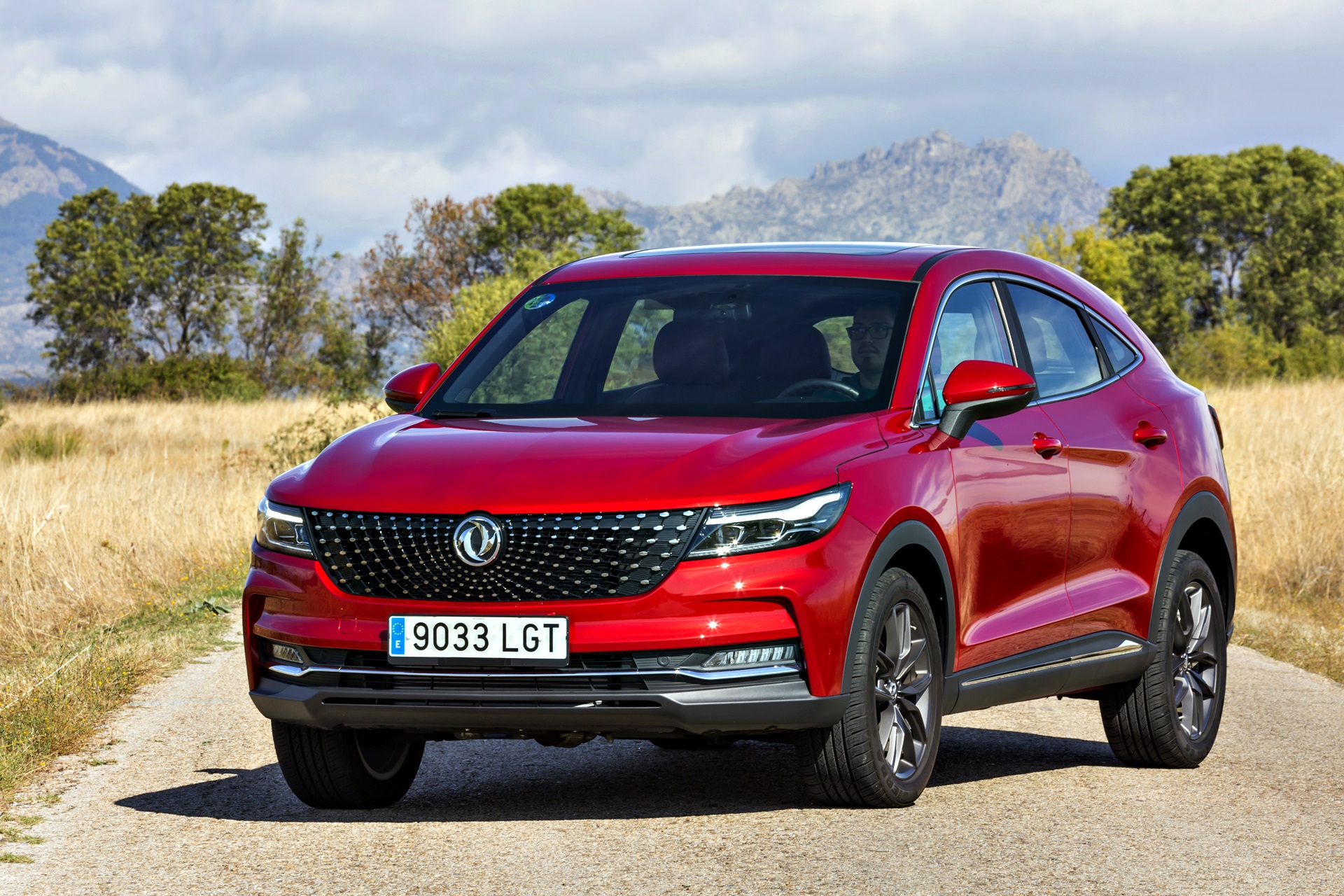
We test the DFSK F5, a stylish crossover designed to bring coupé-SUV looks to mainstream prices despite its premium-inspired design
DFSK’s goal in Spain is clear: to get customers to buy a fashionable product that suits their needs, rather than one from another manufacturer simply because it carries a badge. With a line-up that now includes 3 vehicles, all SUVs, and another one planned for 2021, an electric car that aims to be the people’s EV, getting behind the wheel and carrying out a brief test drive of the DFSK F5 means driving a crossover that draws on the sources of inspiration of the benchmark European crossovers and tries to combine them in a single car. It is a complex task and, as making a good paella shows, having the best ingredients does not always guarantee a delicious dish.
It must be taken into account that, playing the hypothetical buyer interested in buying a coupé-style SUV like this one, I should set aside my prejudices and approach the Chinese crossover as if it were a blank sheet.
Only then will it be possible to understand whether it is a car that meets what one is looking for. And at first glance, the paella seems to be taking shape.
Exterior analysis of the coupé-style SUV
With dimensions of 4,685 millimetres in length, 1,865 in width and 1,645 in height, its generous track width of 2,790 mm, it is homologated for 5 seats.
From the outside, the SUV looks big and is big, especially its silhouette, which extends from the B-pillar to the boot, where, very discreetly, four letters and a number indicate a brand and the model name.
At the front, the large grille, speckled with metallic glints, fulfils its role both in terms of the only powertrain available (the original engineMitsubishi 1.5 TGDI petrol unit, which is literally hidden away in its engine bay) and aesthetically, adding, like everything else on this vehicle, a touch of distinction.
The headlights, like the taillights, bear a defining inscription: FULL LED TECHNOLOGY, and indeed in this car everything goes “full”, because, apart from the body colour and the extended warranty, everything it displays is fitted as standard. In other words, there are no more or fewer options to choose from, whether the petrol-only engine or the one adapted for LPG. Besides showing a design right up to date in terms of Western taste, one of its strong points, in its price-to-quality ratio and practicality, is that it earns the DGT ECO label, since the ECO variant of the DFSK F5 can alternate between gas and petrol at will.
Be that as it may, we continue our route towards the top of the SUV which, with a large panoramic glass roof and a progressive yet decisive rise from its A-pillar, culminates in a peak that, like a good crossover with a design inspired by coupé bodies, begins its endless descent towards the rear. Discreet and without undue complications, with panels resting on a high waistline, the side view merely confirms the first 360º impression: it is a very large vehicle.
And, as I assumed at the start, if I were to reflect on whether to buy the new DFSK F5, regarding its interior appearance I would single out two elements: the wheels, not the tyres, and the front photograph.
Representatives of the brand in Spain do not deny that its designers, based in Germany and the United States, have taken as reference various coupés with an off-road look from the best-known German premium brands, but, honestly, this car reminds me of the DS 7 we tested, and in terms of design that is not bad at all, quite the contrary.
That is to say, overall, the design of this crossover, if we set aside its “similarities to” others, presents a bold face, a textbook outline and a rear end of high fashion.
Habitability of the DFSK F5
And if there is one important thing when testing a DFSK F5, it is getting inside its cabin.
I know that the more critical and, above all, classist reader may grind their teeth on reading the following statement: inside, this car reminds me of the Maserati Levante. But before raising an outcry, let me explain.
The DFSK F5 bears no resemblance whatsoever to any of the interiors of the German SUVs it claims to be based on. It may share a similar design in the air vents, the steering wheel, the centre console… but it is neither a replica nor does it aim to be one.
It takes the best from each house and tries to fit it into a set with a personality of its own, in which it stands out for its elitist air, just like the Maserati Levante, allowing for the differences: the Italian SUV’s cabin, given its genuinely elitist materials, enjoys a design where only Italy could get away with using a colour as striking as the one that bathed the cabin of the Maserati Levante GTS I had the great pleasure of driving, and it is then that this Chinese ‘low-cost’ coupé-style crossover proposal reminds me of the trident brand’s.
Considering the price of the DFSK F5, especially the standard variant, the one without the LPG kit, the interior is genuinely welcoming and its ambience gives off an air of quality which, although only time will tell how well it holds up to use and the wear of daily routines, is at first glance its best bet.
The front seats, with electric adjustment, are the sofa at home you look for to enjoy a good book on an autumn night by the fireside; the passenger seat is the one you enjoy on long journeys without conversation interfering with another companion, simply savouring the fall of the leaves from the deciduous trees; and, without doubt, the rear bench, the equivalent of the rear seats of saloons intended for transporting distinguished personages, because, thanks to the aforementioned wheelbase, for someone of my height, 1.8 metres, with a wingspan typical of a size M, the available space, free and usable for two occupants, is ample, and it is even adequate for three, something not always present in coupé-style SUVs focused on aesthetics rather than the comfort of those travelling behind.
It is true that it features trim, elements and inlays that simulate everything from carbon fibre to fine materials such as metal parts whose finish is not optimal, but, considering the price of the DFSK F5, this is understandable and justified, and it is also offset by others that do provide a premium presence.
Finally, the boot of the DFSK F5 has a capacity of 379 litres. This means that, although it is not particularly tall, as a direct consequence of the generous and angular slope of its architecture, it is very spacious, and the distance from the loading lip, which, incidentally, is high off the ground, to the maximum load height line is deep.
Without a bulky item to hand, I set about imagining, during the presentation and test of the DFSK F5, that in my mental picture my large family suitcase and a cabin bag, along with a few other items, would fit. It should be noted that the variant with the 68-litre LPG tank, which promises a combined range of up to more than 1,100 km, is located where the spare wheel sits on the 100% petrol version, and the additional tank does not reduce boot space at the expense of sacrificing the spare wheel in favour of a puncture repair kit.
Driving analysis of the DFSK F5
Once the cabin has been described, this car gradually wins one over: from its exterior analysis to the interior, always with the RRP of the DFSK F5 as a reference and with its European mainstream rivals in mind, it is time to get behind the wheel.
Having noted the driving position, with the seat adjusted to my liking, what catches my attention is that, although in SUVs the seating height is always high no matter how far the seat base is lowered, in this case, however much I try to lower the cushion to its maximum permitted position, the feeling is that I see over what I usually see from any other SUV, coupé or one with a classic off-road-inspired body, and this is partly also due to its 20 cm of ground clearance.
The steering wheel adjusts for height and reach, and the analogue instrument cluster, which includes a simple on-board computer that, at least on the unit I drove, could only be read in Chinese or English, sits in a dashboard that imitates fine leathers with dignity and much more visual impact.
Its design is eye-catching, dynamic and technological, thanks to the central screen of an equally simple, app-based infotainment system, which is crowned by another touch-panel control for the climate control, positioned between the main display and the gear lever.
The lacquered panels and carbon-fibre-look trim, combined with a mix of cut materials that emulates the most distinguished ones, make you feel like you are in a car of superior quality to what it actually is, because, back to reality, for the price of the DFSK F5, the finish is more than acceptable.
So, in favour of this Chinese SUV, what happens is not unusual in crossovers that aspire to play in the major leagues, although the battle for the cake among premium brands is not its war.
Starting the 137-horsepower, 220 Nm engine, power to the two wheels shows two sides.
On the one hand, and although it is possible to make the CVT transmission respond somewhat more promptly in circumstances such as pulling away onto fast roads or joining traffic from a standstill, the engine is sluggish, and it is advisable to learn to use the torque so as not to get a scare when entering a lane where, whether in town or on roads with speeds above urban limits, one must anticipate and build some momentum before rolling away.
On the other hand, the comfort of only having two pedals means that, in town, all you have to worry about at any moment is accelerating and braking, nothing more.
The route covered in this test of the DFSK F5 included urban roads, motorway and a mountain road.
In that order, this coupé-style SUV, thanks to its comfort and habitability, is a great ally in the disruptive rhythm of any town. It falls short on the tighter turns where, according to my experience, partly because of its dimensions, it needs a wide radius to turn around or manoeuvre to reverse direction.
On fast roads it is true that a bit more power would not go amiss in moments such as overtaking or gradients, but over a medium or long journey its response is balanced, and on winding roads it presents two sides.
On the one hand, thanks to its weight and dimensions, it feels very planted and long, which can be a real benefit for grip and line, but it can also cause uncomfortable inertia and corrections when the pace picks up. Still, it is clear that anyone considering buying a DFSK F5 is not doing so to go racing a stage with it.
Overall assessment of the DFSK F5
To conclude, I stress again that anyone considering buying a DFSK F5 should do so with an open mind, convinced that they like what they see and not what it wants to suggest, a car that can be enjoyed from the inside and which, without being very demanding of its mechanics, can perform like other SUVs, such as, by forced kinship, the Mitsubishi Eclipse Cross.
A crossover aimed at a public looking for a coherent balance between price, quality and presence for the type of vehicle they want. It offers a fashionable body, an interior that conveys more status than one would expect, a powertrain that penalises it due to its inherent nature, and which, overall, satisfies its use.
So, given that the price of the DFSK F5 Classic, the standard version, starts at €26,495 and the ECO from €28,345, both figures include a €2,500 financing discount, it has no rival among coupé-style SUVs with premium aspirations.
Technical specifications of this car


 Kia offers an electric range of 10 models, 50 versions and 400 possible combinations
 The seven finalists for the 2027 European Car of the Year (COTY) are exclusively electric
 Peugeot E-208 GTi: a battery-powered toy that revives the spirit of the 1980s sports cars
Deja un comentario