The 6 hybrid SUVs with the best value for money under €35,000
 Iván Navarro
13 August 2026
7 min.
We selected the six most competitive hybrid SUVs under €35,000 in Spain in 2026, with verified WLTP consumption, combined power and standard equipment.
Buying a hybrid SUV for less than €35,000 in Spain is still, today, the most pragmatic route for anyone who wants to cut consumption without depending on a charging plug. The ECO label helps you enter the ZBEs of Madrid or Barcelona, maintenance is close to that of a conventional petrol car and, with the usual campaign discounts, the final price falls within a reasonable range. It isn’t all idyllic, though: the differences between models are greater than they seem.
We have filtered the national market using verifiable criteria —RRP with usual promotions, WLTP consumption, combined power, warranty and standard equipment— and the result is six references that, in our view, set the standard for the segment today.
Why does a hybrid SUV still make sense in 2026?
The non-plug-in HEV fills a very specific niche: urban and suburban drivers, between 12,000 and 20,000 km a year, without a garage with a socket or without the desire to manage charging. In real mixed driving, a good B-SUV segment hybrid ranges between 4.8 and 5.5 l/100 km. An equivalent petrol car rarely drops below 6.5. The difference, at 15,000 km a year, comes to around €300 in fuel per year — it’s not the panacea, but it adds up.
And there is something that weighs even more: the ECO label. As long as the current ZBE framework remains in force, being able to enter the ZBEDEP Distrito Centro in Madrid without hassle is a tangible advantage. If your case is different —you have a charging point at home and make 40 km daily trips— a PHEV or straight-up electric car will probably suit you better.
Ranking criteria: price, WLTP consumption, power and equipment
Four variables drive this. Price with campaign discounts applied (financed through the brand, which is how 80% of cases are bought). Combined WLTP consumption, cross-checked with published real-world tests. Combined power of the system, because a HEV with 90 CV is not the same as one with 140. And standard equipment, with particular attention to the mandatory GSR2 ADAS and the warranty.
We score each model from 1 to 10 and rank them by overall value for money.
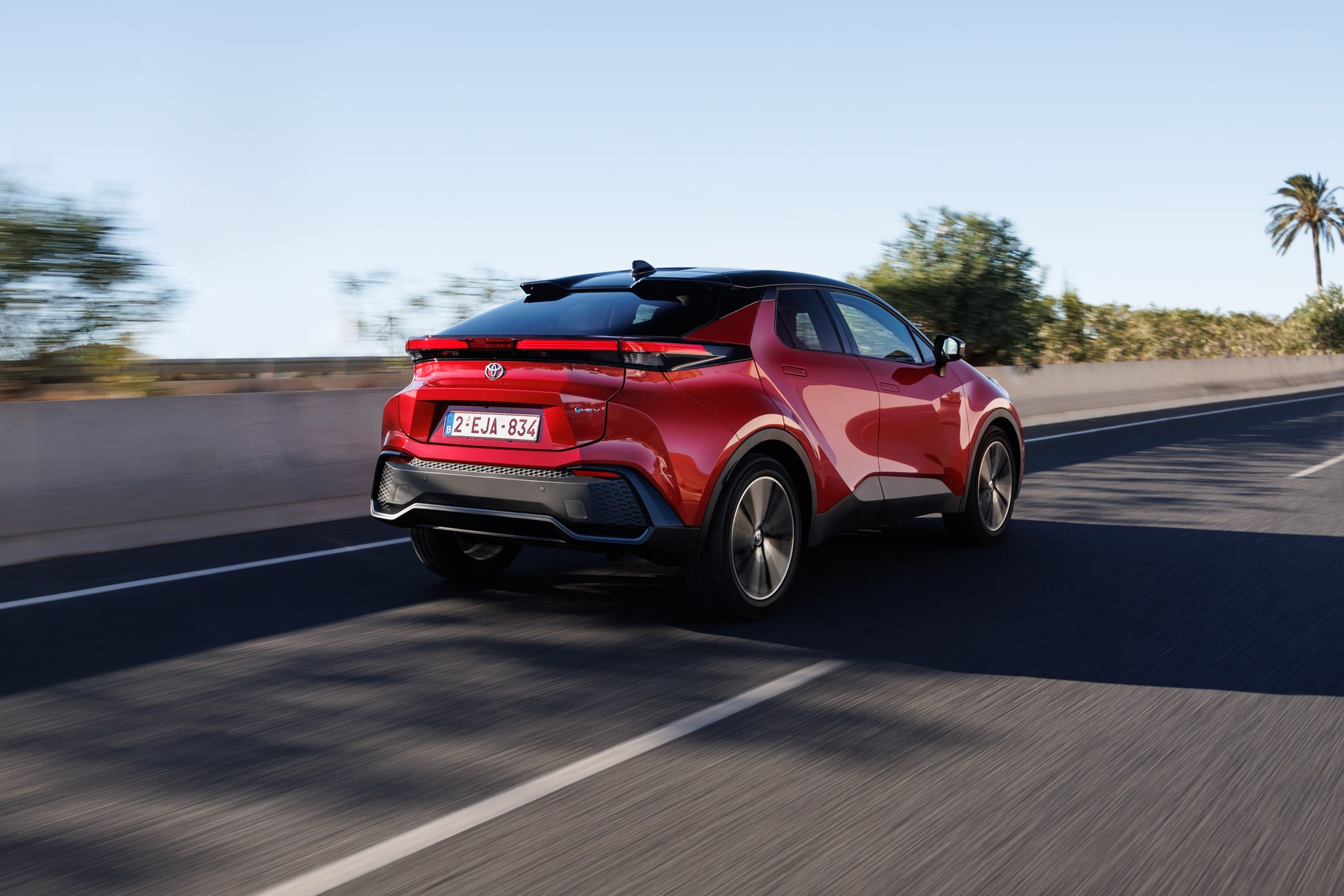
1. Toyota C-HR 1.8 Hybrid — from €29,900
The C-HR is the gold standard of the segment. The fourth generation of the Toyota hybrid system is the most refined you can buy for this money: imperceptible transitions between electric and combustion, and consumption that in the city drops effortlessly below 5 l/100 km. The design, very bold, won’t please everyone — to my taste it goes a bit far at the rear, but at the front it is among the most resolved proposals on the market.
It comes as standard with Toyota Safety Sense 3, an 8-inch screen, a rear camera and dual-zone climate control. The Relax warranty can be extended up to 10 years if you keep up with services at an official dealer network. That is the real ace up its sleeve.
| Power kW | Power CV | Top speed | Range | Consumption | Label | Fuel |
|---|---|---|---|---|---|---|
| 103 kW | 140 CV | 175 km/h | ≈900 km | 4.9 l/100 km | ECO | Hybrid |
2. Hyundai Kona HEV 1.6 GDI — from €28,500
Hyundai has done its homework with the second generation of the Kona. The hybrid version is not the best-seller —the electric one takes the spotlight— but on paper it is among the most complete options under €30,000. Spacious interior for the segment, a 12.3-inch panoramic dual screen and a driving feel that is more “car” and less “appliance” than the C-HR’s.
Real consumption ends up slightly above the Toyota. That said, the 5-year warranty with no mileage limit and the entry price make up for it.
| Power kW | Power CV | Top speed | Range | Consumption | Label | Fuel |
|---|---|---|---|---|---|---|
| 104 kW | 141 CV | 165 km/h | ≈850 km | 4.5 l/100 km | ECO | Hybrid |
3. Kia Niro HEV — from €30,900
The Niro plays in a different league when it comes to space: 451 litres of boot, a 2.72 m wheelbase and rear seats that comfortably carry three adults. It is the “family” hybrid of the ranking. It shares its mechanics with the Kona but tuned with a different character: softer, more oriented toward comfort.
As standard it already fits a 10.25-inch dual screen, Navi with OTA updates and seven years of warranty. With campaign discounts it lands right in the Kona’s well-equipped price range, with more car for the money.
| Power kW | Power CV | Top speed | Range | Consumption | Label | Fuel |
|---|---|---|---|---|---|---|
| 104 kW | 141 CV | 165 km/h | ≈900 km | 4.7 l/100 km | ECO | Hybrid |
4. Renault Captur E-Tech Full Hybrid 145 — from €27,400
The Captur E-Tech is the surprise of the segment in terms of entry price. The technical solution of Renault —1.6 naturally aspirated engine, two electric motors and a dog clutch gearbox without a clutch— always starts in EV mode and can run up to 80% of urban driving time on electric power. In the city it is devastating: 4.7 l/100 km measured is perfectly achievable.
Outside the city it loses some punch. The gearbox shows jerks when asked for everything and the interior, though improved, feels a step below the Kia. But for less than €28,000 with the Techno trim and an integrated Google navigator, it’s hard to ask for more.
| Power kW | Power CV | Top speed | Range | Consumption | Label | Fuel |
|---|---|---|---|---|---|---|
| 105 kW | 145 CV | 170 km/h | ≈850 km | 4.8 l/100 km | ECO | Hybrid |
5. Honda HR-V e:HEV — from €32,500
The HR-V is the most expensive in the ranking and the one that gets the fewest discounts. Even so, it earns its place on merit: the Honda e:HEV system works as a series-parallel setup where the combustion engine almost always acts as a generator. The result: a constant electric-car feel and a linear response that has no rival in the city, not even the Toyota.
The price is paid in equipment —no panoramic screen, no premium ambience— and in a tight 319-litre boot. It is the one someone who values mechanics above everything else would buy.
| Power kW | Power CV | Top speed | Range | Consumption | Label | Fuel |
|---|---|---|---|---|---|---|
| 96 kW | 131 CV | 170 km/h | ≈820 km | 5.4 l/100 km | ECO | Hybrid |
6. Nissan Juke Hybrid — from €28,900
The Juke Hybrid shares its technical platform with the Captur, but Nissan has calibrated it with a different character: quicker steering, slightly firmer suspension and an image that is still the most recognisable in the segment. In the city it spends 80% of its time in EV mode like its French cousin and posts very competitive WLTP consumption figures.
It is held back by the interior, with hard plastics where the Kia already offers a soft touch, and a 354-litre boot. But as a young proposition, it works.
| Power kW | Power CV | Top speed | Range | Consumption | Label | Fuel |
|---|---|---|---|---|---|---|
| 105 kW | 143 CV | 166 km/h | ≈830 km | 5.0 l/100 km | ECO | Hybrid |
Comparative summary table and score
| Model | Price from | CV | WLTP consumption | Boot | Warranty | |
|---|---|---|---|---|---|---|
| Toyota C-HR 1.8 Hybrid | €29,900 | 140 | 4.9 l | 388 l | up to 10 years | 9.2 |
| Kia Niro HEV | €30,900 | 141 | 4.7 l | 451 l | 7 years | 9.0 |
| Hyundai Kona HEV | €28,500 | 141 | 5.4 l | 466 l | 5 years | 8.6 |
| Renault Captur E-Tech | €27,400 | 145 | 4.8 l | 348 l | 3 years | 8.4 |
| Honda HR-V e:HEV | €32,500 | 131 | 5.4 l | 319 l | 3 years + 5 hybrid | 8.2 |
| Nissan Juke Hybrid | €28,900 | 143 | 5.0 l | 354 l | 3 years | 8.0 |
Which model to choose based on your profile
If you mainly drive in the city and want the lowest consumption, Toyota C-HR or Renault Captur. If you need a genuinely large boot and rear seats, the Kia Niro has no rival here. If you’re looking for the most aggressive entry price with modern equipment, the Hyundai Kona. And if driving feel matters more than anything, the HR-V e:HEV.
The Plan Auto+ aid scheme may further reduce the final price in certain cases; check the official website for the current amounts. It is also worth looking at our comparison of hybrid SUVs with the lowest real urban consumption before signing.
Frequently asked questions
What is the difference between an HEV and a PHEV?
The HEV (hybrid) generates and uses its own electrical energy through braking and with the combustion engine; it does not plug in. The PHEV plugs in and offers 40–80 km of pure electric range, but costs more and weighs more.
Does a hybrid SUV have an ECO label?
Yes. All the models in the ranking carry the DGT ECO label, which allows driving in ZBEs with the less strict current restrictions.
How much do you save compared with an equivalent petrol car?
Between 1.5 and 2 litres per 100 km in the city, depending on the model. At 15,000 km/year, around €250–350 a year in fuel.
Which hybrid SUV under €35,000 offers the best warranty?
The Toyota C-HR with the Relax warranty extendable up to 10 years (or 185,000 km) if you keep up with services at an official dealer network, followed by the Kia Niro with 7 years as standard.


 Peugeot E-208 GTi: a battery-powered toy that revives the spirit of the 1980s sports cars
 New Lexus ES: luxury grows and goes electric
 First contact with the Dacia Sandero Hybrid 155: power and efficiency from €19,890
Deja un comentario