Hyundai Santa Fe Geneva Motor Show SUV
The All-New Hyundai Santa Fe Is Previewed in the First Official Images
 Guillermo Lopez
7 February 2018
4 min.
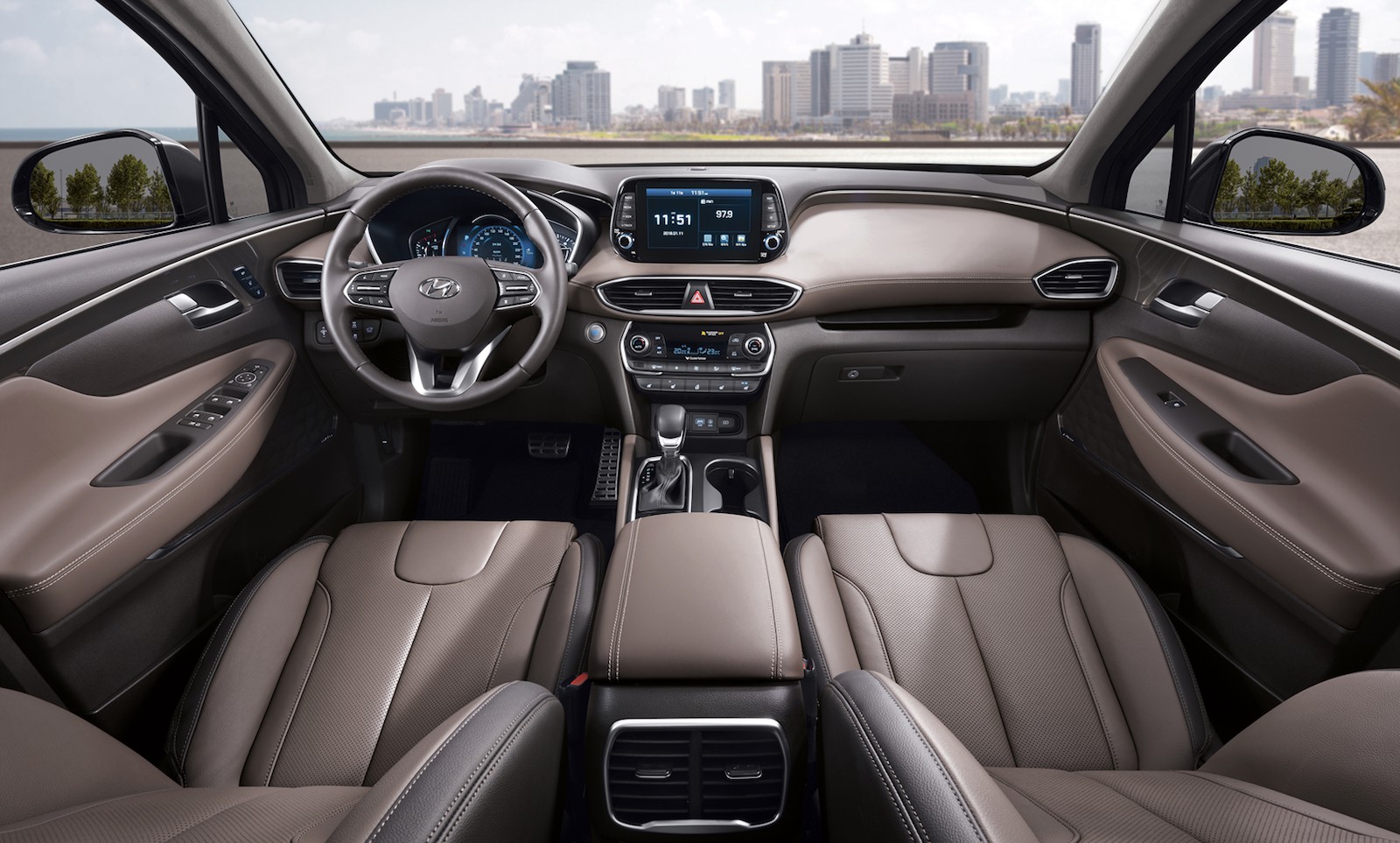
Hyundai has just revealed the first real images of the new Santa Fe, which will be unveiled in early March at the Geneva Motor Show
The all-new Hyundai Santa Fe will make its world premiere in March at the Geneva Motor Show, but ahead of that the Korean brand is starting to release some details and the first images of its large SUV.
Judging by the exterior image released, the fourth generation of the Santa Fe adopts the cascading grille that is the signature icon of the brand’s family look. In this case it is crowned by a chrome strip running from side to side and extending to the ends of the front of the car, underlining the upper set of lights, distributed across two striking twin headlights.
Powerful, large exterior; spacious, comfortable interior
The upper lighting unit is extremely slim and highly stylised, sitting at the extremity of the vehicle and appearing almost imperceptibly below the muscular bonnet line. It integrates the daytime running lights and LED projectors. The lower lighting units are located in the lower part of the front end, placed well out at the sides in recesses built into the front design, which strongly highlights the grille formed by large honeycomb-shaped metal cells, at the centre of which proudly sits the Korean brand’s logo.
In the lower area, below the bumper and the number plate, the front is taken up by a wide air intake divided into three sections: a large one in the centre to channel airflow to the mechanicals — beneath which a plastic guard with a metallic finish begins — and two smaller ones at the sides, just below the headlights, to provide brake cooling.
More than 50 buttons and controls are within the driver’s reach, a tribute to distraction. The exterior styling of the new Santa Fe is bold and powerful. The wheel arches are very pronounced, with an original design that introduces plastic reinforcements in the lower section of a well-defined arch that is stylistically highlighted in the vehicle’s bodywork. The designers at Hyundai have played with the chrome already described at the front (to which the underbody protector is added) and with the elements introduced on the sides: running boards, metal inserts on the door handles, perimeter trim on the side window frames and roof rails.
The new Santa Fe is a large car. It measures 4,770 mm long and 1,890 mm wide and, according to the brand, its wheelbase is longer than that of the previous generation, although no figure has been provided to confirm this. That greater wheelbase allows the model to offer a more comfortable and spacious interior.
The interior of the new Santa Fe is airy and very bright. It improves in terms of quality and design. The dashboard and instrument panel are certainly original. The latter is divided into three distinct zones, both by horizontal lines and by the quality of the materials used, although its shape creates recesses of questionable justification and unclear purpose, such as the one between the instrument cluster hood and the infotainment screen occupying the centre of the dashboard.
Santa Fe with significant safety equipment
Hyundai also states in its brief announcement that it has introduced significant safety equipment on board the new Santa Fe, mostly linked to the new SmartSense technology the brand has been incorporating into the latest additions to its model range.
Although it does not mention specific safety equipment for the Santa Fe, it does clarify that one of the features this fourth generation of the Korean SUV will have is the Rear Occupant Alert, as well as the Safe Exit Assist, a system that warns passengers about to open a door when a vehicle is approaching, thus avoiding potentially dangerous situations.
Either way, what is clear is that the designers at the Korean brand have not followed the current styling trends increasingly being adopted by many models across different segments, which tend to simplify both the shapes and the controls the driver has to operate. More than 50 buttons and controls are within the driver’s reach, distributed across the door panel, the multifunction steering wheel, the central column below the dashboard and next to the infotainment screen. A true tribute to distraction, since to use them the driver must take their eyes off the road to locate them and tell one from another.
Technical specifications of this car


 Peugeot E-208 GTi: a battery-powered toy that revives the spirit of the 1980s sports cars
 New Lexus ES: luxury grows and goes electric
 First contact with the Dacia Sandero Hybrid 155: power and efficiency from €19,890
Deja un comentario