The best electric cars with long range in Spain
 Iván Navarro
19 April 2026
8 min.
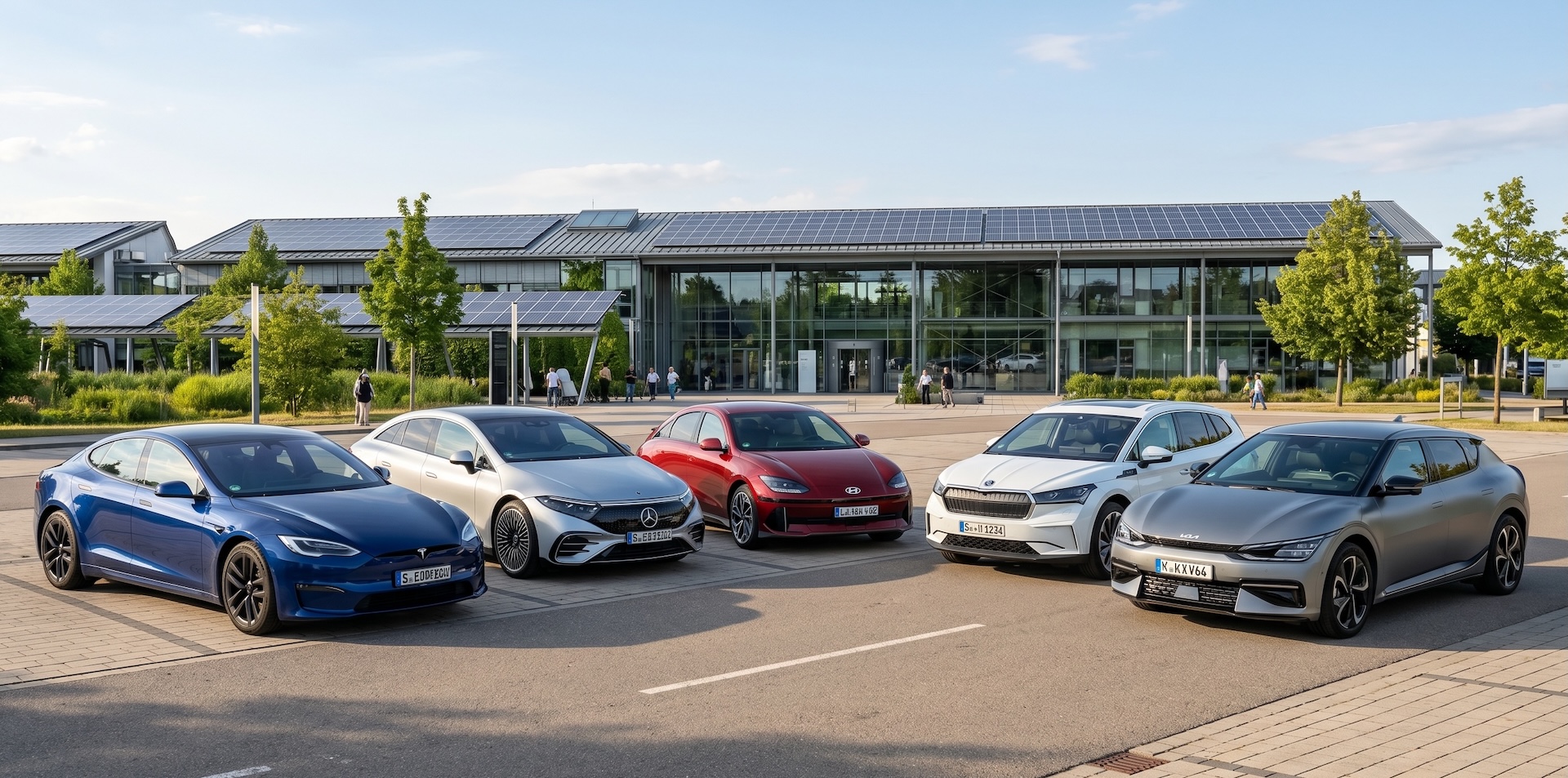
This analysis covers everything from premium luxury saloons to next-generation family crossovers. The future of driving examined through the current leaders of the zero-emission market.
In 2026, demand for electric cars with wide range continues to set trends in Spain: users look for vehicles capable of covering long journeys without compromising interior space or comfort. The market offers very different solutions, from premium saloons to aerodynamic SUVs and fastbacks, with clear differences in battery, efficiency and mechanical layout. Here you will find a selection of models relevant for their real-world or homologated range, with price data and technical advantages to compare uses: frequent motorway trips, family journeys and mixed urban/extra-urban mobility. These options show alternatives for those who prioritise reach, energy economy or a balance between both variables.
Who is this ranking for?
This ranking is based on market data, official specifications and published road tests. It is designed for those who value range as the main buying criterion and need practical references on which real options are available in 2026.
If you drive many kilometres each month and want to avoid frequent recharging, if you plan regular road trips, or if you are looking for an electric car capable of meeting a family’s needs without depending exclusively on charging points, this list will help you identify the most relevant alternatives and compare their technical and economic approach.
What details have we analysed?
We have considered market positioning, official technical data such as homologated WLTP range, declared power and official consumption, dimensions and practical capacity, and the price/technical approach ratio to understand the expected real-world use of each model. Comfort and equipment aspects that affect value for money are also assessed.
Ranking of the best electric cars with long range in Spain
Tesla Model S (from €104,990*)
Indicative price without applying public aid or the brand’s commercial discounts.
Why it is here: The electric saloon from Tesla offers one of the highest WLTP ranges on the market in its longest-range versions, with integrated fast charging and a technical package geared towards efficiency and performance. Its range makes it valid both for long journeys and for mixed use.
Ideal for: Drivers who cover many kilometres on motorways and want to minimise charging stops.
Pros:
- High WLTP range for its segment.
- Fast charging system widely supported by the manufacturer’s network.
- Excellent efficiency at cruising speed.
Cons:
- High price in the longest-range versions.
- Equipment options can quickly increase the final bill.
Mercedes‑Benz EQS 450+ (from €115,000*)
Indicative price without applying public aid or the brand’s commercial discounts.
Why it is here: The electric luxury saloon from Mercedes combines a large-capacity battery with optimised aerodynamics, which translates into competitive ranges within the premium segment. It also offers refined ride quality and equipment geared towards comfort on long journeys.
Ideal for: Users who prioritise comfort and technology on intercity routes and long-distance travel.
Pros:
- High efficiency on sustained journeys.
- Comfort and insulation for long trips.
- Wide charging options and after-sales service.
Cons:
- Entry and maintenance costs above generalist alternatives.
- Weight and size are a drawback on narrow urban streets.
Hyundai Ioniq 6 Long Range (from €44,500*)
Indicative price without applying public aid or the brand’s commercial discounts.
Why it is here: The Ioniq 6 focuses on aerodynamic efficiency and a battery capacity designed to deliver high ranges in RWD versions. Its balance between weight, size and consumption makes it a practical alternative for those seeking range without entering the premium segment.
Ideal for: Drivers who need a good balance between cost, range and efficiency on frequent road trips.
Pros:
- Aerodynamic design that favours range.
- Competitive price/range ratio.
- Good service network and warranties.
Cons:
- Higher-spec equipment in the longest-range versions can raise the overall price.
- Interior space less generous than some equivalent SUVs.
Škoda Enyaq iV 80 (from €44,900*)
Indicative price without applying public aid or the brand’s commercial discounts.
Why it is here: The Enyaq iV offers good range in the 80 version and a spacious cabin designed for families. Its practical, value-oriented approach makes it a solid option for both journeys and everyday use.
Ideal for: Families who need space and range for long trips without giving up everyday practicality.
Pros:
- Spacious cabin and boot.
- Consistent consumption in real-world driving.
- Good price/version ratio.
Cons:
- Less daring design than long-range aerodynamic saloons.
- Some versions require option packs for full equipment.
Kia EV6 Long Range (from €48,450*)
Indicative price without applying public aid or the brand’s commercial discounts.
Why it is here: The EV6 combines an agile chassis, fast charging and competitive range in its Long Range version. It is a versatile alternative for those seeking dynamic handling and sufficient reach for frequent journeys.
Ideal for: Drivers who alternate urban use with intercity trips and value fast charging.
Pros:
- Good DC fast-charging capacity.
- Balanced dynamic behaviour.
- Perceived quality and standard equipment are adequate.
Cons:
- Cost of the most efficient or largest-battery versions.
- Rear space is somewhat tight in versions with the sport pack.
The prices shown in this ranking are indicative and do not apply public aid or the brand’s commercial discounts.
Technical comparison
| Model | Range | Power | Consumption | Top speed | Price (€*) |
|---|---|---|---|---|---|
| Tesla Model S | 652 km WLTP | ND | ND | ND | 104,990 |
| Mercedes‑Benz EQS 450+ | ND | ND | ND | ND | 115,000 |
| Hyundai Ioniq 6 Long Range | 614 km WLTP | ND | ND | ND | 44,500 |
| Škoda Enyaq iV 80 | ND | ND | ND | ND | 44,900 |
| Kia EV6 Long Range | 528 km WLTP | ND | ND | ND | 48,450 |
These data are official and taken from the brands’ official websites.
Purchase aid in 2026: Plan Auto+ and tax benefits
The 2026 Plan Auto+ replaces the previous MOVES programmes and establishes a new system of direct aid for purchasing electrified vehicles in Spain. The programme centralises incentives and prioritises electrification based on origin and price criteria.
Main amounts of the 2026 Plan Auto+
– Direct aid of up to €4,500 for electric passenger cars.
– Up to €5,000 for light N1 category vans.
– Retroactive effect from 1 January 2026.
– Approximate budget allocation of €400 million.
Who can benefit and priority criteria
Beneficiaries are private individuals, self-employed workers and companies. The EEE criterion (Electric, Economic and European) applies, with greater incentives for pure electric vehicles compared with plug-in hybrids. Vehicles priced below €35,000 receive higher aid; those between €35,000 and €45,000 receive reduced aid. There is an additional incentive if the final assembly or the batteries are of EU origin.
Additional requirements and tax advantages
A mandatory minimum discount of €1,000 from the dealership is required. There is a 15% deduction on personal income tax (IRPF) up to a maximum of €3,000. The tax validity runs until 31 December 2026.
Management and possible regional aid
Management is coordinated by the Ministry of Industry together with the Autonomous Communities. Additional regional programmes may exist; for example, the Plan Cambia 360 in the Community of Madrid. At the time of writing, it is not officially confirmed whether these regional aids are compatible with the 2026 Plan Auto+.
FAQ · The 5 questions everyone asks
What is WLTP range and why does it vary in real use?
WLTP range is a standard homologation figure used as a reference; in real use it depends on speed, temperature, load, topography and driving style, so it is usually lower on high-speed routes and in cold climates.
Which model offers the best price/range ratio?
Generalist models with large batteries and efficient aerodynamics usually offer the best price/range ratio; the Ioniq 6 and the Enyaq iV are examples of efficient approaches with a more contained entry cost.
Is power decisive for range?
Maximum power affects acceleration and load-carrying capacity, but range depends more on battery capacity, aerodynamics and overall efficiency than on the declared maximum power.
Should you prioritise fast charging or battery capacity?
If you make long journeys with short stops, fast-charging capability reduces times; if you prefer fewer stops, a larger and more efficient battery will be more useful.
What impact do Plan Auto+ aids have on the final price?
The aids reduce the acquisition cost depending on the vehicle’s price and the plan’s priorities; in addition, the mandatory dealership discount and tax deductions provide extra savings, subject to conditions and availability.
Expert Conclusion
This ranking shows that in 2026 there is a clear range of options: aerodynamic saloons and SUVs with large batteries that allow long journeys without constant dependence on the charging network. For the buyer, this means they can prioritise real-world range without giving up equipment or comfort, always assessing the balance between battery capacity, efficiency and total cost of ownership.
If you want to stretch your money, first look at the real entry price and what comes as standard; if you prefer to play it safe, choose models with high demand and a service network, as they tend to be easier to resell later; and if you mainly drive on fast roads, energy cost and efficiency matter more than the power figure. To decide, compare value for money and market popularity: choose the model that best combines homologated range, real consumption and purchase conditions in your area.


 Peugeot E-208 GTi: a battery-powered toy that revives the spirit of the 1980s sports cars
 New Lexus ES: luxury grows and goes electric
 First contact with the Dacia Sandero Hybrid 155: power and efficiency from €19,890
Deja un comentario