The Renault Scenic, named 'Car of the Year 2024'
 Rafa Guitart @GuitartRafa
26 February 2024
8 min.
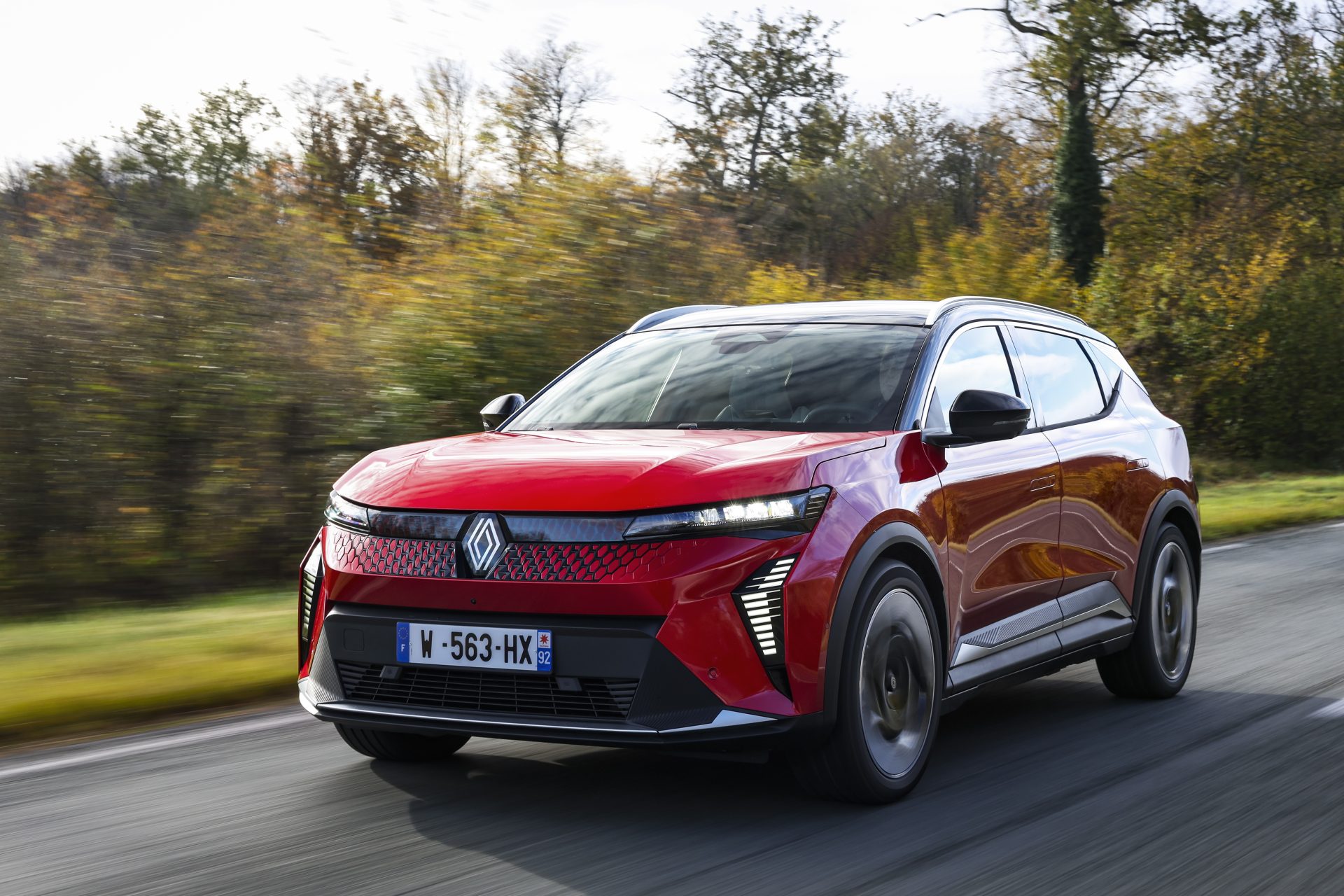
Back on its usual stage and after a thrilling final, the new Renault Scenic has been crowned the ‘Car of the Year in Europe 2024’ with 329 points, ahead of the BMW Serie 5 with 308 points and the Peugeot 3008 with 197 points.
This year the Car of the Year in Europe ceremony was held at its usual venue, the Geneva Motor Show. This is the seventh time that Renault has won the coveted award, taking over from the previous winner, the Jeep Avenger.
After a thrilling final vote, the Renault Scenic managed to beat the runner-up, the BMW Serie 5, by 21 points and the Peugeot 3008, this edition’s third-placed finalist, by 132 points. The following finalists were the Kia EV9 (190 points), the Volvo EX30 (168 points), the BYD Seal (131 points) and the Toyota C-HR (127 points).
The Renault Scenic was the favourite of 22 jurors, compared with 19 for the BMW Serie 5 and 3 for the Peugeot 3008, out of the 58 participants from the 22 European countries taking part. For the vote, each jury member has a total of 25 points to distribute among at least five of the seven finalists, with a maximum of 10 points for a single model, and is required to name one individual winner. As a result, there can be no tie in points for the highest-rated model.
The finalists of 2024
This time, seven brands were in contention for the award. The Chinese BYD made its debut this year with its new Seal model, which is fully electric, while the other participating brands had all previously won the title at least once. BMW entered this time with the new Serie 5, a striking saloon available with petrol, plug-in hybrid, diesel hybrid or electric powertrains, with rear-wheel or all-wheel drive, and also as an estate. Kia, which took part with the new large electric SUV EV9 in six- or seven-seat configuration, was the winner of the 2022 edition with the electric EV6.
Peugeot, whose star this year was the original 3008, has won six times with the 504 in 1969, the 405 in 1988, the 307 in 2002, the 308 in 2014, the 3008 in 2017 and the 208 in 2020. Renault, which this year featured the new Scenic as its star model in 2024, had also won the award six times, with the R-16 in 1966, the R-9 in 1982, the Clio in 1991, the Mégane Scenic in 1997, the Mégane in 2003 and the Clio in 1991 and 2006. Toyota appeared this year with the C-HR in hybrid and plug-in hybrid versions, although it had already won with the first-generation Prius in 2006, with the Yaris in 2001 and again in 2021, while Volvo, with the EX30 as its star, had won with the XC40 in 2019.
The Renault Scenic, an exclusively electric model
Renault has worked hard to develop an electric model capable of meeting the needs of customers in the different European markets, as it offers two battery versions, of 60 and 87 kWh, and power outputs of 125 and 160 kW (170 and 218 CV).
The five available versions of the model feature front-wheel drive, and their exterior dimensions are 4.47 m long, 1.86 m wide and 1.57 m high, with weights ranging from 1,822 kg to 1,947 kg and a boot capacity of 545 litres in all versions. Its performance is in line with its power outputs: acceleration from 0 to 100 km/h in 9.4 seconds and a top speed of 150 km/h for the 125 kW version, and 8.4 seconds and a top speed of 170 km/h for the most powerful variant, at 160 kW.
As for consumption figures, the most efficient versions, with smaller motors, promise 16.3 kWh/100 km, while the more powerful ones rise to 17.2 kWh/100 km. As a result, the homologated ranges under the WLTP cycle vary between 429 and 623 km on a single charge. In this regard, it should be noted that the Scenic can charge on AC at 22 kW and on DC at 130 or 150 kW, depending on battery capacity.
Furthermore, in addition to its good interior space, especially in the rear seats, with large doors, plenty of legroom and a 545-litre boot, with a dedicated compartment for storing the charging cables.
Its handling is very good: agile and predictable. We have only had the opportunity to drive the version with the large battery and 220 CV motor, which offers more than sufficient performance and reasonable consumption figures, below 20 kWh/100 km, provided the legal speed limits are scrupulously observed. Unlike the Mégane, this new Scenic E-Tech has received a more refined setup, with sensitive traction control, a very precise braking system and a well-balanced suspension system.
The route planning system stands out in particular, capable of interpreting the terrain and type of journey to be undertaken, with the option of conditioning the battery temperature to improve fast charging. The paddle shifters behind the steering wheel are also welcome, offering four levels of regeneration, from “sailing” driving to strong deceleration; this system is not incompatible with the physical brakes, meaning you can brake with the pedal while also using the paddles, something not all brands allow.
The new model is offered at prices ranging from 38,700 to 49,370 euros, depending on power and trim level. It will be available at dealerships at the end of next May.
What is the Car of the Year
Car of the Year (COTY) is an international award presented by a jury of automotive journalists from across Europe, held since 1963 (61 years). Its aim is to honour the most outstanding new car to have gone on sale in the 12 months prior to the award date.
The Car of the Year jury is made up of 61 members, representing 23 European countries. National representation on the jury is linked to the size of the country’s car market and its importance in car manufacturing. France, Germany, Great Britain, Italy and Spain each have six members; the other countries have proportionally fewer. In Spain, the jury consists of Félix Cerezo (El Mundo), Juan Ignacio Eguiara (Autopista), Rafael Guitart (Highmotor), Pedro Martín (El Confidencial), Xavi Pérez (El Periódico de Cataluña) and Pere Prat (La Vanguardia).
Jury members are chosen for their personal expertise and not for the prominence of the publications they may represent. New members join the jury by invitation from the jury committee, following recommendations from the regional groups. Each year, all members must confirm that vehicle testing forms an important part of their professional activity.
What does the Car of the Year involve?
The aim of the Car of the Year is to identify a single, decisive winner. The voting process is designed for that purpose and not to provide a ranking of all the competing cars. There are no categories, subdivisions or class winners. Candidate models must be production vehicles available in at least five European markets at the time of voting.
The criteria assessed are: design, comfort, safety, ergonomics, driving dynamics, performance, functionality, environmental requirements, as well as price and market positioning. Technical and technological innovation is essential to the case, as is value for money. Eligible cars must essentially be all-new models, not facelifts or mechanical updates.
Of all the cars presented over the course of the year, seven favourites are selected by all the jurors in November without any scores being given. Then, in February, each jury member must award a maximum of 25 points to distribute among the seven finalists and is obliged to name a winning model, providing a justification for their vote. The maximum number of points for a winner is 10, and the same score cannot be given to the top two choices. If two vehicles finish with the same number of points at the end of the vote, the one with the greater number of first-place votes wins. The winning model is announced at the opening ceremony of the Geneva International Motor Show.
All the winners of the ‘Car of the Year’
1964: Rover 2000; 1965: Austin 1800; 1966: Renault 16; 1967: Fiat 124; 1968: NSU Ro 80; 1969: Peugeot 504; 1970: Fiat 128; 1971: Citroën GS; 1972: Fiat 127; 1973: Audi 80; 1974: Mercedes-Benz S-Class; 1975: Citroën CX; 1976: Simca 1307-1308; 1977: Rover 3500; 1978: Porsche 928; 1979: Talbot Horizon; 1980: Lancia Delta; 1981: Ford Escort; 1982: Renault 9; 1983: Audi 100; 1984: Fiat Uno; 1985: Opel Kadett; 1986: Ford Scorpio; 1987: Opel Omega; 1988: Peugeot 405; 1989: Fiat Tipo; 1990: Citroën XM; 1991: Renault Clio; 1992: Volkswagen Golf; 1993: Nissan Micra; 1994: Ford Mondeo; 1995: Fiat Punto; 1996: Fiat Bravo; 1997: Renault Mégane Scenic; 1998: Alfa Romeo 156; 1999: Ford Focus; 2000: Toyota Yaris; 2001: Alfa Romeo 147; 2002: Peugeot 307; 2003: Renault Mégane; 2004: Fiat Panda; 2005: Toyota Prius; 2006: Renault Clio; 2007: Ford S-Max; 2008: Fiat 500; 2009: Opel Insignia; 2010: Volkswagen Polo; 2011: Nissan Leaf; 2012: Chevrolet Volt / Opel Ampera; 2013: Volkswagen Golf; 2014: Peugeot 308; 2015: Volkswagen Passat; 2016: Opel Astra; 2017: Peugeot 3008; 2018: Volvo XC40; 2019: Jaguar I-Pace; 2020: Peugeot 208; 2021: Toyota Yaris; 2022: Kia EV6; 2023: Jeep Avenger; 2024: Renault Scenic.
The Scénic E-Tech in pictures
Technical specifications of this car


 Peugeot E-208 GTi: a battery-powered toy that revives the spirit of the 1980s sports cars
 New Lexus ES: luxury grows and goes electric
 First contact with the Dacia Sandero Hybrid 155: power and efficiency from €19,890
Deja un comentario