Which hybrid car should I buy for the city in 2026?
 Iván Navarro
20 April 2026
7 min.
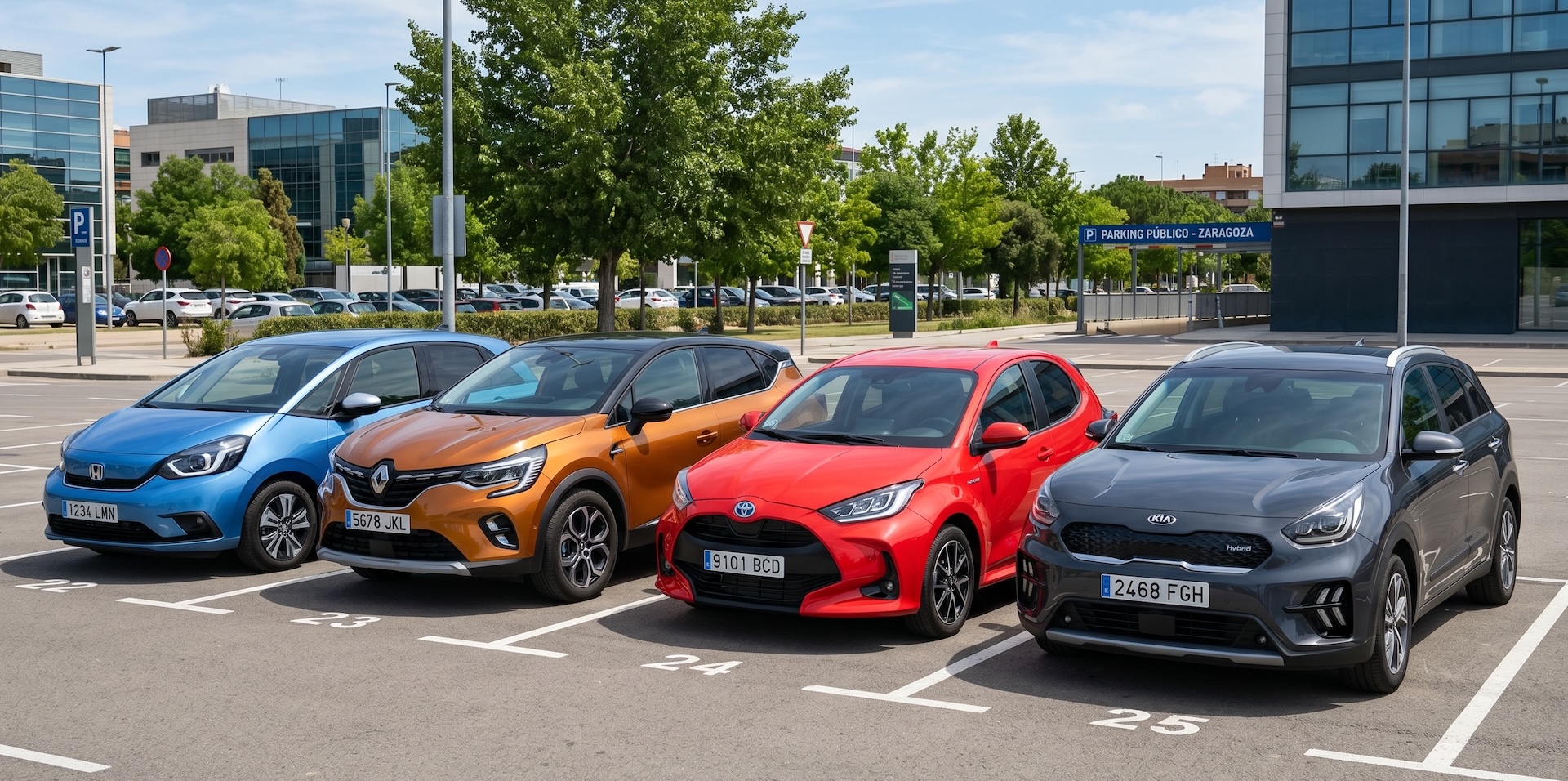
In this analysis we explore four exceptional options that combine efficiency, technology and versatility for today’s driver.
The market for compact hybrids in 2026 has established itself as the practical answer to urban commuting: models that prioritise efficiency, manoeuvrability and reduced running costs, without giving up connectivity and safety. In this context you will find alternatives ranging from affordable mild hybrids to full hybrids with enough battery for short trips in electric mode. Below are relevant options for the city, compared by their technical approach, price and real-world usefulness, with clear differences in size, hybrid solution and intended use.
Who is this ranking for?
This ranking is based on market data, official specifications and published road tests.
If you do a lot of urban driving, if you want to reduce consumption and emissions without relying on charging points, or if you need a compact car for everyday mobility with practical space, this list helps you compare reasonable alternatives that differ in their technical approach.
What details have we analysed?
We have assessed market positioning, official technical data (power and type of hybridisation), homologated consumption where available, dimensions and expected real-world use in the city, and price-to-technical-approach relationship to evaluate the cost per functionality.
Ranking of hybrid cars for the city in 2026
KIA Niro Hybrid (from 27,990 €*)
Indicative price before applying public grants or the brand’s commercial discounts.
Why it’s here: The Niro Hybrid offers a balance between roominess, technology and efficiency in mixed driving; its self-charging hybrid system reduces consumption in urban traffic and its compact chassis makes manoeuvring in the city easy.
Ideal for: Drivers looking for a spacious compact for the city with capacity for weekend trips.
Pros:
- Proven efficiency in urban and suburban environments.
- Good offering of driver assistance and connectivity.
- Competent interior and boot space for its segment.
Cons:
- Entry price higher than non-electrified micro-city cars.
- Dynamic behaviour geared more towards comfort than sportiness.
Toyota Yaris Hybrid (from 21,250 €*)
Indicative price before applying public grants or the brand’s commercial discounts.
Why it’s here: The Yaris Hybrid is the classic reference for urban hybrids: low real-world consumption in the city, very manageable size and proven technical reliability across many cycles of everyday use.
Ideal for: Daily city commuting and drivers who prioritise low running costs.
Pros:
- Low consumption in the urban cycle.
- Size and turning radius suited to parking and moving through narrow streets.
- Retains resale value in urban environments.
Cons:
- Rear seats somewhat tight on long journeys.
- Entry-level trims can feel spartan compared with recent rivals.
Honda Jazz e:HEV (from 23,000 €*)
Indicative price before applying public grants or the brand’s commercial discounts.
Why it’s here: The Jazz combines a versatile, modular interior with an efficient hybrid powertrain; its interior volume and accessibility suit urban families who need cargo flexibility.
Ideal for: Users who need roominess and versatility without giving up urban efficiency.
Pros:
- Well-used interior and modular seats.
- Hybrid system with smooth response in traffic.
- Visibility and ergonomics designed for the city.
Cons:
- Exterior design less distinctive than other rivals.
- Price of some versions can rise quickly depending on equipment.
Renault Captur E-Tech Hybrid (from 24,900 €*)
Indicative price before applying public grants or the brand’s commercial discounts.
Why it’s here: The Captur E-Tech offers a crossover alternative for the city with an elevated driving position and a hybrid system that favours urban journeys with contained consumption.
Ideal for: Drivers who want a car with more presence and comfort without giving up urban efficiency.
Pros:
- Ride comfort and elevated seating position.
- Equipment geared towards connectivity and urban safety.
Cons:
- Larger than pure city cars, which may make parking harder.
- Mixed-cycle consumption sensitive to the type of route.
The prices shown in this ranking are indicative, before applying public grants or the brand’s commercial discounts.
Technical comparison
| Model | Range | ||||
|---|---|---|---|---|---|
These data are official and taken from the brands’ official websites.
Purchase grants in 2026: Plan Auto+ and tax benefits
The 2026 Plan Auto+ replaces the previous MOVES programmes and establishes a new system of direct grants for purchasing electrified vehicles in Spain. It applies to passenger cars and light commercial vehicles, with priority for electric models and with criteria based on origin and price.
Main amounts of the 2026 Plan Auto+
– Direct grants of up to 4,500 € for electric passenger cars
.
– Up to 5,000 € for light vans in category N1.
– Retroactive effect from 1 January 2026.
– Approximate budget allocation of 400 million euros.
Who can benefit and priority criteria
Beneficiaries: private individuals, self-employed workers and companies. The EEE criterion (Electric, Economical and European) applies. Pure electric vehicles are favoured over plug-in hybrids; vehicles priced below 35,000 € receive a higher grant
and those between 35,000 € and 45,000 € receive a reduced grant. An additional incentive applies if the final assembly or the batteries are of European Union origin.
Additional requirements and tax advantages
A mandatory minimum discount of 1,000 € from the dealer. A 15% deduction on personal income tax up to a maximum of 3,000 €. Tax validity until 31 December 2026.
Management and possible regional grants
Management is coordinated by the Ministry of Industry together with the Autonomous Communities. Additional regional programmes may exist. Example: the Plan Cambia 360 in the Community of Madrid. At the time of writing, it is not officially confirmed whether these regional grants are compatible with the 2026 Plan Auto+.
FAQ · The 5 questions everyone asks
Does a self-charging hybrid make sense compared with a petrol car for the city?
Yes, on most urban journeys the hybrid reduces consumption and emissions by using braking energy and electric mode at low speed, which lowers the daily energy cost compared with pure combustion engines.
Do I need charging infrastructure for a hybrid like the Yaris or Niro?
No. Full self-charging hybrids do not need a plug to function as hybrids; the battery is charged by the vehicle’s own system, although access to charging improves the experience with plug-in hybrids.
What is the practical advantage of a hybrid over a small diesel or petrol car?
Lower consumption in traffic jams and urban driving, reduced local emissions and, in many cases, a lower cost per kilometre if use is mostly urban with frequent stops.
What should I check before buying an urban hybrid?
Check standard equipment, size and ease of parking, maintenance costs, service network and the manufacturer’s battery warranty policy.
Do hybrids hold their resale value well?
Hybrids from established brands usually hold their value better due to demand in urban environments and recognition of their efficiency; resale also depends on perceived reliability and the service network.
Expert’s conclusion
This ranking offers a practical view of the urban hybrid segment in 2026: models with different hybrid solutions, all designed to reduce running costs in the city
. For the buyer, it means choosing according to concrete priorities: size, roominess, purchase cost and comfort in daily use.
If you want to stretch your money, first look at the real entry price and what comes as standard. If you prefer to play it safe, look at the service network and the model’s demand: if it is in high demand, it is usually also easier to sell later. And if you cover a lot of kilometres, energy cost and efficiency matter more than the power figure
. If you won’t charge often, don’t buy from the catalogue: buy for your routine.§h298§


 Peugeot E-208 GTi: a battery-powered toy that revives the spirit of the 1980s sports cars
 New Lexus ES: luxury grows and goes electric
 First contact with the Dacia Sandero Hybrid 155: power and efficiency from €19,890
Deja un comentario