Which petrol car with an ECO label should you buy in 2026 for urban use?
 Iván Navarro
12 March 2026
7 min.
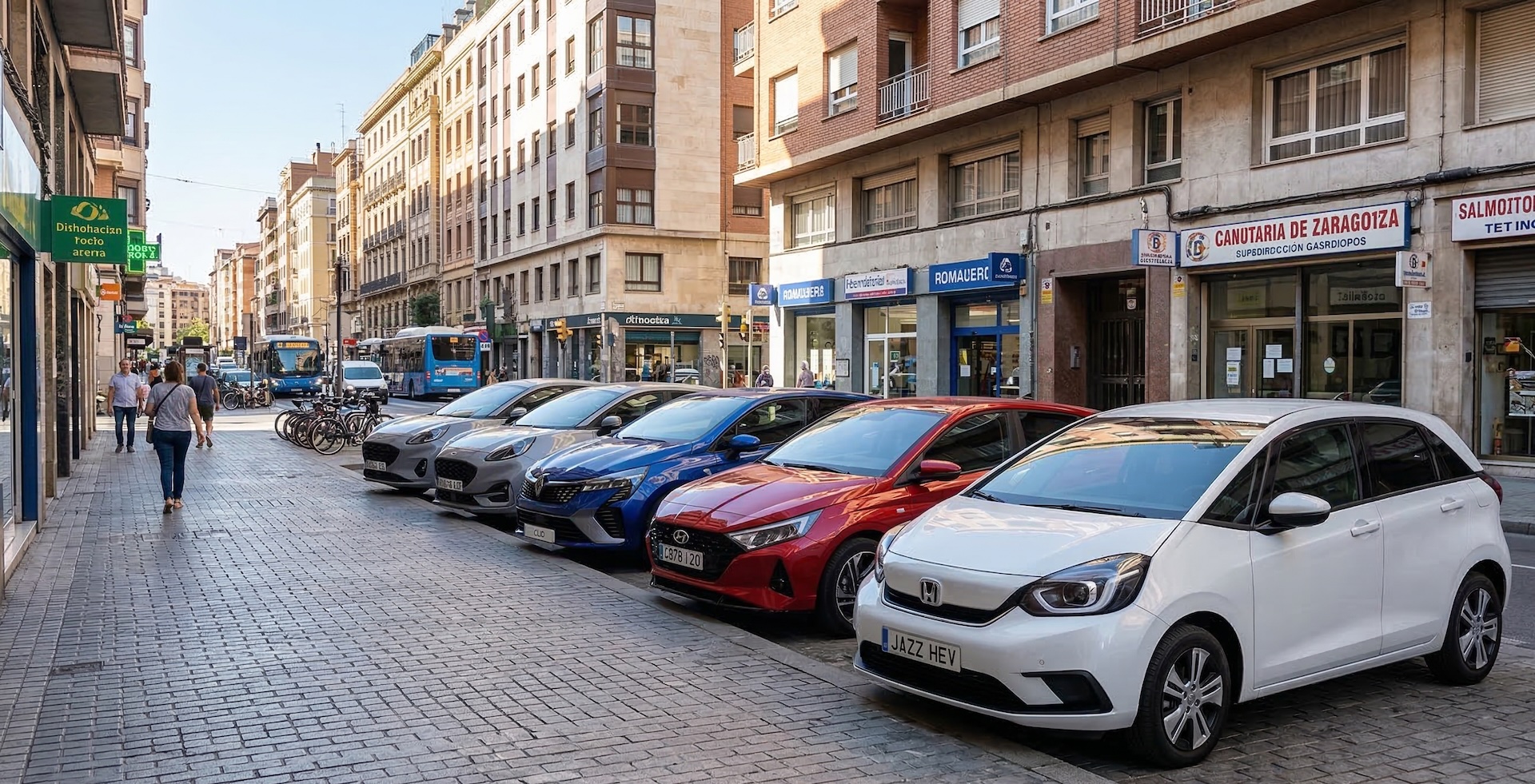
When choosing one of the vehicles we suggest below with an ECO label, bear in mind that the operating cost will depend both on the fuel consumed in regular use and on the maintenance required.
The urban market in 2026 offers petrol cars that keep the ECO label thanks to strategies such as mild or full hybridisation and optimised emissions management systems. These vehicles usually combine low consumption in town, quiet starts and connectivity solutions designed for short journeys, but they raise questions about real running costs, manoeuvrability and their suitability for occasional longer trips.
This buying guide is for…
Drivers who prioritise daily mobility in urban environments and want to reduce emissions and costs without moving to a pure electric vehicle. It makes sense for those who make short trips, park often and value agility and economy in the city. It is not the best option for those who need long daily journeys at high speed or large load capacity, where a modern diesel or a larger hybrid may be more suitable.
Common options in the segment
In the urban segment with an ECO label there are three approaches: hybrids that combine a petrol engine with an electric motor to reduce consumption in urban driving; mild-hybrid (48 V) systems that assist the combustion engine during starts and recover energy; and micro-hybrids with thermal management and injection improvements to reduce emissions. Each approach involves trade-offs in weight, complexity and cost: full hybrids tend to be heavier but more efficient in town; mild-hybrids are less costly and simpler to maintain; micro-hybrids depend heavily on driving style for any benefit to be noticed.
Key criteria for choosing well
Realistic versus homologated range: in urban use WLTP figures can get close to real-world results, but there will be variations depending on weather and air conditioning use. Power and charging speed (where relevant to energy recovery): an electric assist motor with sufficient torque improves response in traffic jams and manoeuvres.
Stability and comfort on the road: a comfortable chassis and precise steering are more valuable on secondary roads and when entering or leaving the city than pure acceleration figures. Genuinely useful technology: urban emergency braking assistants, a rear camera and connectivity that makes route and parking management easier.
Total cost of purchase and use: in addition to the initial price, consider insurance, taxes, maintenance and real consumption. A car with an ECO label may reduce some municipal taxes and benefit from certain traffic restrictions, which adds operational value.
It depends on how you drive
If you alternate short trips with one or two longer journeys a week, a hybrid is usually the right balance. If your driving is almost exclusively urban with frequent stops, a light hybrid or mild-hybrid offers reduced consumption and good response in dense traffic. Climate affects this: in winter, the use of heating and resistors can increase consumption; in summer, air conditioning also has an impact. Practical profile: those who prioritise ease of parking and manoeuvrability will value compact dimensions and good visibility.
Real price: what you should know
The difference between a financed price and a cash price can be considerable; financing offers include interest and often absorb part of the dealer discount, whereas paying in cash lowers the total cost. Equipment frequently raises the base price: driver assistance systems, larger alloy wheels and comfort packs increase weight and consumption. Interpreting the “from” price: it usually corresponds to a basic version with no options, so the final price can rise by several thousand euros depending on the configuration chosen and current promotions.
Reference models on the market
Toyota Yaris (from 21,000 €*)
Urban compact with full hybridisation that prioritises low consumption in metropolitan traffic and ease of use when manoeuvring. It fits well in town thanks to its size, visibility and real-world consumption that holds up in traffic jams.
Best feature
Sustained urban efficiency and a proven hybrid system that limits use of the combustion engine on short journeys.
Room for improvement
Boot space and performance on fast roads; it is not the quickest choice on motorways at high speeds.
Renault Clio E-Tech (from 20,900 €*)
A hybrid approach aimed at balancing urban comfort with the capability for occasional intercity trips. It offers equipment configurations tailored to daily use.
Best feature
Comfortable behaviour and modest consumption in mixed driving, with good response in town.
Room for improvement
A lack of acceleration feel at high speeds and some adaptation time for the hybrid system in very demanding driving.
Hyundai i20 (from 17,500 €*)
An accessible urban model that, in mild-hybrid versions, reduces consumption and emissions without excessive technical complexity; ideal for drivers looking for a controlled price and agility in town.
Best feature
Competitive entry price and agile handling in narrow urban environments.
Room for improvement
Hybridisation benefits are limited compared with a full hybrid in prolonged traffic jams.
Honda Jazz e:HEV (from 22,000 €*)
A self-charging hybrid system with a practical focus: a cabin that is spacious for its size, efficiency in urban driving, good visibility and manoeuvrability.
Best feature
Interior versatility and town economy thanks to the integration of its hybrid system.
Room for improvement
Somewhat conservative styling, and a finish that in basic versions can fall short against better-equipped rivals.
Ford Puma EcoBoost Hybrid (from 23,000 €*)
A crossover urban approach with mild-hybrid technology that provides response in town and an extra degree of versatility for weekend getaways.
Best feature
A combination of roominess and low-speed responsiveness, with a good driving position.
Room for improvement
Consumption on steady high-speed stretches and a slightly higher cost compared with smaller alternatives.
Purchase aid
Purchase aid in 2026: Plan Auto+ and tax benefits. The 2026 Plan Auto+ replaces the earlier MOVES programmes and establishes a new system of direct aid for the purchase of electrified vehicles in Spain.
Main amounts of the 2026 Plan Auto+
– Direct aid of up to 4,500 € for electric passenger cars.
– Up to 5,000 € for N1 light vans.
– Retroactive effect from 1 January 2026.
– Approximate budget allocation of 400 million euros.
Who can benefit and priority criteria
Beneficiaries: private individuals, self-employed workers and companies. The EEE criterion (Electric, Economical and European) applies, with greater incentives for pure battery electric vehicles (BEV) than for plug-in hybrids (PHEV). Vehicles priced below 35,000 € receive higher aid; between 35,000 € and 45,000 € they receive reduced aid. The maximum incentive applies if the final assembly or the batteries are of European Union origin.
Additional requirements and tax advantages
A mandatory minimum discount of 1,000 € from the dealer. A 15% deduction on personal income tax up to a maximum of 3,000 €. Tax validity until 31 December 2026.
Management and possible regional aid
Management is coordinated by the Ministry of Industry together with the Autonomous Communities. Additional regional programmes may exist; for example, the Plan Cambia 360 in the Community of Madrid. At the time of writing, it has not been officially confirmed whether these regional aids are compatible with the 2026 Plan Auto+.
Common buying mistakes
Choosing based on appearance and forgetting to check real urban consumption; underestimating maintenance and insurance costs; opting for versions with large alloy wheels that raise consumption and the risk of urban damage; not considering the effect of equipment on the final price; interpreting the “from” price as the usual price of the car ready to use.
With the right information on real consumption, total cost and suitability for the urban environment, it is possible to prioritise the options that deliver the greatest operational value. The logical next step is to compare these models in up-to-date reviews and real-use tests to refine the choice according to specific needs.


 Peugeot E-208 GTi: a battery-powered toy that revives the spirit of the 1980s sports cars
 New Lexus ES: luxury grows and goes electric
 First contact with the Dacia Sandero Hybrid 155: power and efficiency from €19,890
Deja un comentario