Dacia EV9 Jogger KIA Kodiaq Multivan SEAT Skoda Tarraco Volkswagen Family Buying Guides Minivans Rankings
2026 ranking: the 5 family MPVs and SUVs with the best rear-seat space for three child seats
 Dani Montesinos
16 November 2026
6 min.
Analysis of rear bench width, the number of ISOFIX anchors and compatibility with i-Size child seats across the six most capable family MPVs and SUVs
Having three children of child-seat age turns buying a car into a geometry problem, not a marketing one. It doesn’t matter how many seats the brochure advertises: what decides whether those three car seats fit in the back, with their ISOFIX bases and without the children’s shoulders touching, is the real width of the rear bench in millimetres and the number of anchors available in the second row. This is the first thing to take apart before looking at prices.
Why rear bench width matters more than total seats
A seven-seat SUV can boast about its capacity and yet be unable to accommodate three Group 1/2/3 child seats in its second row if the bench measures less than 1,400 mm of usable width between trim panels. The third row, in most family SUVs, is ruled out for child seats because of the backrest angle and the difficulty of anchoring. So the real test is played out in the second row, and there not all cars are equal: some gain centimetres thanks to a wider chassis, others lose them to a bulky transmission tunnel or to a centre armrest that cannot be removed.
Measurable criteria: ISOFIX, width in mm and i-Size compatibility
For this ranking we used three objective variables. First, the width of the rear bench, measured between the door panels at shoulder height. Second, the number of certified ISOFIX points in the second row: most cars offer two, in the outer seats, leaving the centre with only a three-point seatbelt; very few models approve a third, central ISOFIX, which is exactly what makes the difference when we talk about three seats at once. Third, the manufacturer’s declared compatibility with i-Size seats of groups 1, 2 and 3, which determines whether a 9 kg child and a 25 kg child can share the same bench without fighting over space.
Pure MPVs vs family SUVs: key differences for three seats
MPVs such as the Volkswagen Multivan or the Dacia Jogger start with a structural advantage: their taller, less sculpted bodies allow wider and flatter rear benches, without the narrowing imposed by rear wheel arches in an SUV. Family SUVs, on the other hand, compensate with access height and better dynamic behaviour, although they pay a toll in interior width. Neither format wins in every respect. That is why this ranking mixes both worlds: what we seek is the best real-world solution, not the most eye-catching one in the showroom.
2026 ranking: the 6 best family MPVs and SUVs for three child seats
1. Volkswagen Multivan (T7) — from 56,745 €
It is the MPV with the most real margin. Its continuous rear bench, available with three sliding individual seats, allows three i-Size seats to be installed without any one encroaching on its neighbour, and Volkswagen approves ISOFIX anchors in all three positions in certain configurations. The eHybrid version adds circulation in low-emission zones, something that starts to weigh in the purchase of a car that will be used daily for a decade.
| Engine | Power | Consumption | Label | Fuel |
|---|---|---|---|---|
| 2.0 TDI | 110 kW / 150 CV | 6.5 l/100 km | C | Diesel |
| 1.5 eHybrid | 180 kW / 245 CV | 2.8 l/100 km | ZERO | PHEV |
2. Dacia Jogger — from 24,595 €
The surprise of the list, and the only one rivalling the Multivan in number of ISOFIX points: the Dacia approves three anchors on the second-row bench, unusual at this price range. Its width is tighter than the Multivan’s, but it remains among the best in its category while costing considerably less. We have already covered it in detail in our review of the Dacia Jogger: it remains hard to beat on cost per usable seat.
| Engine | Power | Consumption | Label | Fuel |
|---|---|---|---|---|
| Hybrid 155 | 115 kW / 155 CV | 4.3 l/100 km | ECO | Hybrid |
3. Peugeot 5008 — from 34,590 €
The new generation of the 5008 abandoned the formula of compact seven seats to gain width in the second row, and it shows. The rear bench accepts two certified outer ISOFIX anchors and a central seat with a three-point belt that, thanks to its width, takes a third Group 2/3 i-Size seat without difficulty. It is not the perfect split, but it works better than in the previous generation.
| Engine | Power | Consumption | Label | Fuel |
|---|---|---|---|---|
| Hybrid 145 | 107 kW / 145 CV | 5.2 l/100 km | ECO | Hybrid |
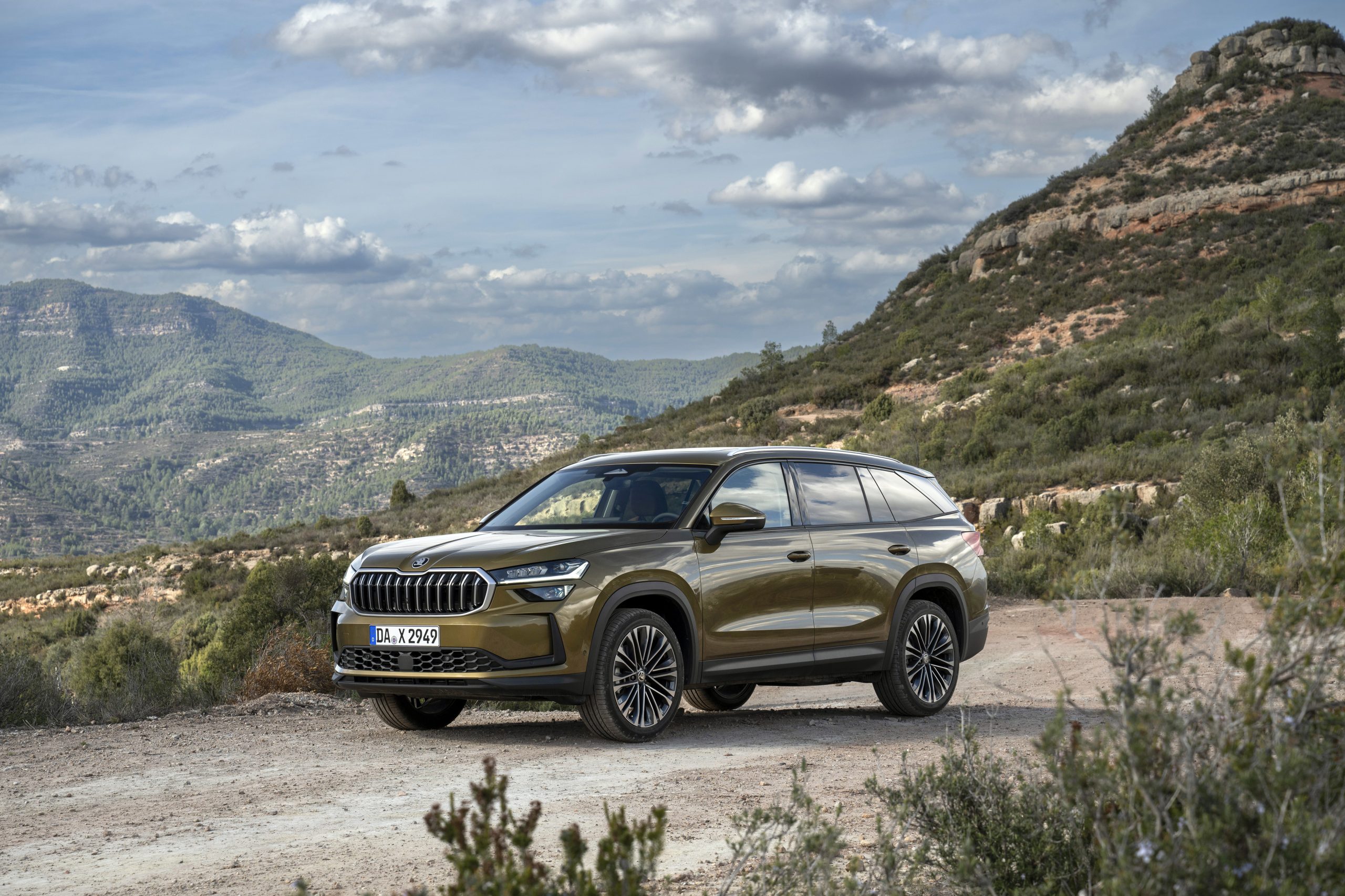
4. Skoda Kodiaq — from 47,300 €
The Kodiaq compensates with a huge boot and a sliding second row that gains legroom when the third row is freed up. The width between panels is generous for an SUV, although the more pronounced central tunnel than in MPVs takes away some comfort from the middle seat with a child seat installed.
| Engine | Power | Consumption | Label | Fuel |
|---|---|---|---|---|
| 1.5 TSI mHEV | 118 kW / 160 CV | 6.8 l/100 km | ECO | Petrol |
| 2.0 TDI | 110 kW / 150 CV | 5.9 l/100 km | C | Diesel |
KIA EV95. Kia EV9 — from 69,670 €
The most expensive on the list, but also the one offering the widest second row in the whole ranking thanks to the E-GMP platform, designed from scratch without a transmission tunnel. It accommodates three child seats with plenty of room between them, and is one of the few SUVs of this size to approve a central ISOFIX. If the family may qualify for the current Plan Auto+, it is worth checking the updated conditions on the official website before closing the purchase.
| Power | Range | Consumption | Label | Fuel |
|---|---|---|---|---|
| 282 kW / 384 CV | 563 km | 22.8 kWh/100 km | ZERO | Electric |
Comparative summary table
| Model | Type | ISOFIX 2nd row | Price from | Score |
|---|---|---|---|---|
| Volkswagen Multivan | MPV | Up to 3 | 56,745 € | 9.2 |
| Dacia Jogger | MPV | 24,595 € | 9.0 | |
| Kia EV9 | Family SUV | 69,670 € | 8.8 | |
| Peugeot 5008 | Family SUV | 2 + central | 34,590 € | 7.9 |
| Skoda Kodiaq | Family SUV | 2 + central | 47,300 € | 7.6 |
For those who also want a third row designed for adults, not just children, it is worth looking calmly at how to choose a family SUV with a third row usable by adults: the order of priorities changes considerably.
Frequently asked questions
Which car fits three child seats in the back best in Spain in 2026?
The Volkswagen Multivan and the Dacia Jogger offer the greatest real rear-bench width combined with three approved ISOFIX anchors, which makes them the safest option for installing three i-Size seats without compromising the centre seat.
Is it mandatory for the car to have three ISOFIX points to carry three child seats?
No. The regulations allow a seat with a three-point belt in the centre position if the manufacturer expressly authorises it, although having ISOFIX in all three seats improves fixing and reduces the margin for error during installation.
Can 7-seat SUVs fit three child seats in the third row?
In practice, almost no family SUV approves ISOFIX in the third row, and the backrest angle rarely allows a correct installation. The solution almost always involves concentrating the three seats in the second row.
What minimum width does a rear bench need for three i-Size seats?
There is no single figure because it depends on the width of each seat, but below 1,400 mm between panels, fitting three Group 1/2/3 seats together is usually very tight or outright unfeasible.
Technical specifications of the cars in this article
 Kia offers an electric range of 10 models, 50 versions and 400 possible combinations
 The seven finalists for the 2027 European Car of the Year (COTY) are exclusively electric
 Peugeot E-208 GTi: a battery-powered toy that revives the spirit of the 1980s sports cars
Deja un comentario