Behind the wheel of the new Opel Astra: keys to making the right purchase
 Antonio Roncero @roncero_antonio
4 June 2020
8 min.
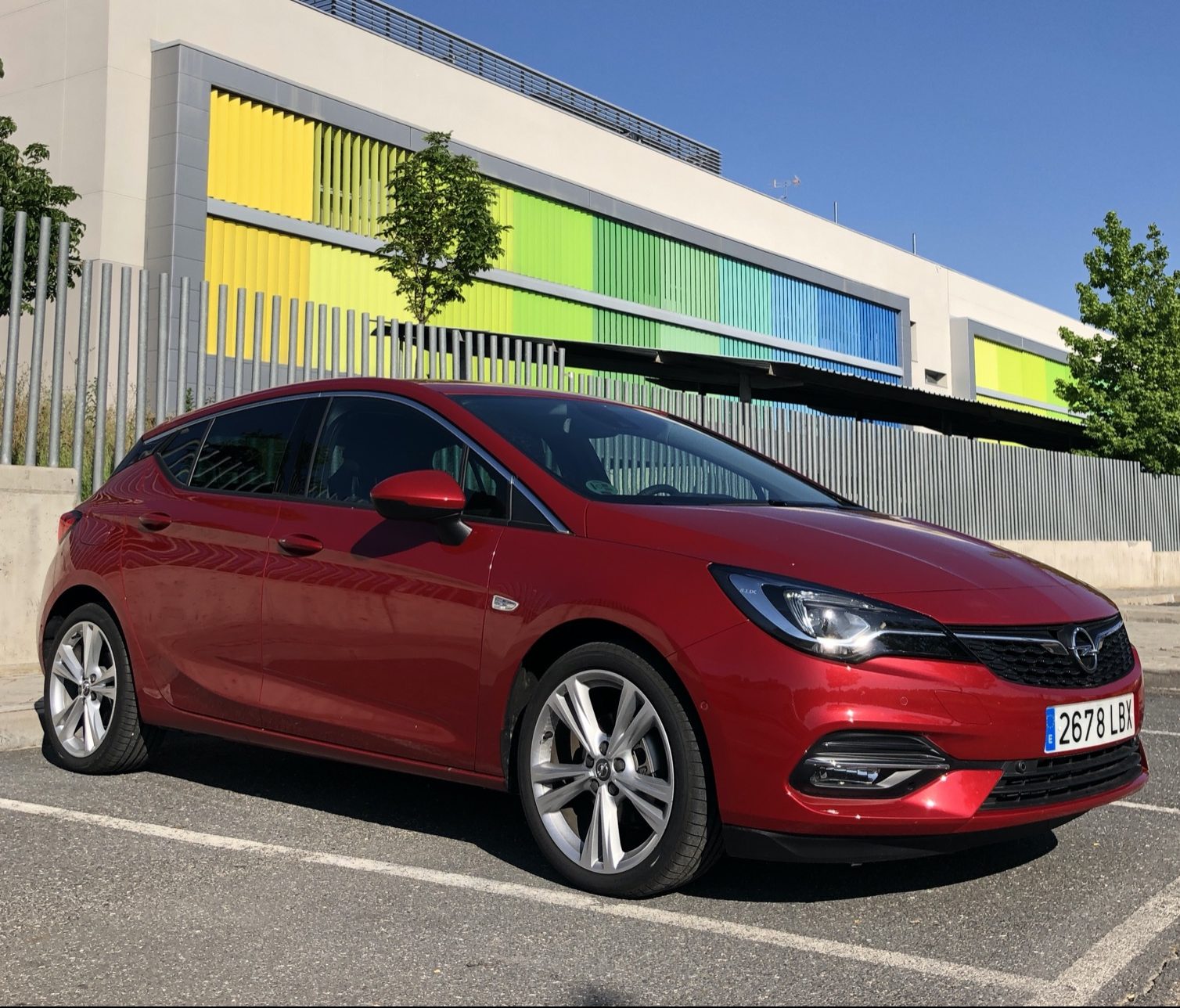
We road-tested the refreshed Opel Astra range and give you some keys to help you choose the most suitable engine or equipment.
Opel has updated its Astra range with many improvements, both in equipment and in the engine line-up. Now that we have tested it, we analyse the most important features of this new range, and we can go into detail on the versions that interest us most… and the ones that interest us least.
What changes in the new Opel Astra 2020
To begin with, it is worth remembering that the Astra that Opel sells as MY2020, and which was presented in September 2019 at the Frankfurt Motor Show, is not a new generation. The base is still that of the Astra presented in 2016, on which a restyling has been carried out. It continues to be offered both as a 5-door body and with the elegant and practical estate, which has a price premium of around 900 euros. A variant well worth considering.
The main changes in the new Astra range are aimed at reducing emissions and consumption, for which a new range of engines is used, in addition to incorporating some aerodynamic improvements (such as active grille shutters or a greater underbody covering), which was already good. There are also slight changes to the calibration of the suspension damping, which seek to improve agility and comfort. Externally, the changes are so small that it is hard to tell whether we are looking at the new model or the previous one.
In petrol there are 3 variants of the 1.2-litre 3-cylinder, with 110, 130 and 145 CV, always with a six-speed manual gearbox, and a 1.4 with 145 CV paired with a 7-speed CVT gearbox, also a 3-cylinder. All feature direct injection, a turbocharger, variable valve timing and a balance shaft to reduce vibration.
The diesel offer includes two variants of the 4-cylinder 1.5D engine, with 105 and 122 CV, the latter also available with the modern 9-speed automatic gearbox. Both versions use a variable-geometry turbocharger, a diesel particulate filter and AdBlue injection.
Other improvements in this new Astra range affect equipment. The range is structured around four versions: a basic entry-level one, the GS Line with certain sporty details, the 2020 special edition and the more luxurious Elegance.
Among the new details, the digital instrumentation stands out (only partially, as it still retains some analogue dials), the new seats with ventilation option, new multimedia systems and improved safety and driver-assistance systems, thanks to a new higher-resolution front camera.
Which petrol Astra should you choose?
What might seem like a dilemma on paper, deciding on a mechanical version, is not so much if we take into account the configuration of the range, the prices and the performance of the engines.
Without doubt, the most balanced version is the 1.2 petrol with 130 CV. Including discounts, you can have it in GS Line trim from 19,600 euros, only 800 euros more than the 110 CV 1.2 version in the same trim. Don’t rule it out if you decide to stick with the basic trim, available only with the 110 CV: you can have it from 18,050 euros, and the engine does the job. But it is better to take the leap.
It has 20 CV more power, with 225 Nm of maximum torque (compared with 195 Nm for the basic petrol engine) and, consequently, better performance, with the same homologated average consumption on the WLTP cycle: from 4.3 l/100 km in the combined cycle. A figure that in real-world use is more around 6.5 l/100 km, which is not bad at all.
Above this engine sits the 1.2 with 145 CV and manual gearbox, of which we give more detailed driving impressions at the end. Its main problem is not technical; it is simply that it is not offered in the trims that interest most, and it is only combined with the Elegance version, which “shoots up” the price. This is not a problem, given that you can choose the 1.2 with 130 CV with the most interesting trim, the GS Line.
As for the 1.4 with 145 CV and CVT gearbox… If you want an automatic Astra, I recommend “switching sides” to the diesels. The combination of the 1.5D engine with the torque-converter 9-speed gearbox works much better than this petrol engine with a continuously variable transmission, which works very well in town but noticeably hampers performance when you take to the open road.
The diesel versions of the new Opel Astra
At least in this generation, in the short or medium term, the Astra is not expected to receive electrified versions or versions running on gas. So there is no possibility of choosing an Astra with an ECO or ZERO environmental label. However, if you are looking for a compact to cover many kilometres a year and consumption is a key factor, the new diesel engine is the alternative.
At equal trim, the difference between the two Astra diesel engines is… just 100 euros!
The less powerful version, with 105 CV, is offered in the basic and GS Line trims, while the more powerful one, with 122 CV, is combined with the GS Line and Elegance trims, in the latter case paired with the 9-speed automatic gearbox. Neither engine stands out like other turbodiesels of similar power in compacts rivalling the Astra, nor are they a benchmark for smoothness. They do the job, but they won’t make you forget the petrol versions.
If you have to decide on one of the diesels, if you want to invest the minimum in equipment you should look at the 105 CV in basic trim, available from 19,000 euros. But for 850 euros more, the GS Line trim is worth it. And at equal trim, the more powerful diesel engine costs just… 100 euros more! Don’t think twice. If you choose diesel, the 122 CV, without a doubt.
And if you have to choose between petrol and diesel, I still stick with the 1.2 petrol with 130 CV as the most balanced version of the range.
Behind the wheel of the Opel Astra 1.2 145 CV Elegance
The 1.2 145 CV version with manual gearbox, which we were able to live with for several days and cover a good number of kilometres, has two handicaps that make it inadvisable compared with the 1.2 130 CV that we consider the “master buy” of the range.
The first we have already mentioned: it can only be chosen in Elegance trim, which takes the price above 24,000 euros; admittedly with “top” equipment. The second is that this version does not differ so much in performance from the 1.2 130 CV, which holds its own very well in “efficient” use and does not feel out of place if you are looking for the upper part of the rev counter.
It should be noted that, in seeking to homologate very low consumption figures, Opel has chosen gear ratios so long that they mask the good performance of the 1.2 145 CV, forcing more frequent gear changes than would be necessary with closer ratios. It would probably consume a little more on the homologated cycle… and a little less in real use, where this 1.2 gave us 6.8 l/100 km on the trip computer.
One point to improve is the operation of the start-stop. In certain situations, such as when you approach a give-way sign and make an almost-stop but pull away again quickly without coming to a complete halt or stopping for a minimal time, the engine cuts out too early and takes a while to restart when you try to move off again, creating a sensation similar to stalling.
Otherwise, the changes to the damping have done the Astra good, which gains precision and agility without losing comfort, especially in the sportier suspension compared with the two other options available. There are no notable differences in the interior, which retains the pleasant dashboard design and the same dimensions in terms of passenger and luggage space, in line with the class average.
The new digital instrumentation with the 8-inch screen is very comprehensive, but I don’t really understand why it is combined with analogue gauges rather than taking the opportunity to offer a full large digital display, as its main rivals do, especially in the Volkswagen Group. The higher quality of the rear-view camera is noticeable, as is the superior performance of the new multimedia systems, especially the most complete, the Navi Pro.
The 8-inch screen offers good resolution, compatibility with Apple CarPlay and Android Auto and an easy, intuitive menu, and it offers the possibility of online services such as traffic status information or map updates.


 Peugeot E-208 GTi: a battery-powered toy that revives the spirit of the 1980s sports cars
 New Lexus ES: luxury grows and goes electric
 First contact with the Dacia Sandero Hybrid 155: power and efficiency from €19,890
Comentarios cerrados