Brabham BT62: some keys to understanding its performance
 Antonio Roncero @roncero_antonio
21 April 2020
3 min.
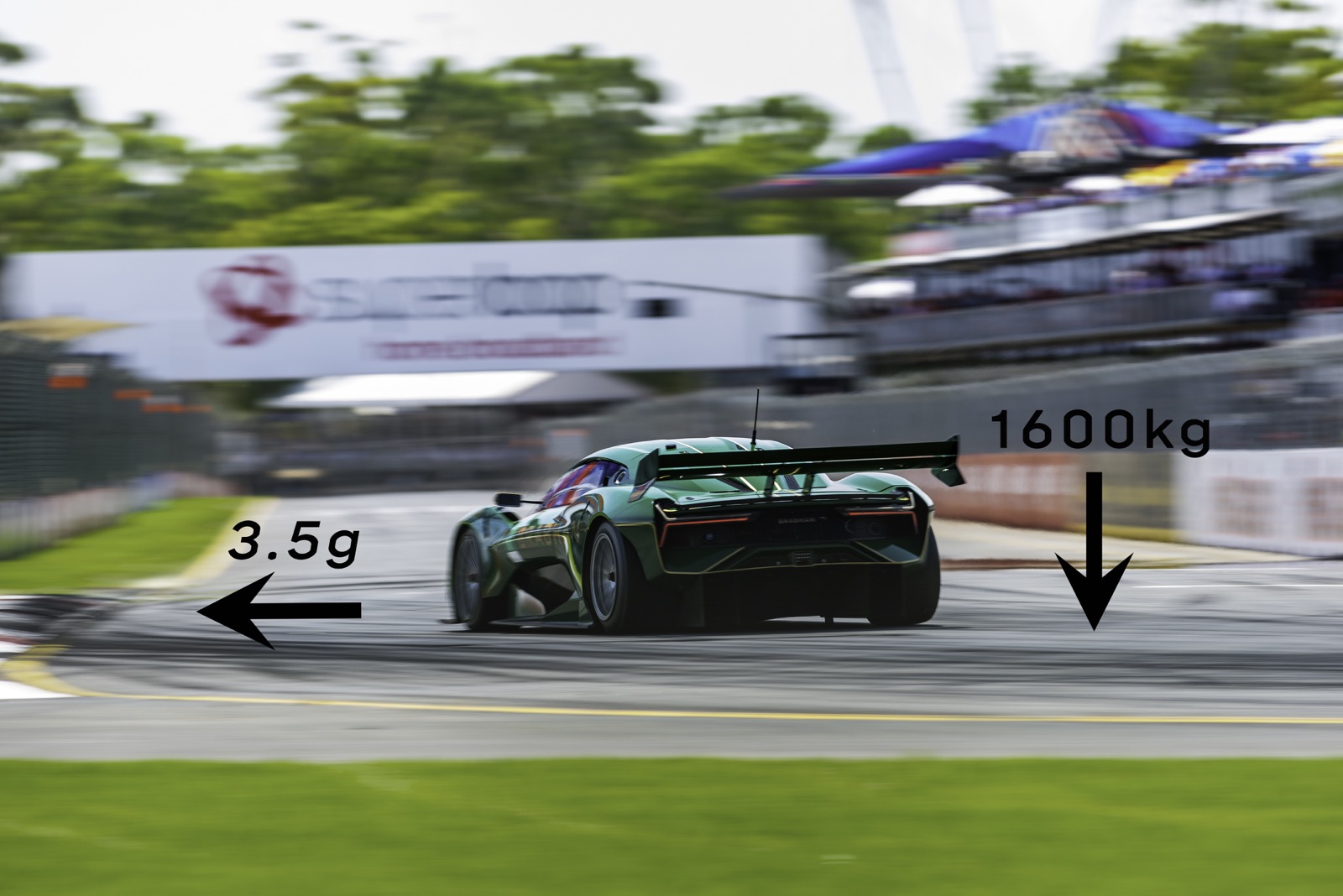
A look at the aerodynamics of the Brabham BT62 explains why it is one of the most effective supercars in the world on the track.
The Brabham BT62 is a supercar built for track use, equipped with a naturally aspirated 700 CV V8 engine, and only 70 units will be built, as a tribute to the brand’s 70th anniversary.
Now that some journalists have been able to drive the car at the Mount Panorama Circuit – also known as Bathurst Motor Speedway – making a magnificent impression with its performance, Brabham reveals one of the secrets behind its being hailed by the international press as “the best track supercar in the world”.
It has also been described as one of the easiest cars in its class to drive quickly on track, even for non-expert drivers. And its main secret is none other than aerodynamics.
Balance between drag and downforce
As we saw recently when analysing the aerodynamics of the Porsche 911 Turbo, the main problem engineers face in a high-performance sports car is achieving the balance between drag and downforce.
The latter is responsible for pressing the car onto the asphalt, allowing higher cornering speeds. But to achieve high downforce values, aerodynamic appendages are generally needed that worsen the drag coefficient and therefore the drag, and even the cooling of the engine or of the brakes.
From the computer to the track
Models created on computer using CFD (Computational Fluid Dynamics) allow designers to study the airflow over the vehicle before it reaches the track. In this design phase, engineers can add and test elements individually, checking how each affects the whole.
Here, the goal is a design that first channels the airflow and then directs it through the bodywork. The images show how the low-pressure airflow moves around the bodywork, while the high-pressure zones at the front and rear are responsible for generating “downforce“, improving stability.
Other important aspects include directing the cooling airflow exactly where it is needed. Keeping low-pressure air in the lower area of the car is key to preventing lift at high speed, which would affect stability by preventing the suspension and tyres from working properly.
At the same time, it is necessary to use the higher-pressure airflow to make the most of the downforce that the bodywork itself and the wings can create. This flow is also passed through the radiator via the bonnet, diverting it toward the sides. The low-pressure vortices generated allow the air to flow along the sides of the bodywork, instead of passing toward the underbody, which would affect the operation of the rear diffuser.
The Brabham BT62 against its rivals
It is precisely the low-pressure zone beneath the fully faired bodywork that helps the centre of pressure and the static centre of gravity of the car favour the BT62’s stability at high speed.
Specifically, the following table shows some of the downforce values generated by the Brabham BT62 and its rivals, along with other relevant data. For example, besides being the least powerful and also the lightest, the BT62 is capable of generating a maximum downforce of 1,600 kg, double that of a McLaren Senna, for example, and almost three times that of a McLaren P1, withstanding lateral cornering forces of up to 3.5 g.


 Peugeot E-208 GTi: a battery-powered toy that revives the spirit of the 1980s sports cars
 New Lexus ES: luxury grows and goes electric
 First contact with the Dacia Sandero Hybrid 155: power and efficiency from €19,890
Comentarios cerrados