Can we trust the lap times published by manufacturers at the Nürburgring?
 Jaime Gomez
27 April 2017
4 min.
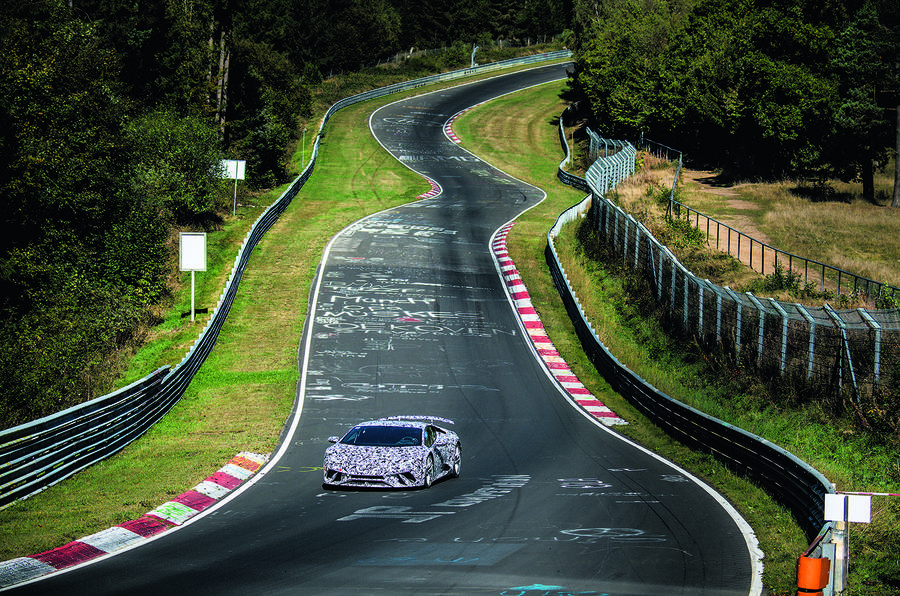
The veracity of the records set on the Nordschleife is once again called into question following suspicions such as the one surrounding the Lamborghini Huracán Performante.
The Nürburgring Nordschleife circuit is used by most manufacturers to measure the dynamic capabilities of their latest models. Over the last decade, the lap record on the Bavarian track has been reduced by almost a minute, a figure that demonstrates the great evolution cars have undergone and that we would not be aware of if the “Green Hell” did not exist.
Inevitably, the Nürburgring has become the biggest benchmark for manufacturers, who compare their cars with each other, trying to take the title of “best car at the Ring”, but how reliable are these times?
For example, the Lamborghini Huracán Performante became, a few months ago, the fastest production vehicle around the “Green Hell” with a lap time of 6 minutes and 52 seconds; this mark represents a five-second improvement over the previous record: Porsche 918 Spyder.
The Lamborghini Huracán Performante boasts of being the fastest production vehicle with 6 minutes and 52 seconds. Many wonder how a supercar with 631 CV of power has so clearly beaten one of the most powerful hypercars on the market: 874 CV of power. In fact, the power-to-weight ratio favours the Bavarian model (1.87 kg per CV) over the Italian supercar (2.19 kg per CV). Logically, something is wrong…
The problem is that there are no common rules for all manufacturers when setting a lap time at the “Ring”; that is, not all cars run under the same conditions, and of course, all models are modified compared with their production versions. Most of the cars that set the records we know of use roll cages, an element that improves the torsional rigidity of the vehicle and therefore its cornering dynamics. In some cases, manufacturers offset that added weight (the roll cage) by removing weight from the vehicle itself; the result is a stiffer car with no weight penalty whatsoever.
Another element manufacturers play with to improve their cars’ times is the type of tyre used. In many cases (such as the recent record set by the Honda Civic Type R), the compounds are track-only, offering a level of grip far superior to street tyres, and they are not even available on the market to the average driver.
The type of tyre and the roll cages are elements used by manufacturers to improve performance on the track. The clearest solution to this problem is for cars to set their times under equal conditions, preferably in their final production version (without any kind of modification). In this regard, Ferrari enthusiast and collector James Glickenhaus has proposed a system that would eliminate at the root all the doubts raised by lap records set on the legendary Nürburgring Nordschleife. This is what he said in an interview with Autocar:
“What I propose is the Glickenhaus Road Cup, a championship that would take place during the 24 Hours of Nürburgring and after the qualifying of the race cars. These are the rules: the driver must be the owner of the vehicle, and it must be registered and legal to drive on public roads. It starts in Cologne and drives to the Nürburgring on the same set of tyres that will be used for the fast lap on the circuit; they must be street-legal tyres, and they can be replaced by other special compounds at the circuit. Everyone drives and sets a time. Whoever is the fastest is the winner,” says the American.
The truth is that Glickenhaus’s system would be very attractive, but it is quite unlikely to ever be put into practice, and manufacturers would be unwilling to accept it. A shame.


 Peugeot E-208 GTi: a battery-powered toy that revives the spirit of the 1980s sports cars
 New Lexus ES: luxury grows and goes electric
 First contact with the Dacia Sandero Hybrid 155: power and efficiency from €19,890
Deja un comentario