Cars with History: BMW Z1
 Fernando Alvarez
6 June 2012
3 min.
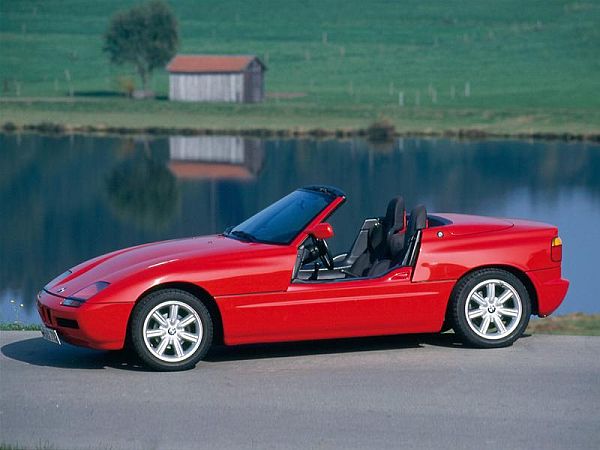
The BMW Z1 turns 25 years old, and at Coches con Historia we take a look back at its history and at how BMW decided to revisit the two-seaters of the 1950s.
When BMW introduced the Z1 in 1988, it closed a cycle of more than 30 years during which the German brand had not offered a two-seater. Its predecessor, the beautiful BMW 507, had been the last two-seat convertible from the brand, before BMW focused mainly on large saloons and iconic cars such as the BMW 2002.
BMW Technik had been commissioned by the BMW board of directors to develop a concept that would represent “freedom on four wheels”, placing more emphasis on the “pleasure of driving and performance”, rather than “prevailing only on comfort or convenience, as the competition’s models did”. In short, it had to be a fun car to drive and had to leave aside the formality and coldness of Mercedes-Benz. The engineers drew the first lines of what would become the Z1, at first glance a compact with a low centre of gravity and a front-mounted engine.
One of the features of the Z1 was that it was designed with plastic body panels that could deform on impact and then return to their normal shape, in addition to being replaceable or repaintable in another colour in less than 40 minutes if necessary, depending on the brand. But what drew the most attention on the Z1 were the retractable doors that slide down into the body of the vehicle, and the material used for the floor and underbody of the car, a special composite of fibreglass and plastic.
BMW presented the Z1 in 1987 at the Frankfurt Motor Show, where it enjoyed a sweeping initial success. Orders for the small roadster literally started pouring in to Munich, and there is a known case of a German magazine that was determined to buy one of the prototypes, offering up to 100,000 marks of the time for it.
Its engine was a 2.5-litre unit producing 170 hp, perhaps too much for the size and weight of the Z1, making it the fastest roadster in the world, with a top speed of 240 km/h and acceleration from 0 to 100 km/h in under 8 seconds, paired with a 5-speed manual gearbox.
Despite all the expectation it had generated everywhere, the Z1 was far from a success for BMW. Launched in 1988 at a price of 80,000 marks, production ended in June 1991 with 8,000 units built. The brand maintains that it was a success despite the limited production, and that some examples survive to this day, with at least 300,000 kilometres covered.
A roadster created even before the Mazda Miata/MX-5 appeared, and considered the forerunner of this type of small two-seater. The Z1 was not very successful, nor even as well known as other models from the brand, but it was the forerunner of several technical solutions used later on, and it is no coincidence that BMW will celebrate the 25th anniversary of this convertible at the Frankfurt Motor Show.


 Peugeot E-208 GTi: a battery-powered toy that revives the spirit of the 1980s sports cars
 New Lexus ES: luxury grows and goes electric
 First contact with the Dacia Sandero Hybrid 155: power and efficiency from €19,890
Deja un comentario