Mercedes Historia Pick-up Reports
Classic cars with history: Mercedes-Benz and its link to pick-ups
 Guillermo Arnal
28 March 2015
6 min.
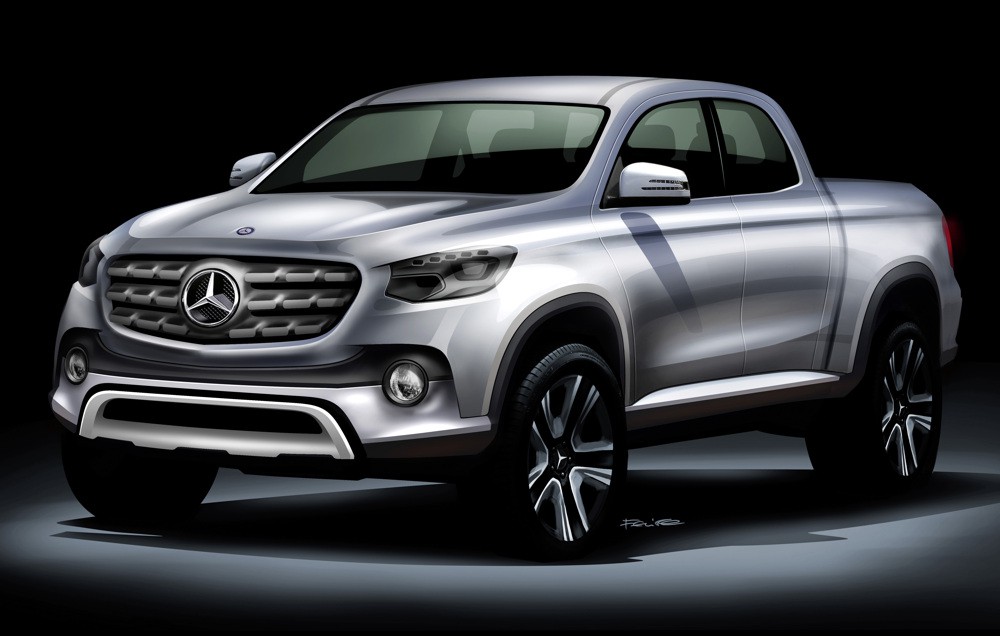
Roland Zey must have broken into a broad smile yesterday. Mercedes-Benz will finally make real the dream that the former head of the Argentine division, and current head of its Sales Control and Development department, confessed in May 2013: to launch a new pick-up that features the silver three-pointed star emblem on its grille.
The news, which the Wall Street Journal and the North American edition of Car and Driver, among others, confirmed was not an April Fools’ joke ahead of the Anglo-Saxon 1 April, is striking, but is not a novelty in the history of the Stuttgart brand. As some of you may know, both the company itself and small coachbuilders built other pick-ups in the past with Daimler’s authorisation. In this article we are going to gather the data on the best-known ones.
With a 38 CV engine they could carry 750 kg. 1,098 units were built between 1946 and 1949.
A hardworking nature from the outset
The W136 pick-ups were born to facilitate the transport of materials needed to rebuild what was destroyed in World War II.The first pick-up to carry the Mercedes-Benz emblem was built by the company itself. It was based on the versatile 170 V W136, the only model for which a sufficient amount of documentation had survived after the Second World War, and it was created in response to the production restrictions imposed on Germany by the United States Government and the need to rebuild everything devastated by the war, including the brand’s factories such as the one at Sindelfingen – which, incidentally, celebrates its centenary in 2015.
Between 1946 and 1949, 1,098 units of these Pritschenwagen – the German term for this type of vehicle – were assembled. 440 of them were allocated to the German police. They were powered by the M136 I four-cylinder, 1.7-litre engine that produced 38 CV, coupled to a six-speed manual gearbox. These pick-ups could carry 750 kg and their GVW reached 2,100 kg.
These variants allowed the brand to increase its presence in certain countries because they helped it overcome customs difficulties.
Overcoming obstacles
The 170 D and SD pick-ups had greater representation in Argentina and South Africa due to the role they played in entering those markets.The same W136 platform was used to design new pick-ups that allowed certain countries to access the Mercedes-Benz range through these practical vehicles. Although they are also remembered in Australia and New Zealand, Argentina and the Union of South Africa, where the pick-ups are called bakkies, were the main driving forces behind their manufacture due to the deficient road and rail networks, an outdated fleet of commercial vehicles and the peculiarities of their laws concerning the importation of vehicles and their manufacture.
Founded in 1951, Mercedes-Benz Argentina, SRL began assembling the pick-ups based on the 170 Da W136 in 1952 at its facilities in San Martín, an activity that continued until shortly before its closure when it was taken over in 1955 by the Revolución Libertadora. They were powered by the OM 636 diesel engine of identical displacement and power to the one mentioned above.
At that time, the presence of Mercedes-Benz in South Africa was also quite meagre. The legislation of that country imposed higher tariffs on passenger cars than on commercial vehicles. The German company wanted to increase its sales, so its main local distributor devised a way to circumvent that restriction.
According to Fred Schnetler in his work Progress, Passion and People, the Making of Daimler Chrysler South Africa (2002, Daimler Chrysler South Africa), the Johannesburg headquarters, with the support of its engineer Heinz Grossman, decided to import only the front section of the bodywork of the 170 D/SD, a strategy that helped to save costs.
When the units arrived in South Africa, the local company Morewear Industries added the rear body at its factory in Germiston, a town on the outskirts of Johannesburg. The activity lasted until the middle of the 1950s, a period similar to that of Mercedes-Benz Argentina.
The most famous Ponton pick-ups were created by a German coachbuilder and South African importers.
The Ponton pick-ups
The South African ones were distinguished from those by Binz by the separation between the cab and the bed and the spare wheel hidden behind the driver’s seat.The pick-ups built on the W136 gave way to similar bodies mounted on the W120 and W121. There were two variants: one designed by the German coachbuilder Binz based in Lorch – whose catalogue also included other Ponton conversions into estates, ambulances, etc. – and another developed by Daimler AG’s South African importers Cargo Motors, NMI, Stanley Porter, Haaks Garage, Ronnie’s Motors and John Williams. They differed in details such as the separation between the cab and the cargo area or the position in which the spare wheel was placed.
Daimler’s archives state that 1,098 180 pick-ups were produced between 1955 and 1962, 2,439 180 D in an identical time span – the diesel variants were more popular – and only 136 examples of the 190 D with this body between 1958 and 1961. The South African market registered some 400 of these vehicles, which were intended not only for private owners but also for other services such as Johannesburg airport.
The OM 615 engine that came as standard on the 220 D was not altered in this conversion.
The Argentine 220 D
The coachbuilder El Detalle from Santa Fe was responsible for transforming the W115 chassis imported from Germany into pick-ups.Mercedes-Benz Argentina regained prominence in the field of pick-ups adorned with the famous star at the beginning of the 1970s. Tariff policy prevented the import of finished passenger cars, but not of loose parts of the bodywork and mechanical components that would later be used to assemble commercial models – never passenger cars.
In pursuit of the goal of gaining market share locally, Mercedes-Benz Argentina imported 1,044 220 D W115 chassis with the doors and other components separately, like a genuine jigsaw puzzle. The coachbuilder from the Argentine city of Santa Fe, El Detalle, known for working on buses mounted on Mercedes-Benz bus chassis, then converted those 220 Ds into pick-ups with a monocoque body with single or double cab, ready for distribution to the public.
The engine underwent no modifications: it remained the OM 615 diesel of 2.2 litres that produced 60 CV of power, coupled to a four-speed manual transmission. They could carry up to 650 kg, less than the W136, although logically they were a much more evolved product. One even appeared in the cinema, specifically in the Argentine film Millonarios a la fuerza directed by Enrique Dawi and released in 1979.
Sources | Coche Argentino, Cuyo Motor, Daimler AG, Foro TC Urbano, Mbzponton.org: production figures and history of the variants, Oldtimer-Foren and test of a 170 Da pick-up on Drive-MY.
Photos | Daimler AG, MB Oldtimer Bus/Trucks/Transporter on Pinterest and Zeke P. on Flickr


 Peugeot E-208 GTi: a battery-powered toy that revives the spirit of the 1980s sports cars
 New Lexus ES: luxury grows and goes electric
 First contact with the Dacia Sandero Hybrid 155: power and efficiency from €19,890
un comentario
Deja un comentario
Que tal, El Detalle NO ERA DE SANTA FE, sino que del norte del Gran BUENOS AIRES.
MÁS INFO EN -> http://camionargentino.blogspot.com.ar/2012/05/el-detalle.html