Goodyear vs Firestone, the parallel war behind Ford vs Ferrari at Le Mans 66´
 Alvaro Avilés
13 November 2019
4 min.
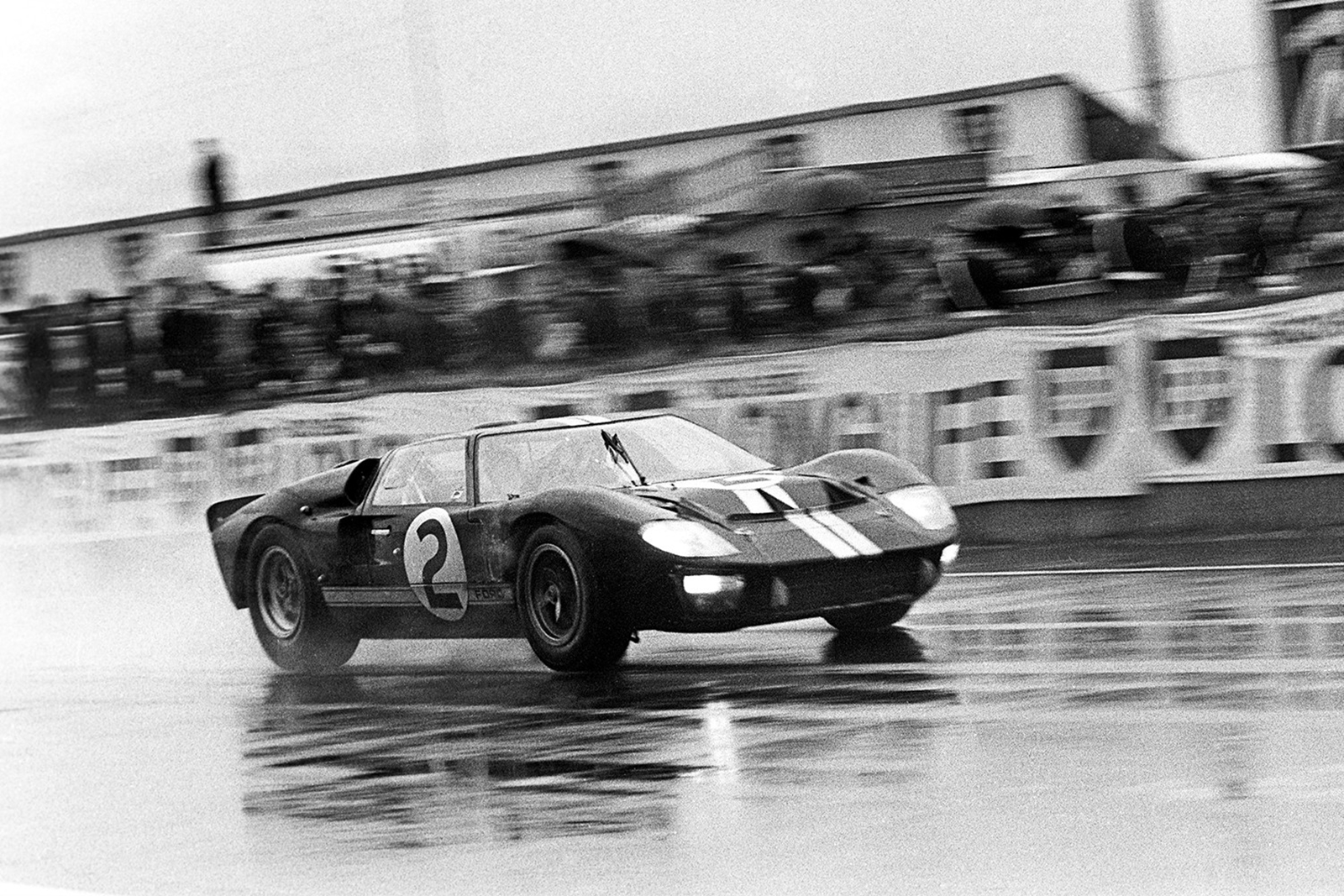
The 1966 24 Hours of Le Mans was one of the races to remember because of the historic defeat of Ferrari at the hands of Ford. However, there was also a parallel tyre war, fought by Goodyear vs Firestone, which we tell you about
The film Le Mans 66´ hits cinemas this Friday, 15 November, as one of the most anticipated films for all motor enthusiasts. We have already shown you the trailer for the film, based on the war at the 1966 24 Hours of Le Mans between Ford and Ferrari.
Although in this story told in the film starring Matt Damon and Christian Bale, Ford was the clear winner and Ferrari the loser, another parallel battle was also fought: the tyre war. In it, two manufacturers of American origin clashed in what was a genuine civil war: Goodyear vs Firestone.
Goodyear has always been an innovative brand, and without going any further, it was the first company to look into autonomous driving. This happened in 1956, and the star was the Golden Sahara II, the first autonomous vehicle that Goodyear decided to put on the carpet of the Geneva Motor Show that same year.
The Goodyear vs Firestone war erupted with the race underway
To understand this battle, we need to set the scene, because the 1966 edition of the 24 Hours of Le Mans began with a torrential downpour. Ford and Shelby American had put a fleet of three Ford GT40s on the asphalt of the La Sarthe circuit: number 1 of Ken Miles/Denny Hulme (the protagonists of Le Mans 66´), number 2 of Bruce McLaren/Chris Amon, and number 3 of Dan Gurney/Jerry Grant.
Cars 1 and 3 were shod with Goodyear tyres, but car number 2, painted black and driven by Bruce McLaren, started the race on Firestone tyres. Although the first two had no problems with the water on the track, Bruce McLaren’s car began to lose pieces of its tread on the Mulsanne straight, travelling at 337 km/h.
McLaren knew perfectly well that his goal was to fight for victory and that he would not be able to do so on Firestone tyres. For that reason, he took advantage of the driver change with Chris Amon to seek out the Firestone representative and express his dissatisfaction to such an extent that, on the spot, they decided to fit Goodyear tyres.
Therefore, the three Ford GT40s developed by Shelby American to defeat the Ferrari fleet were already running on Goodyear tyres. The race unfolded with some blatant battles on the track, above all between Ken Miles and Lorenzo Bandini, a Ferrari driver.
Once the night had passed, Ford GT40 number 3 had to retire and the Ferrari cars were out of contention, so three Ford drivers were at the head: Ken Miles, Bruce McLaren and Ronnie Bucknum of the Holman & Moody team.
Ford and Goodyear reached success hand in hand
So that the imminent victory would sting even more in Maranello and, especially, for Enzo Ferrari himself, Ford decided that its three cars would cross the finish line together, to capture a photo that has gone down in competition history.
This wish was coordinated so well that Ford GT40 number 1 of Ken Miles and number 2 of Bruce McLaren crossed the chequered flag completely side by side. Although the victory should really have gone to Ken Miles and Denny Hulme, who had fought for the win from the start, the final result was different.
The organisers decided to award the victory to Bruce McLaren, since, despite a technical tie, car number 2 had started the race from a further-back position. Therefore, under the regulations, this car had covered more metres and deserved the win.
This final decision has been one of the most controversial in motor racing history and, in fact, the debate is still open. However, if one thing became clear, it is that the great winners of the 1966 24 Hours of Le Mans were Ford and Goodyear, since, had it not been for the tyre brand, Bruce McLaren would not only have failed to take the victory but probably would not even have been able to finish the race.


 Peugeot E-208 GTi: a battery-powered toy that revives the spirit of the 1980s sports cars
 New Lexus ES: luxury grows and goes electric
 First contact with the Dacia Sandero Hybrid 155: power and efficiency from €19,890
Comentarios cerrados