Honda continues to bet on hydrogen, and these are its plans
 Antonio Roncero @roncero_antonio
2 February 2023
4 min.
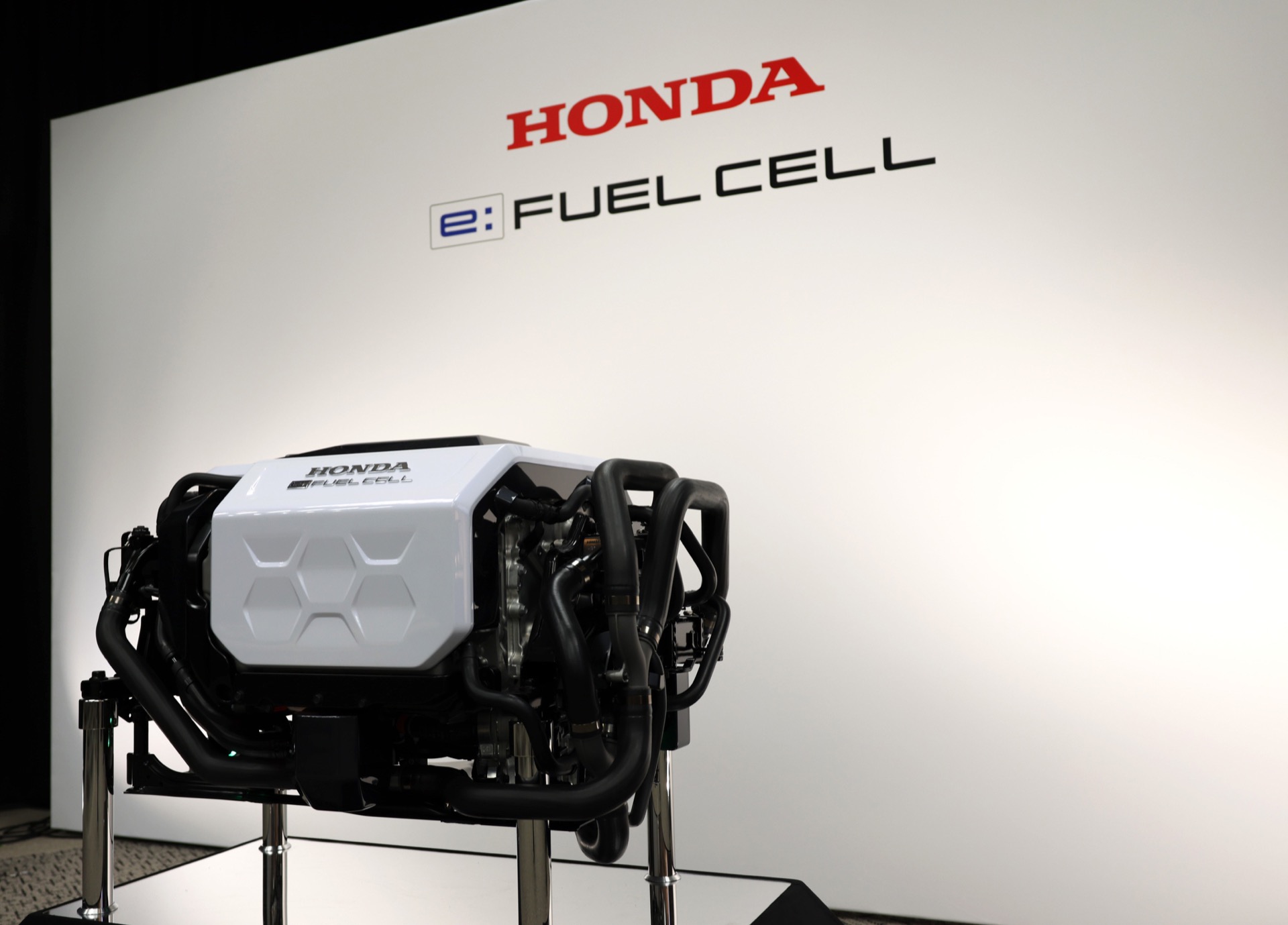
At Honda they are betting on hydrogen as the fuel of the future, and to do so they have ambitious development plans that include the launch of a new fuel cell model by 2024.
Honda has a plan: to keep moving forward and expand its hydrogen-based business. And to carry it out, the Japanese brand will not focus solely on fuel cell electric vehicles (FCEV), but will also pay special attention to the commercial vehicle sector, power generation plants and construction machinery. In addition, Honda will continue developing hydrogen technology with a view to its future application in the field of space engineering.
Honda’s idea is to expand as far as possible the applications of its fuel cell system not only for its own vehicles, but also for internal and external applications, thereby boosting demand for green hydrogen. Let us recall that Honda has been researching this technology for more than three decades. Its first production hydrogen car, the Honda FCX Clarity, which was advanced for its time, was presented in 2007 and sold between 2008 and 2015 without much success. It was followed by the second generation, the Clarity, which remained on the market until its production ceased in 2021.
A new fuel cell car for 2024
Now, with a completely different market situation, hydrogen is once again taking center stage in Honda’s strategy to achieve carbon emissions neutrality by 2050. To do this, as a first step, Honda will launch in 2024 a new model based on the Honda CR-V equipped with a new generation of fuel cells, on which the brand has been working together with General Motors for ten years.
Initially it will only be sold in North America and Japan, and it promises a reduction in the cost of the fuel cell to one third of the system fitted to the last Honda Clarity FCEV, with twice the durability and a notable improvement in resistance to low temperatures, thanks, among other measures, to the use of innovative electrode materials and a new cell sealing structure. And this is only a first step, since by 2030 Honda expects to halve the cost and double the durability of its future fuel cells compared with those presented in 2024. By then, a fuel cell car is expected to cost the same as an equivalent one equipped with a diesel or petrol engine.
Trucks, machinery and other hydrogen applications
But Honda will not focus only on its FCEV models. The brand plans to start selling its fuel cell system modules from mid-2020 for other applications, with an initial target of around 2,000 units a year, rising to 60,000 units a year by 2030 and exceeding 200,000 units a year from 2035.
The properties of the fuel cell will gain importance as a power source in all mobility-related products that require rapid refuelling and in which it is not easy to apply battery-only technology. In addition, Honda proposes systems connecting several fuel cells in parallel, to reach even greater power outputs. Among the possible fields of application for this technology, Honda considers commercial vehicles, construction machinery such as excavators or wheel loaders, and stationary power generation plants.
Also this January, Honda has started road tests in China of trucks with the new-generation fuel cell system in collaboration with Dongfeng. And by March 2024, Honda will begin road tests in Japan of a fuel cell truck prototype developed together with Isuzu.
As for power generation systems, Honda has installed a stationary plant with 500 kW of capacity at the campus of American Honda Co., Inc, in California, reusing fuel cells from Honda Clarity vehicles, to serve as backup power for the data centre. The idea is to apply this technology in the data centres of all Honda factories around the world.
Related information of interest


 Peugeot E-208 GTi: a battery-powered toy that revives the spirit of the 1980s sports cars
 New Lexus ES: luxury grows and goes electric
 First contact with the Dacia Sandero Hybrid 155: power and efficiency from €19,890
Deja un comentario