Electric Cars Comparisons Family
How to Choose a Family Electric SUV in 2026: Range, Boot Space and Real Charging Costs
 Dani Montesinos
31 July 2026
7 min.
A guide to choosing a family electric SUV based on range, boot space, charging costs and TCO. Recommendations by usage profile and models available in Spain.
Choosing a family electric SUV in 2026 has become a more nuanced exercise than it seems. Looking at the WLTP figure and signing on the dotted line is no longer enough. You need to weigh real-world range, boot capacity, charging architecture and cost per kilometre. And do it with an eye on how an average Spanish family will actually use the car: short daily trips, a couple of long journeys a year and the eternal question of whether the home socket is up to the job.
Why 2026 is a good year to make the leap to the family electric SUV
The offer has widened. There are 800 V platforms trickling down to lower price ranges, cheaper LFP batteries and a fast-charging network that, although uneven, already makes it possible to cross the Iberian Peninsula without engineering-level planning. The segment’s average price remains above that of its combustion equivalent, admittedly, but the gap is narrowing.
The state of the Spanish electric car market in 2026
Spain still lags behind Germany or the Netherlands in electric penetration, but the range available is practically the same. Korean, German, French and Chinese brands are competing for the same customer. What’s interesting: prices range from €38,000 for a Renault Scenic E-Tech to €60,000 for a well-equipped Mercedes EQB. There’s plenty to choose from.
What has changed compared with 2024-2025
Two things. First, charging curves are flatter and more sustained — it’s no longer enough to look at the peak kW figure. Second, OTA software has become a genuine purchasing criterion: a car that improves over time versus one that stays stuck.
Real-world range vs WLTP range: what to really look at
WLTP is optimistic. Not scandalously so, but it is. On the motorway at 120 km/h, an average electric SUV drops to around 70-75% of its homologated figure. In the city it can exceed it. For a family that drives 15,000 km a year with two or three long trips, the useful figure is the motorway one, not the mixed one.
How to interpret WLTP range for real family use
Practical rule: multiply the WLTP figure by 0.75 if you’ll be travelling loaded, with a roof rack, or with children who demand full heating in January. If the result doesn’t exceed 350 real-world km, forget about doing Madrid–Valencia without stopping.
Motorway, city and long journey: three different scenarios
On the motorway consumption shoots up, and this is where the models with good aerodynamics and large batteries separate the wheat from the chaff. In the city, any decent electric car does the job. The key scenario is the long journey: how many stops, how long they take, and whether the charging curve holds up to 80%.
Boot space: the criterion that matters most (and is most often forgotten)
Boot space in an electric SUV rules in a family. A pushchair, two large suitcases and the dog’s bag won’t fit just anywhere.
Usable litres vs catalogue litres
Manufacturers measure in their own way. A 500-litre boot from VW is not the same as a 500-litre one from Tesla — shape matters as much as volume. Prioritise usable height and the regularity of the opening.
Seat configuration and modularity
Rigid or roll-up parcel shelf, 40/20/40 folding backrests, double floor, front frunk… Details that matter more in day-to-day life than 20 extra km of range.
The real cost of charging: what nobody tells you clearly
The cost of charging an electric car is where TCO is decided. Charging at home overnight on an off-peak tariff works out at around €3-4 per 100 km. At an ultra-fast charger on the motorway, the figure shoots up to €15-20 per 100 km. Yes, you read that right.
Home charging vs public fast charging
If you have a garage with a socket, an electric car is unbeatable. If you depend on the public fast-charging network, the saving compared with an efficient diesel evaporates.
Kilowatt-hours, tariffs and day-to-day tricks
Subscriptions from providers such as Iberdrola, Repsol or Ionity bring the price per kWh for fast charging down to reasonable levels. Without a subscription, be prepared to pay €0.65–0.75/kWh at premium chargers.
The best family electric SUVs on sale in Spain in 2026
Kia EV6 — from €40,820
The Korean benchmark. 800 V E-GMP platform, exemplary fast charging and a design that hasn’t aged. 490-litre boot, just enough for a family of four. In our view, it still strikes one of the best balances between sportiness and practicality.
| Power kW | Power CV | Top speed | Range | Consumption | Label | Fuel |
|---|---|---|---|---|---|---|
| 168 kW | 229 CV | 185 km/h | 528 km | 15.9 kWh/100 km | ZERO | Electric |
Hyundai Ioniq 5 — from €34,335
The technical sibling of the EV6, but with a squarer body and surprisingly spacious interior. The trick: a 3-metre wheelbase. Three adults fit comfortably in the back.
| Power kW | Power CV | Top speed | Range | Consumption | Label | Fuel |
|---|---|---|---|---|---|---|
| 168 kW | 229 CV | 185 km/h | 570 km | 16.8 kWh/100 km | ZERO | Electric |
Tesla Model Y — from €40,760
The best-selling car in the segment for a reason. Its own Supercharger network, impeccable software and low consumption thanks to its aerodynamics. Minimalist interior: for those who appreciate it; for those who don’t, a wasteland.
| Power kW | Power CV | Top speed | Range | Consumption | Label | Fuel |
|---|---|---|---|---|---|---|
| 220 kW | 299 CV | 201 km/h | 600 km | 14.1 kWh/100 km | ZERO | Electric |
Skoda Enyaq — from €36,255
The most sensible family electric car. Enormous boot (585 litres), sober but well-resolved interior and a restrained price. No fireworks, but it works.
| Power kW | Power CV | Top speed | Range | Consumption | Label | Fuel |
|---|---|---|---|---|---|---|
| 140 kW | 190 CV | 160 km/h | 456 km | 15.9 kWh/100 km | ZERO | Electric |
Volkswagen ID.4 — from €34,165
The “electric SUV for those who want a VW”. Nothing more, nothing less. The software has improved with the latest updates. Strangely, the interior feels a step below the Enyaq.
| Power kW | Power CV | Top speed | Range | Consumption | Label | Fuel |
|---|---|---|---|---|---|---|
| 210 kW | 286 CV | 180 km/h | 561 km | 15.7 kWh/100 km | ZERO | Electric |
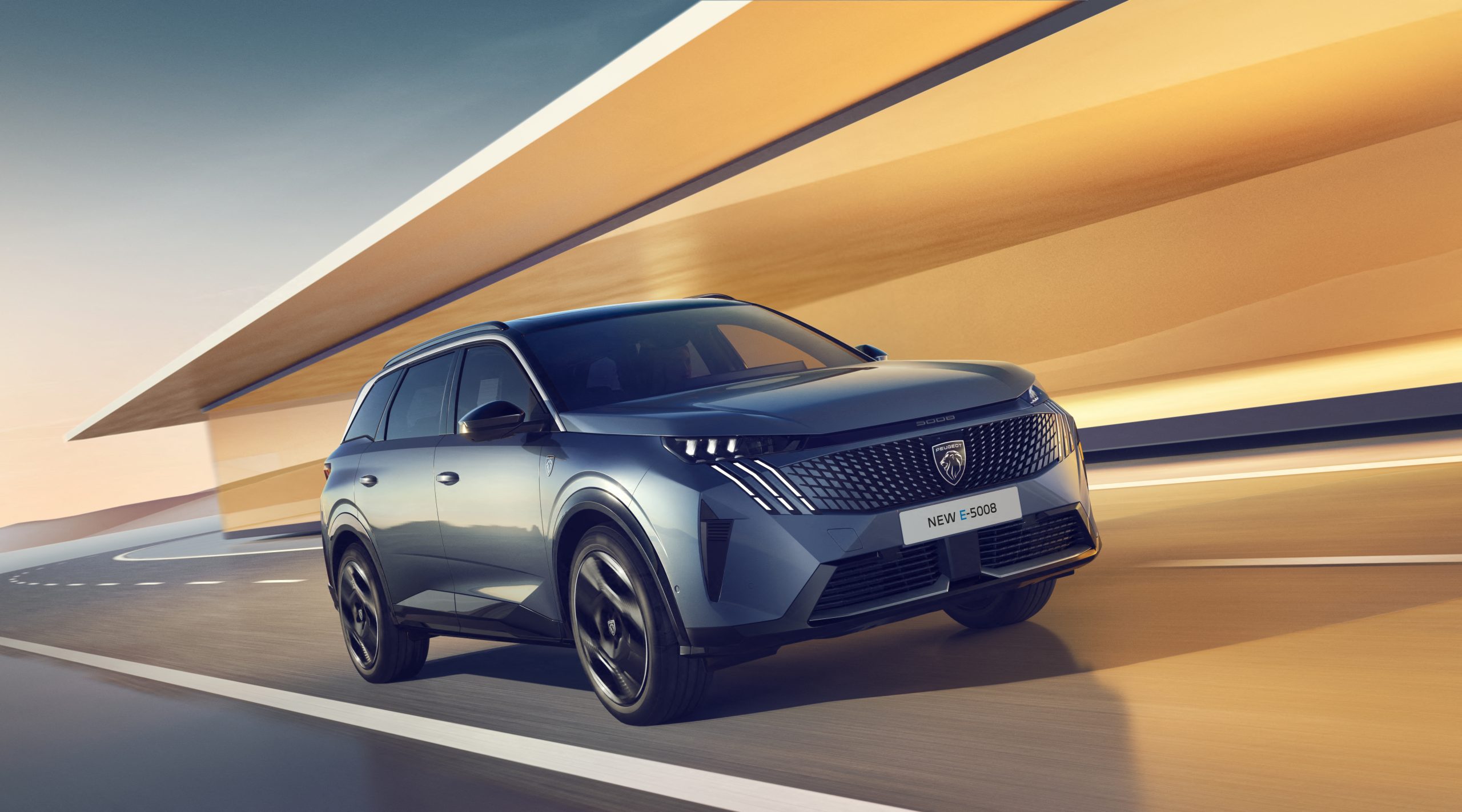
Peugeot E-5008 — from €44,500
A genuine 7-seat electric SUV, not a compromise. STLA Medium platform, revised i-Cockpit and a flexible boot. For large families it’s one of the most complete options on the market.
| Power kW | Power CV | Top speed | Range | Consumption | Label | Fuel |
|---|---|---|---|---|---|---|
| 157 kW | 210 CV | 170 km/h | 500 km | 17.8 kWh/100 km | ZERO | Electric |
Renault Scenic E-Tech — from €41,160
The revival of the Scenic as an electric. Good consumption, integrated Google technology and an aggressive price. The most “French family car” of the lot.
| Power kW | Power CV | Top speed | Range | Consumption | Label | Fuel |
|---|---|---|---|---|---|---|
| 160 kW | 220 CV | 170 km/h | 623 km | 16.8 kWh/100 km | ZERO | Electric |
Comparison: which family electric SUV to choose according to your profile
Urban family with access to home charging
Renault Scenic E-Tech or Skoda Enyaq. Sufficient range, and a ridiculously low cost per km when charging at home.
Travelling family with frequent long journeys
Kia EV6 or Hyundai Ioniq 5. The 800 V architecture makes all the difference when you stop every 300 km.
Large family needing 7 seats
Peugeot E-5008. Not much else to choose from in the segment.
Summary table: family electric SUV 2026 at a glance
| Model | Price from | Range | Boot | Score |
|---|---|---|---|---|
| Kia EV6 | €40,820 | 528 km | 490 L | 9.0 |
| Hyundai Ioniq 5 | €34,335 | 570 km | 527 L | 8.8 |
| Tesla Model Y | €40,760 | 600 km | 854 L | 9.2 |
| Skoda Enyaq | €36,255 | 456 km | 585 L | 8.7 |
| Volkswagen ID.4 | €34,165 | 565 km | 543 L | 8.2 |
| Peugeot E-5008 | €44,500 | 500 km | 748 L | 8.5 |
| Renault Scenic E-Tech | €41,160 | 623 km | 545 L | 8.9 |
FAQ
Which family electric SUV should I buy in 2026?
It depends on use. For an urban family with a home socket, the Renault Scenic E-Tech or Skoda Enyaq. For frequent long journeys, the Kia EV6 or Hyundai Ioniq 5 thanks to their 800 V charging. For genuine seven seats, the Peugeot E-5008.
How much real-world range does a family electric SUV need?
At least 450 km WLTP to get 320-340 real-world km on the motorway. Below that, long journeys become complicated with stops every two hours.
How much does it cost to charge an electric SUV per month?
Charging at home on an off-peak tariff, between €40 and €60 a month for 1,200 km. On the public fast-charging network, the figure can easily triple.
Is an electric SUV worth it if I don’t have a garage?
Only if you have regular access to a semi-fast charger nearby at less than €0.35/kWh. If you depend on fast charging on the motorway, the saving compared with a good hybrid is diluted.


 Peugeot E-208 GTi: a battery-powered toy that revives the spirit of the 1980s sports cars
 New Lexus ES: luxury grows and goes electric
 First contact with the Dacia Sandero Hybrid 155: power and efficiency from €19,890
Deja un comentario