500e Fiat Hyundai Inster Electric Cars
Hyundai Inster or Fiat 500e: pitting two icons of urban electric mobility against each other
 Iván Navarro
10 March 2026
5 min.
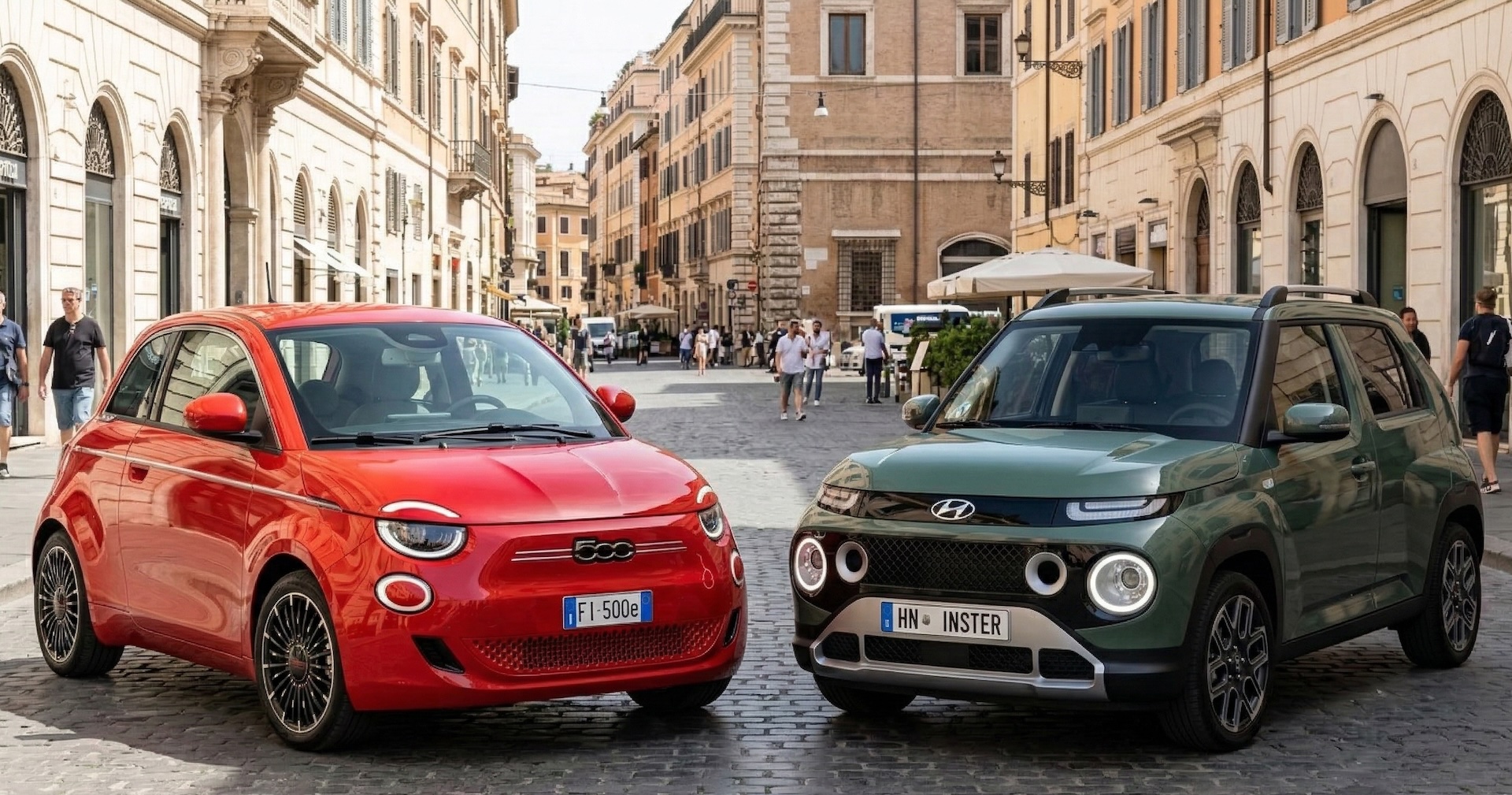
The FIAT 500e and the Hyundai Inster are currently two of the most interesting options on the market for anyone looking for an electric vehicle for urban mobility. Below we analyse them face to face.
This comparison analyses the main features of the Hyundai Inster against the Fiat 500e, focusing on performance, comfort, connectivity and maintenance costs, to guide users looking for a compact electric car for urban and peri-urban use.
Introduction
In 2026, the urban electric segment maintains a consolidated presence in Spanish registrations and continues to adapt to demands for more efficient and connected mobility. The comparison focuses on two models that represent different approaches to urban electric cars: one with an emphasis on space and practicality, and another with a focus on compact design and city mobility.
Both models were selected for their relevance in urban environments and for offering comparable alternatives in size and real-world use. In 2026, expectations of real-world range, cost per kilometre and user experience are decisive criteria for those who value electric mobility.
Context of the comparison
Who tends to hesitate between these two models: drivers who prioritise manoeuvrability and low running costs versus users who value interior space and technology equipment on mixed urban-peri-urban journeys. The choice depends on usage pattern, boot space needs and connectivity preferences.
In 2026, emissions regulations and urban charging infrastructure condition the practical usefulness of each proposal, so comparing WLTP range against real consumption and charging times is essential.
Key differences in approach
Hyundai Inster
An approach oriented towards practicality and interior space, with a solution designed for urban use with occasional inter-urban trips. Its positioning seeks a balance between comfort and everyday efficiency.
Fiat 500e
A compact, urban approach that prioritises small size, ease of parking and a distinctive exterior design. It is designed for mostly urban journeys and short trips.
Comparison by objective criteria
Interior space
The Hyundai Inster offers more rear passenger space and a driving position designed for longer journeys. The Fiat 500e has a smaller cabin, efficient for two adults and children on short trips.
Boot
Cargo volume is a differentiator for family use or occasional deliveries: larger in the Inster, more limited in the 500e, which affects versatility on trips with luggage.
Powertrains and efficiency
Both are 100% battery electric (BEV). The Inster is geared towards a more powerful motor for comfort on peri-urban roads; the 500e prioritises a balance between consumption and compactness. WLTP range is indicative; real consumption varies with urban driving pattern and climate.
Relevant technology
Both incorporate connectivity for navigation and charging management. The Inster usually offers screens and assistants with a comfort focus; the 500e includes basic integrations optimised for urban use.
Driving experience
Inster: stable and comfort-oriented driving. 500e: agility in the city and a small turning circle. The feel in town depends on the suspension tuning and the response of the one-pedal regenerative braking.
Comparative table of key data
| Model | Engine type | Power (CV) | WLTP range/consumption | Top speed | Dimensions (L x W x H mm) | Boot (L) |
|---|---|---|---|---|---|---|
| Hyundai Inster | Battery electric BEV, rear-axle motor/direct drive | 136 CV (range 136–170 CV depending on version) | WLTP: 320–360 km (depending on battery) | 160 km/h | 4050 x 1780 x 1520 | 330 |
| Fiat 500e | Battery electric BEV, front-axle motor | 118 CV | WLTP: 300–320 km | 150 km/h | 3570 x 1680 x 1520 | 185 |
Price and real cost
Hyundai Inster (from 29,900 €*)
The final price varies by trim level, chosen battery, driver-assistance options and financing promotions offered by the dealer network.
Fiat 500e (from 27,900 €*)
The final price depends on the version (standard or larger battery), optional equipment, connectivity packages and financing terms.
* Indicative price without applying public aid or the brand’s commercial discounts.
Purchase aid
Both models are pure electric; therefore, in Spain in 2026 they may be eligible for direct state aid (Plan Auto+) and regional or local subsidies. The amount and criteria vary by autonomous community and by compliance with requirements (new registration, scrappage, etc.).
The prices indicated above do not include possible direct discounts or regional or municipal incentives applicable in 2026.
Advantages and limitations of each model
Hyundai Inster
Advantages: 1) Greater interior space and boot for mixed urban-peri-urban use. 2) Battery options with greater WLTP range.
Limitations: 1) Larger dimensions that make parking in very narrow spaces difficult. 2) Slightly higher base price, influenced by equipment and battery.
Fiat 500e
Advantages: 1) Compactness and manoeuvrability in the city; small turning circle. 2) Exterior design and urban positioning that make it easy to use in dense environments.
Limitations: 1) Limited boot, less versatility for cargo. 2) More constrained useful range for long peri-urban trips.
Which user each model suits best
If the priority is space for occupants and occasional cargo and frequent peri-urban journeys are made, the Hyundai Inster is more suitable. If you are looking for a vehicle essentially for the city, easy to park and manoeuvre, with compact design, the Fiat 500e fits better.
When to move on to a ranking or buying guide
When the decision-maker has defined quantifiable variables (annual kilometres, boot needs, access to charging points and final budget with financing), it is worth moving on to a buying guide or comparative ranking that includes operating costs and detailed dynamic tests. This step makes it possible to check real cost per kilometre and satisfaction in daily use.
This comparison is based on market data, official specifications and published tests, and reflects the state of the segment in the Spanish market in 2026.
Technical specifications of this car


 Kia offers an electric range of 10 models, 50 versions and 400 possible combinations
 The seven finalists for the 2027 European Car of the Year (COTY) are exclusively electric
 Peugeot E-208 GTi: a battery-powered toy that revives the spirit of the 1980s sports cars
Deja un comentario