Hyundai KIA RAV4 Santa Fe Sorento Toyota Tucson Hybrid Cars Comparisons Family Tests SUV
Hyundai Santa Fe vs KIA Sorento hybrids: which seven-seat family SUV offers more value under 55,000 euros
 Iván Navarro
17 August 2026
6 min.
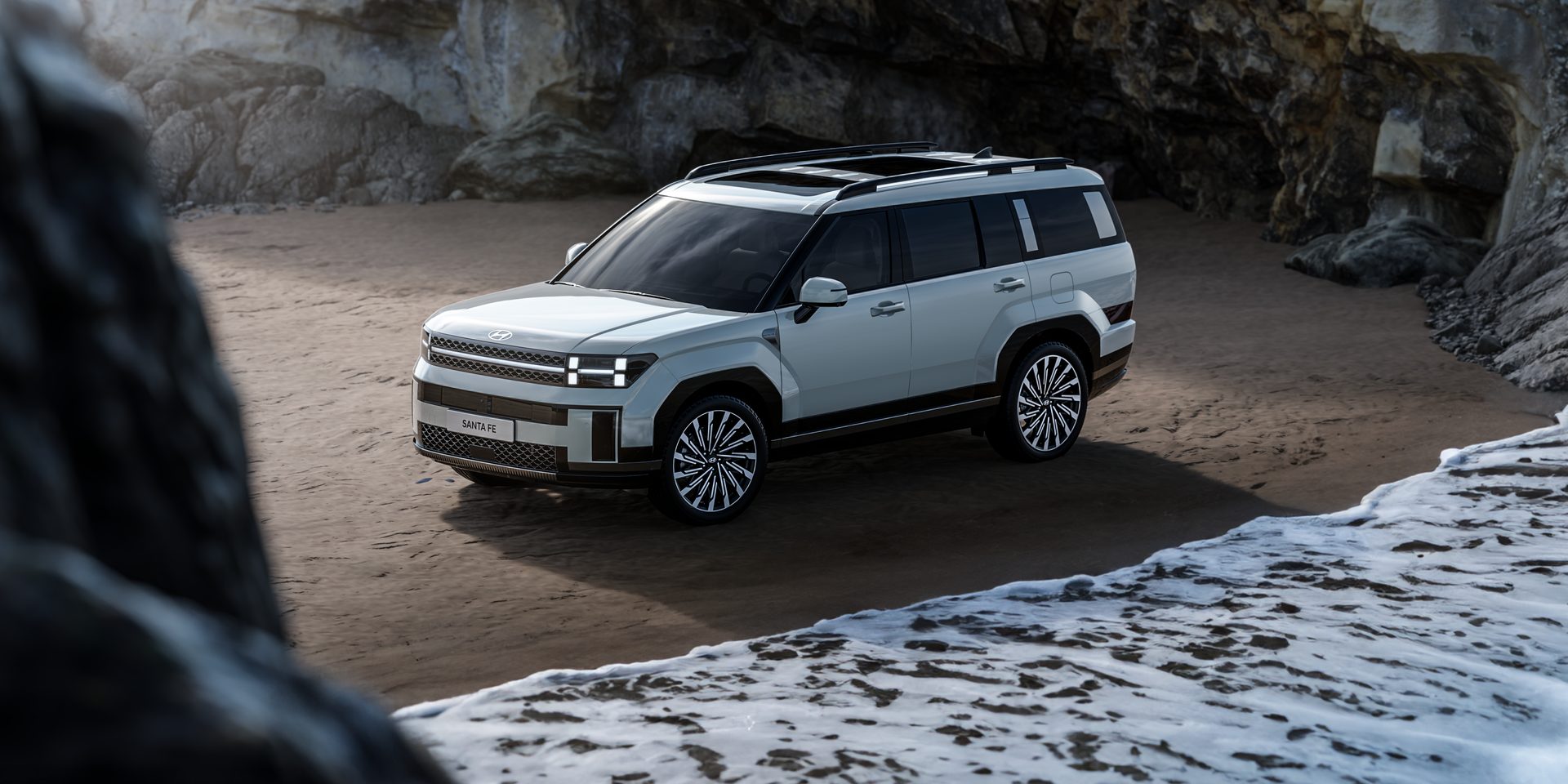
We compare the Hyundai Santa Fe HEV and the KIA Sorento PHEV, two Korean seven-seat SUVs with different hybrid approaches, to find out which offers better real value for Spanish families.
Two cousins, two philosophies. The Hyundai Santa Fe and the KIA Sorento share a platform, Korean DNA and a family focus, but each tackles electrification in its own way. One opts for the hybrid, simple and straightforward. The other goes a step further with the plug-in hybrid and its CERO label. The question is inevitable: which makes more sense for a Spanish family looking for seven genuine seats without crossing the psychological barrier of 55,000 euros?
Why compare these two Korean SUVs?
Both play in the same league —a mid-size seven-seat family SUV with at least an ECO label— and both come from the same parent company. That makes them obvious references for anyone seeking space, proven reliability and long warranties (seven years with KIA, five with Hyundai). The nuance lies in the powertrain: HEV versus PHEV. And that nuance changes everything, from the price to the tax treatment and daily use.
The approach of the Hyundai Santa Fe HEV
The new Santa Fe has taken a dramatic styling turn. Its boxy design, almost like a military vehicle reinterpreted in a premium key, does not leave anyone indifferent. Inside, there are two panoramic screens, carefully chosen materials and a cabin that feels spacious all around. The third row —the eternal pending subject of this segment— is usable here for adults on short journeys, something not all rivals can claim.
Hyundai Santa Fe HEV, from ≈56,000 €
Under the bonnet is a 1.6 T-GDi hybrid that combines petrol and electric motor to deliver around 240 CV combined. A simple system, no cables, no charging planning. You fill up at the petrol station and that’s that. For many families, in practice, that is a weighty argument.
| Power kW | Power CV | Top speed | Range | Consumption | Label | Fuel |
|---|---|---|---|---|---|---|
| ≈180 kW | ≈240 CV | ≈200 km/h | Data not available | ≈6.5 l/100 km | ECO | Petrol hybrid |
The approach of the KIA Sorento PHEV
The Sorento plays a different game. More substantial in its design, more sober, with an almost high-end American crossover look. Its interior shares the Santa Fe’s philosophy —they share electronic architecture— although with a somewhat more classic ambience. Here there is a serious battery: 14 kWh, good for around 60 kilometres of homologated electric range, enough for a city user to forget about petrol during the week.
KIA Sorento PHEV, from ≈61,400 €
The 1.6 T-GDi combined with the electric motor delivers around 250 CV and standard four-wheel drive in this configuration. The CERO label opens the doors of Madrid’s ZBEDEP Distrito Centro and beyond without friction. Of course, it has to be plugged in. If it isn’t, the homologated consumption of 1.5 l/100 becomes a bad joke —in depleted mode, this car demands its petrol ration like any conventional hybrid. Heavy, and with a battery you have to haul around.
| Power kW | Power CV | Top speed | Electric range | Consumption | Label | Fuel |
|---|---|---|---|---|---|---|
| ≈190 kW | ≈250 CV | ≈180 km/h | ≈60 km | ≈1.5 l/100 km | CERO | Petrol/plug-in PHEV |
Real price and the 55,000-euro trap
Let’s be honest: on paper, neither of the two comes in below 55,000 € at the official RRP. The Santa Fe HEV starts at around 56,000 € and the Sorento PHEV at around 61,400 €. That said, dealer discounts, commercial campaigns and manufacturer financing promotions come into play —with a little negotiation, the Santa Fe HEV can quite easily drop below that barrier. The Sorento PHEV has a harder time, though not impossible in specific deals or under the current Plan Auto+ scheme. Remember that these prices are recommended RRPs, without discounts, campaigns or public aid.
Real family use: who wins day to day
It depends on your routine. If you drive 30–40 km a day in the city and have a charging point at home or at work, the Sorento PHEV is unbeatable. You can run on electric almost all week and save the petrol for weekend trips. Without a plug, forget it —you’ll pay more for a car that consumes the same or worse than an HEV. If your profile is motorway driving, long trips and irregular mileage —say a Madrid–Cádiz run with the family and the boot packed to the roof—, the Santa Fe HEV makes more sense. Less weight, less complexity, predictable consumption.
Tax, label and LEZ
Here the Sorento comes out on top. The CERO label gives it free rein in the most restrictive Low Emission Zones, whereas the Santa Fe, with its ECO label, has a somewhat smaller margin in the medium term. If you live in central Barcelona or Madrid and use the car daily there, that difference matters. For those living outside those rings, it is a secondary factor. We made a similar comment about the Toyota Hyundai Tucson versus the Toyota RAV4 in the lower segment.
Roominess and third row
A technical tie with a slight advantage for the Santa Fe. Its more squared-off body design frees up a few key centimetres in the second and third rows. The Sorento is by no means bad, but the feeling of airy space is different. If you regularly carry seven people, the Hyundai will make life a little easier.
Summary comparison and score
| Model | Power | Consumption | Label | Price from | Score /10 |
|---|---|---|---|---|---|
| Hyundai Santa Fe HEV | ≈240 CV | ≈6.5 l/100 | ECO | ≈56,000 € | 8.4 |
| KIA Sorento PHEV | ≈250 CV | ≈1.5 l/100* | CERO | ≈61,400 € | 8.2 |
*Homologated consumption conditional on use with a charged battery.
Verdict: who offers more value for money
In our view, and measuring value for money invested, the Hyundai Santa Fe HEV is the most rational choice for the typical Spanish buyer. It costs less, consumes predictably without relying on a plug and offers the same —or better— roominess than its cousin. The Sorento PHEV shines if and only if you are going to exploit its plug-in nature every day. Without that use, the extra outlay does not pay off. That said, if you live in the heart of a big city and the CERO label is non-negotiable, the equation changes.
Frequently asked questions
Can the Santa Fe HEV be driven in Madrid’s ZBEDEP Distrito Centro?
Yes, with caveats. The ECO label allows circulation in the current Low Emission Zones, although regulations evolve and it is advisable to check current municipal rules.
How much real electric range does the Sorento PHEV have?
In real conditions, expecting between 45 and 55 electric km is reasonable against the 60 homologated km, depending on temperature, use of air conditioning and driving style.
Is the Sorento PHEV worth it if I can’t plug it in at home?
No. Without regular charging, the extra cost over the Santa Fe HEV is not recouped and real consumption soars when hauling a depleted battery.
Can these SUVs qualify for the Plan Auto+ aid?
The Sorento PHEV, given its plug-in nature and CERO label, fits as a natural candidate under the Plan Auto+ framework. Check the official website for updated amounts and conditions.
Technical specifications of the cars in this article


 Peugeot E-208 GTi: a battery-powered toy that revives the spirit of the 1980s sports cars
 New Lexus ES: luxury grows and goes electric
 First contact with the Dacia Sandero Hybrid 155: power and efficiency from €19,890
Deja un comentario