SERES Seres 5 Electric Cars ECO Tests SUV
I have driven the Seres 5 and the more I think about it, the clearer it becomes: the Chinese know how to build good cars
 Antonio Roncero @roncero_antonio
1 August 2024
11 min.
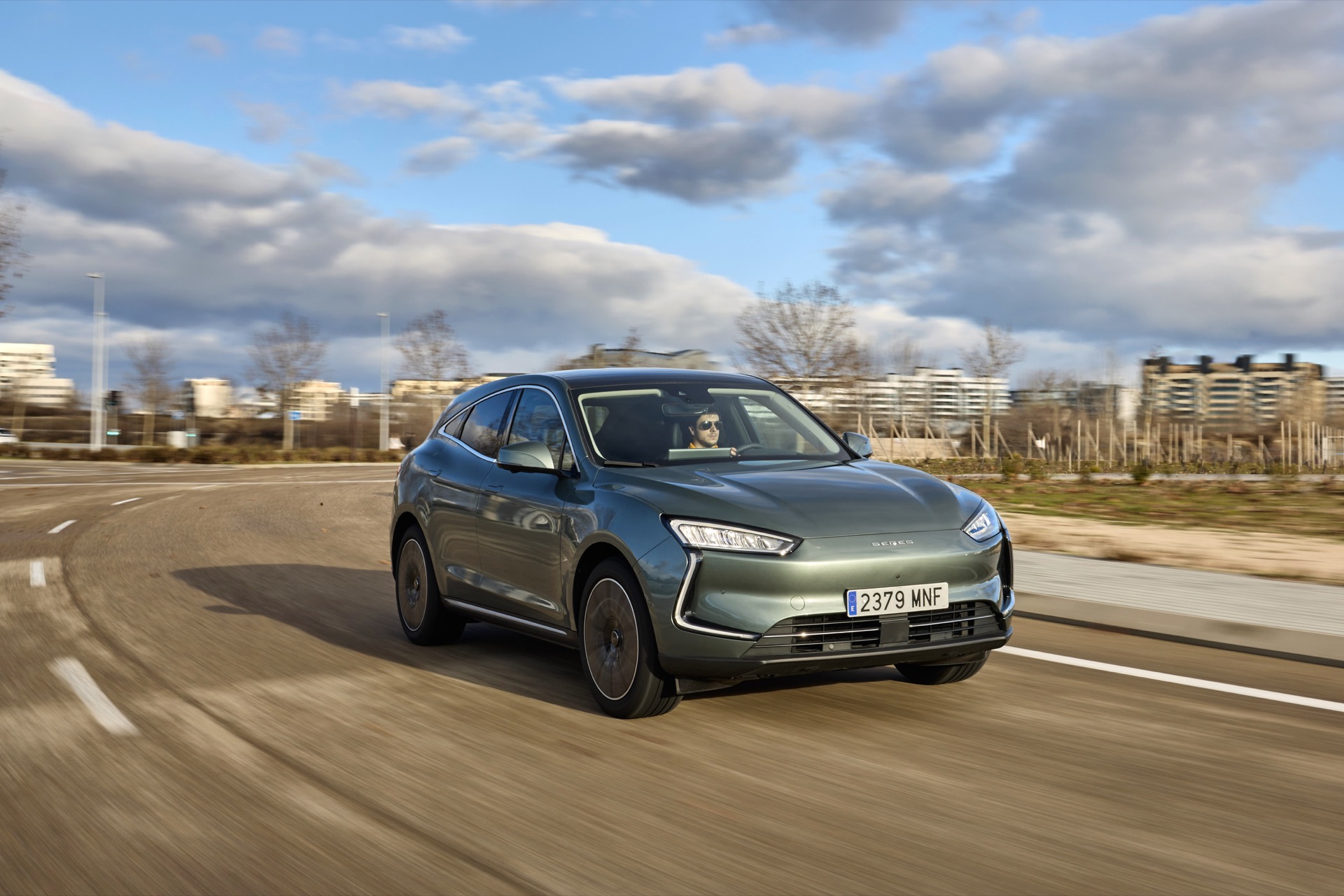
With versions producing 300 CV and 584 CV, range of up to 500 km and generous standard equipment, the Seres 5 wants to carve out its own niche among electric SUVs of its size… and price.
It is rare for each new Chinese car arriving in our market not to be a surprise, and the Seres 5 is no exception. Especially because Seres is a very young brand, founded in 2016, and until now the only reference we had was the Seres 3, a car that was simply “adequate” and struggled to hold its own in a direct comparison with its main alternatives, whether they come from China or Europe.
But the Seres 5 is something else, and further proof that Chinese manufacturers, beyond making “cheap” cars, are capable of doing whatever they set their minds to. We have already seen it, not long ago, with BYD. But let’s go into more detail on this SUV that, at times, wants to be premium… and in certain respects even succeeds.
I spy, I spy… what do you see? An SUV, but I can’t tell which brand it is
Designed at the brand’s Design Centre in Silicon Valley, California, the Seres 5 is a car that recalls many other SUVs of its size… and at the same time none of them. It is the typical car that, if you remove the logo -or even without removing it- and run a “clinic”, asking people whether they could identify the brand, would get the most varied answers.
But it cannot be denied that its flowing lines with a near-coupé SUV silhouette and details such as the door handles flush with the bodywork, the 20-inch alloy wheels as standard or the welcome and farewell animations of the full LED headlights with high resolution, are a statement of intent: we are, by no means, looking at a “cheap” Chinese car.
And we have not yet talked about power, equipment… or price. We’ll get there. What I can tell you in advance is that, with its 4.71 metres in length, the Seres 5 competes with cars such as the CUPRA Tavascan, the Ford Mustang Mach-E, the Skoda Enyaq or the Tesla Model Y, to name just a few rivals. And it does not compete with them on size alone.
4×2 and 4×4 versions, up to 584 CV and 500 km of range
The Seres 5 is offered in two mechanical versions. The 2WD variant has a permanent-magnet synchronous motor driving the rear wheels, which delivers 220 kW (299 CV) and a maximum torque of 299 CV. It reaches an electronically limited top speed of 180 km/h and accelerates from 0 to 100 km/h in 6.8 seconds.
The 4WD version uses a second motor -in this case an asynchronous induction unit- on the front axle, delivering 210 kW (285 CV) and 520 Nm of torque, providing all-wheel drive and a system output of 430 kW (584 CV). The performance figures here are impressive, not so much for the top speed, which rises to 200 km/h, but for the acceleration: the Seres 5 4WD is capable of reaching 100 km/h from a standing start in 4.2 seconds.
The battery, manufactured by CATL, is of lithium iron phosphate chemistry, with a capacity of 80 kWh in both versions. Seres homologates a range of up to 500 km for the rear-wheel-drive variant, and up to 483 km for the 4WD. The battery, as is customary in new-generation electric cars, has a flat design and is integrated into a chassis with a front axle featuring deformable parallelogram suspension and a sophisticated multi-link rear end. So far, things are not going badly…
Where the Seres 5 could be said to fall short, especially if we are talking about premium aspirations, is in the maximum DC charging power it accepts. It settles for 100 kW, below what is now usual in this category, although this is not really a drama: according to the manufacturer the battery can go from 30 to 80% capacity in 45 minutes; with AC and an 11 kW charger it would need around 4 and a half hours.
An interesting detail is that it comes as standard with V2C bidirectional charging, which allows it to supply 220 V and up to 3.3 kW to other devices, such as an electric bicycle… or even to charge other vehicles.
Some curious details and some areas for improvement
The interior of the Seres 5 follows the “Tesla pattern” that is increasingly common in electric cars, especially those from China: clean lines with hardly any buttons and a large central screen, which in this case is 15.6 inches and positioned horizontally. The instrumentation is also digital, at 12.3 inches.
At first it feels strange not to have to press any button to start the car… or to leave it. You arrive with the key in your pocket, it unlocks, and all you have to do is select “D” on the gear lever and set off. When you get out, at most the car will remind you to take your phone from the inductive charging pad; again, you simply put the gear selector into “parking” and you can leave the car. The first few times you will glance back with suspicion to check whether it has really switched off completely, but you soon get used to it, and when you go back to a car with a “start” button, you end up missing it.
What still does not sit well with me, however much the new voice assistants want you to talk to them for everything -in the Seres 5 you can even open the boot with a voice command- is that there are no buttons for the main functions. Something the Seres 5 takes to the extreme, as you have to navigate through the touchscreen menus for everything, even to open the charging port flap or to adjust the air-conditioning vents. At least the screen has good resolution and all the menus and functions are well translated into Spanish. Something that, curiously, is not always the case with the information shown on the instrument panel.
The sense of quality conveyed by the design, the materials and the finish is good overall, without reaching the luxury you might expect from a car at its list price -don’t jump ahead, we’ll come back to this- and better than one would expect from a car priced where the Seres 5 lands once all the possible discounts and purchase incentives are applied. As for space, the front seats are very good, the rear ones adequate and the boot weak, with just 367 litres of capacity, which makes the additional almost 70 litres available under the front bonnet all the more valuable.
As curious features, the Seres 5 offers customisable modes such as the “Relax” mode, which reclines the seat and configures the climate control so you can rest comfortably in the car while waiting, for example, for the battery to charge. Or the “pet” mode, which adjusts the cabin temperature and leaves a message on the screen for the more curious, warning that the owner will be back shortly and the air conditioning is switched on.
Behind the wheel of the Seres 5: comfortable performance
More than enough performance in either version, in my opinion; given how well the 2WD version goes, there is no need to opt for all-wheel drive in a car of this kind… unless you place great value on knowing that every morning a car with almost 600 CV is waiting for you in the garage, capable of accelerating from 0 to 100 km/h like a Porsche 911.
Because beyond the pure acceleration figures, the Seres 5 is far from even approaching the sporting behaviour of the electric SUV that, today, is the true reference: the Porsche Macan EV. And yet the 4WD version even has a driving mode called “Circuit”, and the brand has not skimped on equipping the Seres 5 with good tyres, in this case Pirelli P Zero PZ4, more sporting in character than the car itself. The remaining programmes are one focused on energy saving, a comfort mode, a sport mode and a customisable one in which you can even choose how the motor delivers power across three levels.
The best thing about the Seres 5 is that it is very comfortable and easy to drive, with good insulation and a suspension that conveys a sense of quality when crossing potholes. The speed-sensitive power steering has three adjustment levels, and it always feels smooth yet never imprecise, and the brakes are not easily troubled, with a pedal that also has good feel.
There are also three energy recuperation modes: off, normal and high; but there is no button or paddles to switch between them on the move. That would be welcome, because depending on the driving situation, the lowest recuperation mode sometimes falls short, while the strongest one brakes too much.
As for energy consumption and real-world range, it depends greatly on the type of use, and I have even noticed significant differences between setting off after leaving the car overnight in the garage unplugged, or doing so straight after disconnecting it from the charger. In the latter case, on daily trips along the M-30 and M-40 ring roads around Madrid, barely entering the city, I have recorded on-board computer averages of around 18-19 kWh/100 km with the Seres 5 2WD, while a motorway journey with some secondary roads, always at the pace of traffic, pushes the figure up to 24 kWh/100 km.
This means that it is advisable to plan trips with legs of no more than 300 km between charging stops, leaving a safety margin.
Seres 5 equipment and price
We have left the most “tricky” part of the Seres 5 for last: the price. Because the list price of €63,500 for the 2WD version, rising to €69,950 for the more powerful variant, is a bit of a shock -however well built the car is and however much performance, refinement and technology it offers-, especially when compared with its rivals. But there are two things to bear in mind: the discounts and the standard equipment.
With the discounts applied for financing the purchase, the price of the Seres 5 AWD falls to €53,850, and €60,995 for the Seres 5 4WD, which is still a high price, but at least it is less of a “downpour”… And things become interesting if the purchase incentives under the Plan Moves III come into play, because then the Seres 5 2WD drops to a more than attractive €46,850 with the maximum aid, or just below €50,000 without scrapping a car.
Both versions have the same equipment, which at this price can indeed be described as very complete, including the aforementioned 20-inch wheels, adaptive high beams -which work very well, by the way-, configurable interior ambient lighting, HUD instrumentation, a panoramic sunroof, heated and ventilated electric leather seats with massage, dual wireless phone charger, powered tailgate, panoramic parking camera and a powerful 11-speaker sound system.
The only option is metallic paint, which costs around €570. Even the ADAS safety equipment is closed: adaptive cruise control with traffic-jam assist, rear cross-traffic alert, forward collision warning and the warning of hazards from approaching pedestrians or cyclists when opening the doors are all included.
Once you know what it offers, the Seres 5 may well win you over, but the natural mistrust that an unfamiliar brand can inspire is likely to surface. In this case, the brand’s argument is its dealer network, with around 25 points already spread across Spain… and an 8-year or 150,000 km warranty.
As I said, the Chinese also know how to build cars. And if not, just ask the European manufacturers, who for now do not seem to have a defined plan to face the onslaught.
Seres 5 – Image gallery

 Kia offers an electric range of 10 models, 50 versions and 400 possible combinations
 The seven finalists for the 2027 European Car of the Year (COTY) are exclusively electric
 Peugeot E-208 GTi: a battery-powered toy that revives the spirit of the 1980s sports cars
Deja un comentario