Hybrid Cars Family Review Safety SUV
In-depth analysis of the Hyundai Santa Fe: the most technologically advanced and safest family SUV in its segment under 70,000 euros?
 Dani Montesinos
30 June 2026
5 min.
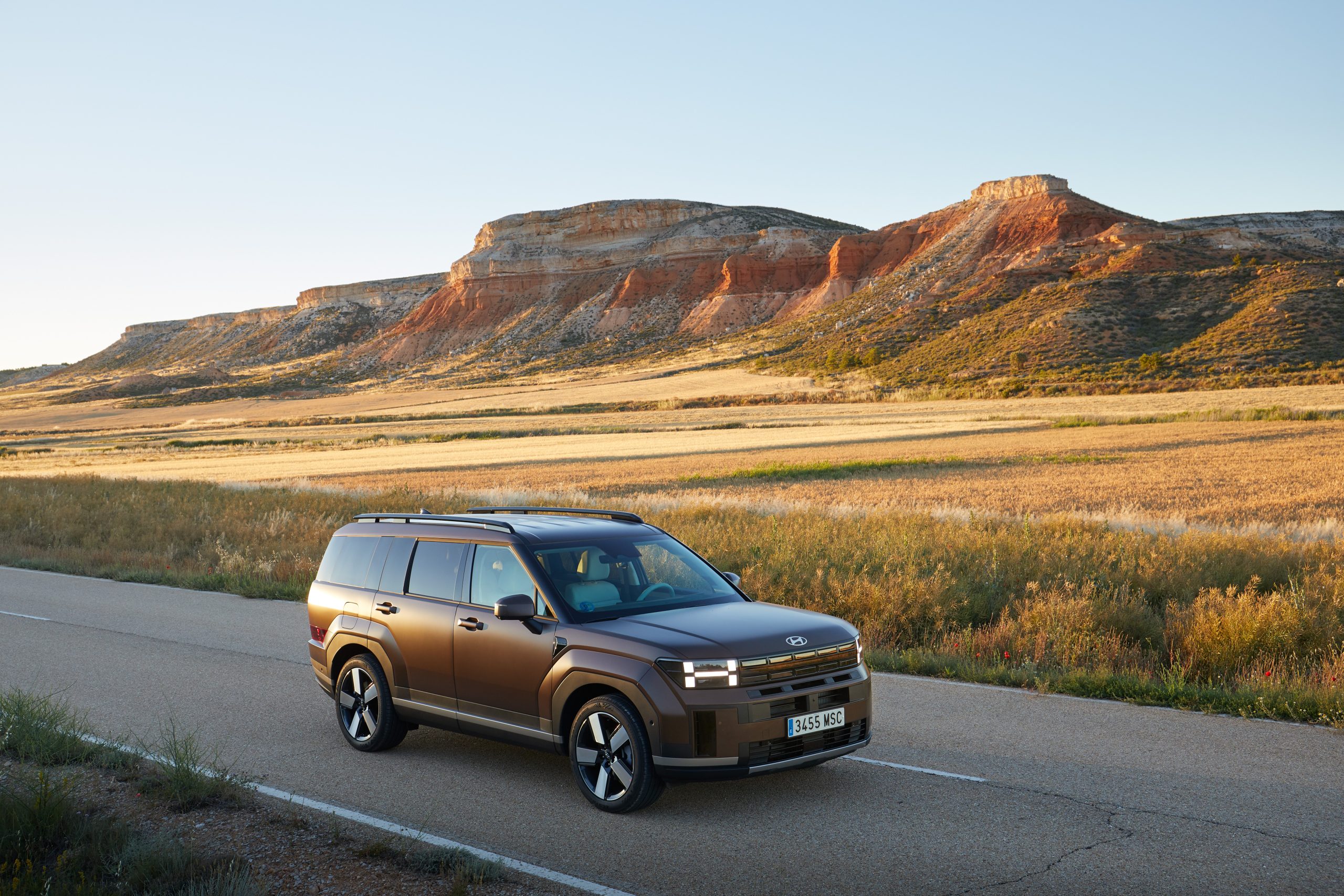
We analyse the Hyundai Santa Fe HEV with 240 CV, a 7-seat family SUV with premium technology and high-end safety, compared with its direct rivals
The Hyundai Santa Fe has transformed. What for two decades was a discreet and efficient family SUV has become, in its fifth generation, a statement of intent as bold as its new bodywork. Straight lines, a monumental rear inspired by British land yachts, and a level of interior space that rewrites the rules of the segment. But behind its polarising styling there is something more interesting: a technological and safety proposition that aspires to premium territory without crossing the psychological barrier of 70,000 euros.
A Hyundai Santa Fe that breaks moulds in design and approach
The new generation abandons conservatism. The front with H-shaped LED lights, the angular wheel arches and the enormous tailgate — designed to make loading easier in an upright position — make up an SUV that looks like nothing else in its category. Hyundai has decided to play bold, and the result is a car that can be recognised from 200 metres away.
The Hyundai Santa Fe HEV range: engine, performance and real-world consumption
The Hyundai Santa Fe HEV uses the well-known 1.6 T-GDi full hybrid with a combined output of 240 CV (176 kW), an automatic gearbox and front-wheel or all-wheel drive. The homologated figures point to 6.4 l/100 km of average consumption and 140 g/km of CO₂, remarkable numbers for a vehicle nearly five metres long with 7 seats. Top speed is around 200 km/h.
| Power kW | Power CV | Top speed | Range | Consumption | Label | Fuel |
|---|---|---|---|---|---|---|
| 176 kW | 240 CV | 200 km/h | data not available | 6.4 l/100 km | ECO | Hybrid |
Interior, perceived quality and 7-seat practicality
Inside, the qualitative leap is palpable. A curved 12.3-inch dual screen, soft-touch materials on contact surfaces, a central console with dual wireless chargers and a UV-C sterilising compartment. The third row is accessible and usable by adults on short journeys — something unusual in this segment — and the boot holds around 700 litres in the 5-seat configuration.
On-board technology: screens, connectivity and driver assistance
The Hyundai SmartSense package includes level 2 semi-autonomous driving, assisted lane change, automatic braking with junction detection, a head-up display with augmented reality and a 360º camera with 3D view. Android Auto and Apple CarPlay integration is wireless, and the system supports OTA updates.
Safety: high-end ADAS equipment
Here the Santa Fe plays in a different league. The standard ADAS deployment on the top trims — blind-spot monitoring with camera, safe exit assist, rear occupant alert, nine airbags including the central one — competes directly with premium offerings that cost 20,000 euros more.
Hyundai Santa Fe price: what does it offer from around 49,000 €?
The Hyundai Santa Fe price starting point in the HEV Maxx version is around 49,000 € recommended retail price. Below the 70,000 € threshold, it offers 7 seats, an ECO label, 240 CV and equipment that, at European premium brands, belongs to the paid options catalogue. Reminder: all prices mentioned are indicative manufacturer RRPs, without dealer discounts, campaigns or purchase incentives.
Direct rivals on the Spanish market
Kia Sorento from around 50,040 €
A close technical cousin, it shares the N3 platform and philosophy. More conservative styling but equally capable, with hybrid and PHEV options.
Skoda Kodiaq from around 49,910 €
The Czech champion of rationality. Enormous space, sober finishes and efficient TSI/TDI engines, though with less electronic sophistication.
Peugeot 5008 from around 34,850 €
Distinctive i-Cockpit design, electric and hybrid options, and a more urban, European approach than the Hyundai.
Nissan X-Trail from around 33,550 €
With its series hybrid e-Power system, it is the most efficient in the city. Less luxurious but technologically quirky.
Comparison table and verdict
| Model | CV | Seats | Label | From | Technology | Safety | Efficiency | Total |
|---|---|---|---|---|---|---|---|---|
| Hyundai Santa Fe HEV | 240 | 7 | ECO | 48,920 € | 9.5 | 9.5 | 8.5 | 9.2 |
| Kia Sorento | 215 | 7 | ECO/ZERO | 50,040 € | 8.5 | 9 | 8.5 | 8.7 |
| Skoda Kodiaq | from 193 | 7 | C | 49,910 € | 7.5 | 8 | 7.5 | 7.7 |
| Peugeot 5008 | from 145 | 7 | C/ECO/ZERO | 34,850 € | 8 | 8 | 8 | 8.0 |
| Nissan X-Trail | from 204 | 7 | ECO | 33,550 € | 7.5 | 8 | 9 | 8.1 |
Highmotor verdict
The Hyundai Santa Fe review that emerges from this analysis is clear: we are talking about the 7-seat family SUV with the most complete technological and safety proposition below 70,000 €. It is not the cheapest, the most efficient or the most rational. It is the most ambitious. And that, in a segment dominated by good sense, is a valuable rarity.
Frequently asked questions
How much does the Hyundai Santa Fe HEV really consume?
The homologated WLTP consumption is 6.5 l/100 km, with emissions of 140 g/km of CO₂. In real mixed use, figures usually range between 7 and 8 l/100 km depending on terrain and driving style.
Does the hybrid Hyundai Santa Fe have an ECO label?
Yes. The 240 CV HEV version carries the DGT ECO environmental label, which allows unrestricted access to the low-emission zones in Spain’s main cities.
Is it really a usable 7-seat SUV?
Yes, unlike many rivals. The third row is easy to access thanks to the door design and roof geometry, and it is viable for adults on short journeys or children for everyday use.
What is the difference between the Hyundai Santa Fe and the Kia Sorento?
They share a platform and engine options, but the Santa Fe opts for a more disruptive design and more sophisticated technological equipment, while the Sorento keeps a more conventional look and a slightly lower starting price.


 Kia offers an electric range of 10 models, 50 versions and 400 possible combinations
 The seven finalists for the 2027 European Car of the Year (COTY) are exclusively electric
 Peugeot E-208 GTi: a battery-powered toy that revives the spirit of the 1980s sports cars
Deja un comentario