Loads protruding from a vehicle: regulations and signage
 Mónica Redondo @MonicaRedondoD
3 June 2021
4 min.
Are you going to transport something that sticks out of your car? This is for you!
Now that the State of Alarm has ended and travel between provinces has been restored, you may be thinking about a weekend getaway or even the upcoming holidays. We’re sure you’ve seen more than one car driving with its boot open or carrying a load that exceeds the limits, and this can pose a serious danger to traffic.
Although your car is not intended exclusively for transporting goods, you should know that you can carry them if you need to. However, you must take into account the permitted dimensions depending on the vehicle you drive. Passenger cars may only carry loads that protrude from the rear. Vehicles intended for transporting goods may carry loads that protrude from the front, rear and sides, subject to conditions.
Load signage on a passenger car
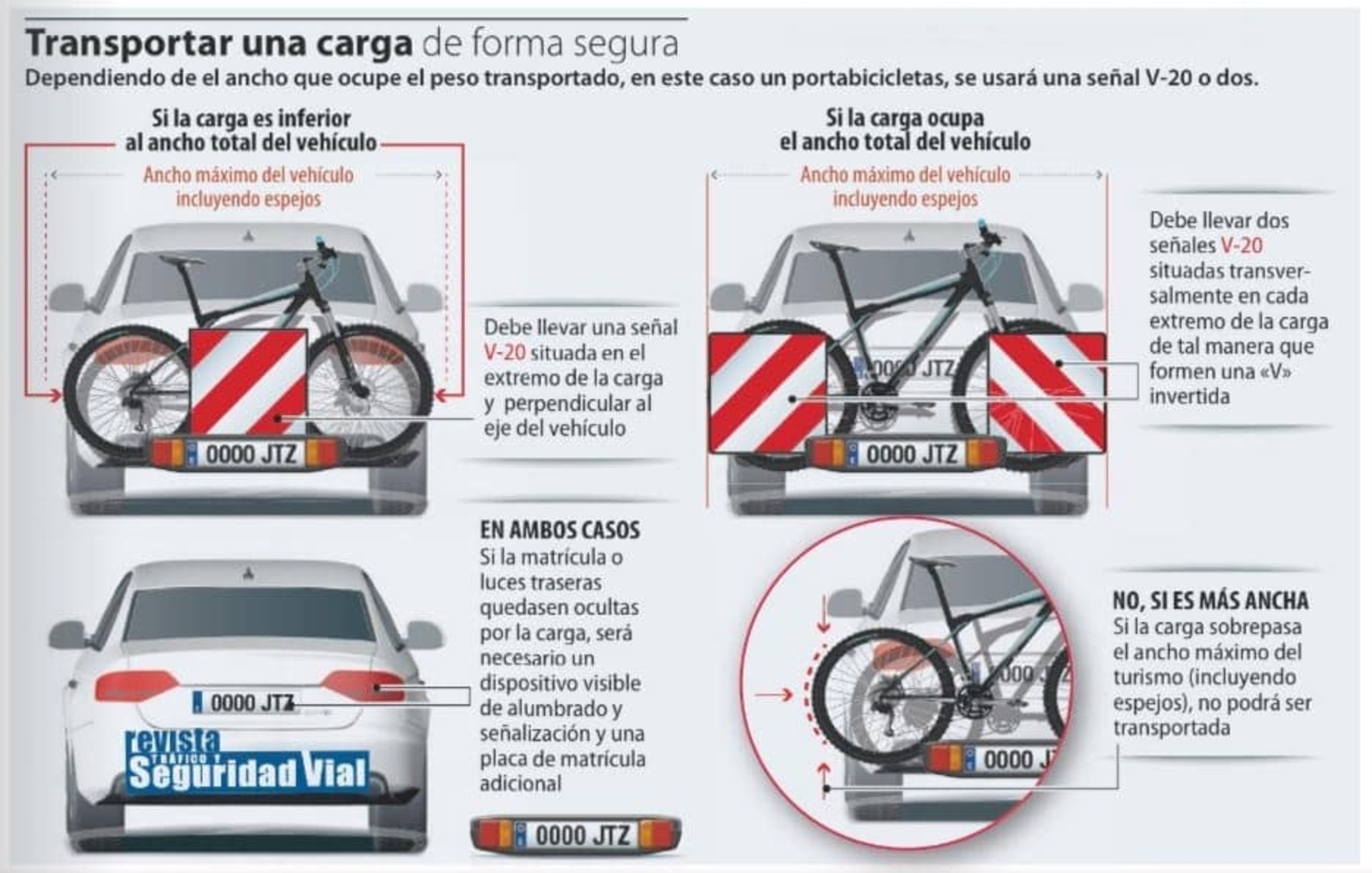
The way to mark a load on your car is with the sign known as V20, a 50×50 cm square panel with diagonal red and white stripes. Depending on the width the load occupies, you may need one or two signs.
- One sign is placed if the transported object is narrower than the maximum width of the vehicle at the rear (including the rear-view mirrors). It must be placed perpendicular to the vehicle’s axis at the end of the load.
- Two signs are placed if the transported load protrudes lengthwise, occupying the full width of the vehicle (including the rear-view mirrors). They must be positioned transversely at each end of the goods so as to form an inverted “V” shape.
The sign must be fastened securely, as sheltered from the wind as possible. Avoid using cable ties.
Load signage on a van
Vans have two options that vary depending on the length of the vehicle. Essentially, the reference measure is five metres in length.
- If the van or commercial vehicle is longer than five metres, the load may protrude two metres at the front and three metres at the rear.
- If the van or commercial vehicle does not exceed five metres in length, the DGT establishes that the load to be transported, provided it is indivisible, may exceed one third of the vehicle’s length, both at the front and at the rear.
As with passenger cars, if the load protrudes beyond the limits of the van, you must mark it correctly with one or more V-20 signage plates:
- One sign is placed if the transported object is narrower than the maximum width of the vehicle at the rear (including the rear-view mirrors). It must be placed perpendicular to the vehicle’s axis at the end of the load.
- Two signs are placed if the transported load protrudes lengthwise, occupying the full width of the vehicle (including the rear-view mirrors). They must be positioned transversely at each end of the goods so as to form an inverted “V” shape.
- Two signs are placed if the transported load protrudes from the sides of our van. In this particular case the law allows a maximum of 40 centimetres on each side, provided the total width of the vehicle plus the load does not exceed 2.55 metres in width.
It is important to note that if the number plate or the rear light clusters are obscured by the load, a lighting and signalling device is required, plus an additional number plate placed outside the load. Whatever is being transported, the load must be positioned so that:
- It does not move inside.
- It does not compromise the stability of the vehicle.
- It does not produce noise, dust or other nuisances.
- It does not obscure lighting devices.
If you are going to drive between sunset and sunrise or in adverse weather conditions, the load must be marked with a red light. There is also a height limit for goods. The maximum height of the vehicle and its load may reach four metres. However, it must be borne in mind that the height of the load may under no circumstances compromise the stability of the vehicle, nor fall, either totally or partially.
Failing to mark the load may result in a financial penalty
The DGT, based on article 15 of the General Traffic Regulation, considers driving without signage or exceeding the limits to be a minor offence, which carries a financial fine of 80 euros.


 Peugeot E-208 GTi: a battery-powered toy that revives the spirit of the 1980s sports cars
 New Lexus ES: luxury grows and goes electric
 First contact with the Dacia Sandero Hybrid 155: power and efficiency from €19,890
Deja un comentario