Hyundai i30 Family Range / versions Geneva Motor Show
New Hyundai i30 Wagon, the most versatile option
 Francisco Javier
24 February 2017
4 min.
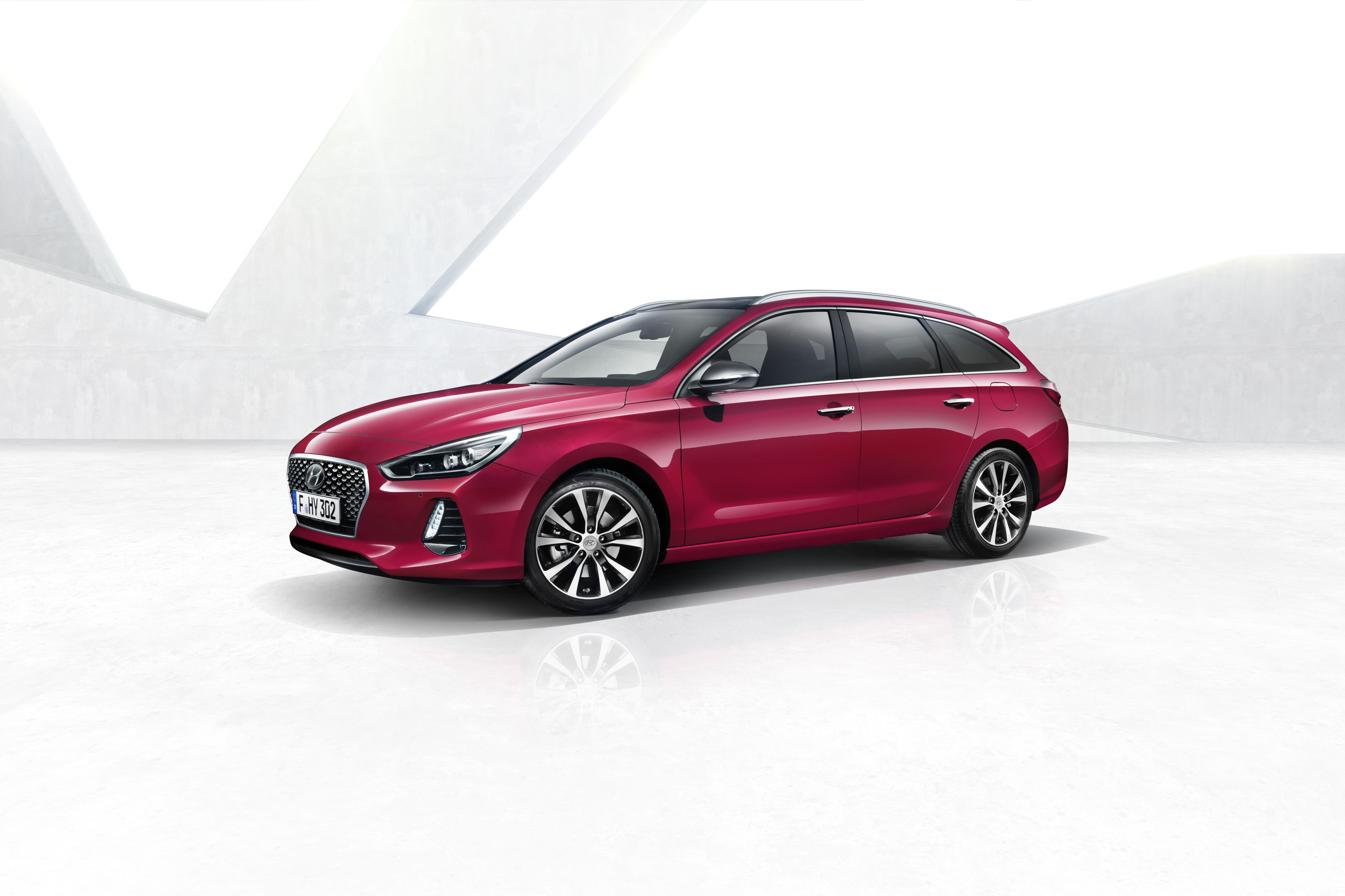
New Hyundai i30 Wagon
The new Hyundai i30 5-door was presented not long ago, and now it is the turn of the family version (Wagon), which offers more space and versatility. The chosen stage is the next Geneva International Motor Show, where the New Generation Hyundai i30 Wagon will make its official debut. The elegant and eye-catching visual appearance of the family bodywork resembles that of a shooting brake, although it also emulates the silhouette of a coupé.
It has a total length of 4,585 mm (5-door version: 4,340 mm), a height of 1,465 mm (1,475 mm with roof rails), a total width of 1,795 mm and a wheelbase of 2,650 mm, the same as those of the 5-door bodywork. The interior retains the advantages of the 5-door variant, which are enhanced by the larger boot volume, with 602 litres of space and 1,650 litres with the rear seats folded. Versatility is reinforced by the additional storage space under the boot floor with several compartments.
With regard to active and passive safety measures, the new Hyundai i30 Wagon features Autonomous Emergency Braking (AEB), Driver Attention Alert, High Beam Assist and Lane Keeping Assist System. In this way, it incorporates in its equipment systems that may be associated with vehicles from higher segments.
New Hyundai i30 Wagon
The Autonomous Emergency Braking (AEB) system uses camera sensors and operates in three phases. In the first phase it warns the driver visually and audibly, and controls braking to avoid a collision or minimise the damage when one is unavoidable. The optional pedestrian detection uses a front radar and prevents or reduces the consequences of an impact with a pedestrian.
The Advanced Smart Cruise Control System (ASCC) maintains a constant speed and distance from the vehicle ahead , accelerating and braking automatically up to 180 km/h. The Blind Spot Detection (BSD) gives a visual alert in the rear-view mirrors if another vehicle is detected, in order to avoid a possible accident.
The Rear Cross Traffic Alert (RCTA) system reduces the risk of collision with vehicles that may approach when reversing in narrow areas with poor visibility. The Driver Attention Alert (DAA) system detects signs of fatigue-related distraction in the driver in order to prevent possible accidents.
The Lane Keeping Assist System (LKAS) warns the driver when dangerous manoeuvres are made at more than 60 km/h by detecting the position of the vehicle.
New Hyundai i30 Wagon
The Speed Limit Information Function (SLIF) identifies road speed signs and displays the speed limit in real time. The information is shown both on the navigation system screen and on the TFT display.
The High Beam Assist (HBA) system detects both oncoming vehicles and vehicles ahead in the same lane, switching the dipped beam as appropriate. Whenever no vehicles are detected, the HBA system maximises the driver’s range of vision.
Connectivity and infotainment systems are very much present in the new Hyundai i30 Wagon. The 8″ touchscreen of the next-generation navigation system offers state-of-the-art connectivity features such as Apple CarPlay, Android Auto and LIVE Services. A wireless charging system for smartphones with the Qi standard is also available. Among the options available for the sound system, you can choose the system featuring a 5″ capacitive LCD touchscreen with integrated dynamic rear-view camera, Bluetooth connectivity and My Music functionality.
The engines available for this variant will be the same as those fitted to the 5-door version. Under the bonnet, it can be equipped with two petrol engines: the 1.4 T-GDI, which delivers 140 CV, and the new three-cylinder 1.0-litre T-GDI, which produces 120 CV. The diesel range consists of a single unit, the 1.6-litre turbo four-cylinder, which offers 90 CV, 110 CV or 136 CV of power.
Source | Hyundai
Technical specifications of this car


 Peugeot E-208 GTi: a battery-powered toy that revives the spirit of the 1980s sports cars
 New Lexus ES: luxury grows and goes electric
 First contact with the Dacia Sandero Hybrid 155: power and efficiency from €19,890
Deja un comentario