Peugeot Photos Minivans Tests SUV
Peugeot 3008 2.0 HDi 150 CV, road test (Part II)
 Diego G. Moreira
14 December 2009
6 min.
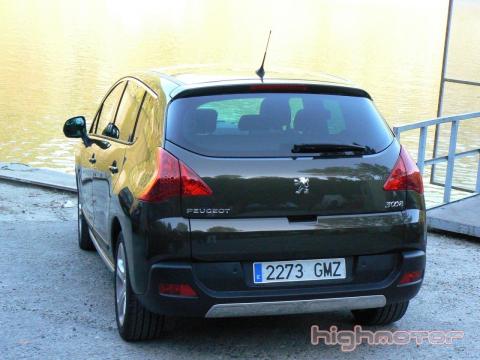
We have already seen how the Peugeot 3008 behaves on the road, as well as how the 2.0 HDi 150 CV engine performs and its consumption figures. So now we turn to its image and interior. Perhaps these are the two most distinctive aspects of the 3008: first, its unconventional exterior design, which is quite innovative, and second, its spacious and comfortable interior, typical of an MPV.
The first thing that caught our attention about the Peugeot 3008 is that it is a car rarely seen, and with such a distinctive design, far from the crossovers that are multiplying across our cities or the MPVs that, when we see them on the street, already cover the whole colour range of the manufacturer. So having a rarely seen design that draws attention is a positive point. Let’s now get into the road test and look at its exterior design…
Exterior design
A bold image and considerable dimensions: it measures 4.36 metres long, 1.83 m wide and 1.63 m high. Despite its dimensions, and above all its height, the Peugeot 3008 has a fairly good drag coefficient, better than many similar models (Cx 0.296), and even with its large front end, the Peugeot 3008 offers less air resistance than a C4 Picasso, for example.
Turning to the purely aesthetic aspects, it is impossible not to mention its shapes: that very large front end, where the central grille is the most important element of the front, leaving the other elements as secondary in the front design. Its front headlights, which on the Spork Pack trim are xenon, are not as elongated as on other models of the brand, and the bonnet is of modest dimensions.
We cannot overlook the huge panoramic roof, which is not electric, that our unit had, and from which, using a button inside, we could open the blind for a full view of the sky. At the rear, its fin-shaped light clusters and LED-effect indicators draw attention, and the boot lid can be opened in two parts (pick-up style), making it easier to load any object into the boot.
For those who do not like the exterior image, I personally think it is a matter of getting used to it, and if we move quickly to its interior we will soon acquire a liking for the 3008.
Interior design and habitability
When we go into the interior of the Peugeot 3008, the first thing that will please us is its spaciousness. It seems bigger inside than it looks from outside. As soon as you get in you have a sense of space, helped by the panoramic roof that lets in a lot of light and above all gives a feeling of openness. The designers of Peugeot have once again given free rein to imagination in the dashboard, with a centre console with aircraft-style controls and a rather futuristic look. We should also not forget that electronics are very present in the 3008, with features such as the speed projection onto a screen on the windscreen (see detail) or a system that measures the safety distance to other vehicles.
Returning to that centre console and materials in general, the quality improves considerably compared with the Peugeot 308, for example, and practically all the controls on the centre console have good materials and correct fitting (better than many rivals). On the centre console we have the controls for the windscreen projection screen, the safety distance warning system, the climate controls and, in the middle, the sound and navigation system (which we will discuss in the third part), all topped by the navigation screen, which sits in a very good position inherited from the 308.
In my view, the novelty of the centre console contrasts somewhat with a slightly simpler instrument panel, but one that fulfils its purpose perfectly. On the steering wheel are the traditional radio and cruise control controls, which are already a classic on the Peugeot, so practically every button is within hand’s reach. There is only one exception, the on-board computer control (see detail), which I do not understand why it has been placed so low and so out of the way, in a position that forces you to bend down.
Inside the cabin another important point is the large central storage compartment, and I think the word “large” falls short. Because between the front seats, where the gear lever sits (which has finally been covered in leather), there are also two cup holders (one of which disappears if you fit the Grip-Control), and besides these elements there is a glovebox of large dimensions, big enough to fit a 1.5-litre bottle upright (see detail), which is undoubtedly very practical. Under the armrest there is also the USB socket for the sound system.
The driving position in the front seats is very good: you sit high, with comfortable seats that offer good lateral support. As I mentioned in the first part of the test, it is very comfortable inside for travelling , and the sense of space and openness also helps.
In the rear seats there is enough room for five passengers (for maximum comfort, four), with sufficient legroom (with air vents for the rear seats) and headroom, since the 3008 is a tall car. And turning to storage spaces, the Peugeot 3008 aims to be an MPV, that is, it offers practical solutions throughout the cabin. Besides the central compartment, it has large door pockets and several storage spaces under the rear seats (see detail), as well as a normal glovebox and an additional one below the steering wheel.
And from storage we move on to the boot, which could have been somewhat larger (it is within the normal range) with a capacity of 432 litres. But the best thing about the boot is its versatility: it has a shelf that adjusts to different heights (see detail), which adds to its versatility, and the tailgate opening in two stages helps with loading. And if we fold down the rear seats we get a very wide, flat loading surface (see detail), practical for transporting any large items. And we must not forget the curious and practical torch that the 3008 comes with, a nice detail.
So quality materials and interior space are two strong points of the Peugeot 3008 in the interior, and as for the exterior design, that is more a personal matter, but it is certainly not a car with classic lines nor one that leaves people indifferent. In the third part of the test we will talk about the price of the Peugeot 3008 and its equipment, as well as our overall assessment.
Photos | David Taboada


 Peugeot E-208 GTi: a battery-powered toy that revives the spirit of the 1980s sports cars
 New Lexus ES: luxury grows and goes electric
 First contact with the Dacia Sandero Hybrid 155: power and efficiency from €19,890
Deja un comentario