Austral BYD C-HR Hyundai KIA Nissan Qashqai RAV4 Renault SEAL Seal U Sportage Toyota Tucson Hybrid Cars Comparisons Tests Rankings SUV
Ranking 2026: the 5 hybrid compact SUVs with the best value for money under 32,000 euros
 Iván Navarro
25 August 2026
6 min.
We analyse the five most interesting hybrid compact SUVs under 32,000 euros in Spain: WLTP consumption, standard equipment and real cost of ownership, laid out on the table.
The hybrid compact SUV segment has become the rational refuge of the Spanish buyer who doesn’t want to plug the car in every night but doesn’t want to pay for diesel either. The offer below the psychological 32,000-euro barrier is richer than it seems — and also more uneven. We have filtered the domestic market looking for what any reader with a calculator on the table would look for: which hybrid compact SUVs under 32,000 euros really deliver once you cross standard equipment, WLTP consumption, warranty and running cost.
From the earlier shortlist of candidates we have deliberately ruled out the BYD Seal U DM-i. For a couple of seasons the Chinese brand was the obvious reference in any value-for-money comparison, but, in our view, that advantage has narrowed considerably: with the arrival of new European and Asian players — and with price adjustments from the established rivals — the BYD proposition is no longer the obvious shortcut it once was. It remains a competent car; we simply consider that today it does not lead the cost-to-product equation in full hybrid within this price threshold.
With the ground cleared, let’s get to the point.
What we demand from a hybrid compact SUV under €32,000
The logic of the typical buyer here is simple: they want to spend little on petrol without depending on a cable, they want an ECO label, and they want a genuinely family car. On that basis we have weighted four variables: homologated WLTP consumption, relevant standard equipment (ADAS, dual-zone climate control, infotainment with wireless Apple CarPlay/Android Auto), manufacturer warranty and estimated five-year maintenance cost. The starting price has been taken for the already-equipped entry configuration, not the stripped-down promotional version.
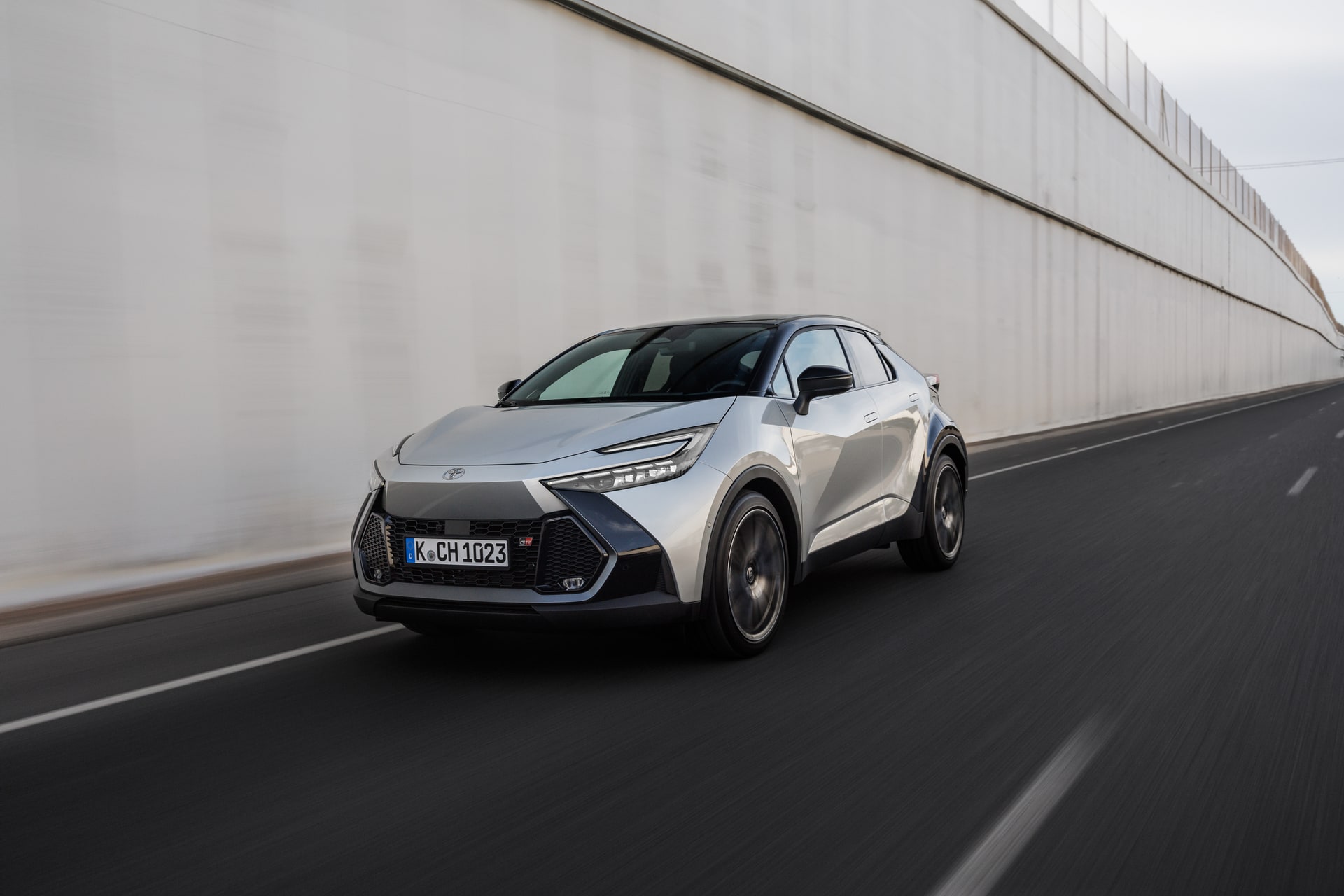
1. Toyota C-HR 140H — from 30,900 €
We start with the one that most often quietly takes the segment’s prize. The Toyota C-HR 140H offers the fifth generation of Toyota’s hybrid system, with 140 CV combined, and posts a WLTP consumption figure that in practice translates into 4.8–5.2 l/100 km in mixed use. Bold design — perhaps too bold for some — and a reliability that remains the benchmark of the segment. The warranty extendable to 10 years/185,000 km if you keep up servicing at an official network is an argument few rivals can answer.
That said, the boot (388 litres) is clearly smaller than that of its more family-oriented rivals. It is the price of a coupé-SUV design.
| Power kW | Power CV | Top speed | Range | WLTP consumption | Label | Fuel |
|---|---|---|---|---|---|---|
| 103 kW | 140 CV | 170 km/h | ~950 km | 4.8 l/100 km | ECO | Hybrid |
2. Renault Austral E-Tech Full Hybrid — from 36,500 €
The Renault Austral E-Tech is probably the most sophisticated of the group in terms of product perception. Interior with the vertical OpenR screen, materials that feel a step above the segment average, and a series-parallel hybrid system with a clutchless multimode gearbox that is smooth in town and surprisingly restrained on the motorway. 200 CV of combined power in the full hybrid version.
In practice it homologates at 4.6 l/100 km and in real use hovers around 5.3–5.5. It is not the cheapest to get into, but the standard equipment — 360° camera, head-up display in mid-range trims, level 2 ADAS — makes up for it.
| Power kW | Power CV | Top speed | Range | WLTP consumption | Label | Fuel |
|---|---|---|---|---|---|---|
| 147 kW | 200 CV | 175 km/h | ~1,100 km | 4.7 l/100 km | ECO | Hybrid |
3. Nissan Qashqai e-Power — from 31,900 €
Here we must add a conceptual asterisk: the Nissan Qashqai e-Power is not a conventional hybrid. It is an extended-range electric vehicle with a petrol generator — the wheels are always driven by the electric motor, and the 1.5 petrol engine works as a generator. The result on the road is peculiar: instant response, silence when pulling away, and yet a consumption figure that shines in town (under 5 l/100 km) but suffers somewhat on sustained motorway driving.
For those who live in urban and peri-urban environments, the logic is hard to argue with. Behind the wheel it feels more like an electric car than a hybrid, and for many buyers that is exactly what they are looking for without yet wanting to commit to recharging.
| Power kW | Power CV | Top speed | Range | WLTP consumption | Label | Fuel |
|---|---|---|---|---|---|---|
| 140 kW | 190 CV | 170 km/h | ~1,000 km | 5.3 l/100 km | ECO | Hybrid |
4. Kia Sportage HEV — from 31,700 €
The Kia Sportage HEV earns its place in this ranking on its own merits: 239 CV combined in the top version, one of the most accomplished designs in the segment, and that 7-year/150,000 km warranty which remains a serious differentiator when calculating total cost of ownership. The HEV entry point sits just below our 32,000 ceiling in front-wheel-drive configurations.
WLTP consumption of 5.4 l/100 km and a cabin with a curved dual screen that gives the whole an premium air. In our view, it is the one that best balances “a genuinely family car” with hybrid efficiency. We recently pitted it in a parallel analysis against the Toyota RAV4 in the higher segment, but in the compact SUV class it keeps its muscle.
| Power kW | Power CV | Top speed | Range | WLTP consumption | Label | Fuel |
|---|---|---|---|---|---|---|
| 176 kW | 239 CV | 196 km/h | ~1,050 km | 5.4 l/100 km | ECO | Hybrid |
5. Hyundai Tucson HEV — from 31,900 €
First cousin to the Sportage, it shares the platform and hybrid system, but the Hyundai Tucson HEV opts for a bolder formal language — those integrated headlights in the grille — and a cabin that feels slightly more sober. 239 CV combined and practically identical WLTP consumption. The difference comes down to taste and occasional dealer offers, not to the product. A head-to-head duel between the two on real-value terms leaves them almost tied.
A 5-year warranty with no mileage limit, slightly below the Korean sibling’s package, but still generous.
| Power kW | Power CV | Top speed | Range | WLTP consumption | Label | Fuel |
|---|---|---|---|---|---|---|
| 176 kW | 239 CV | 196 km/h | ~1,050 km | 5.4 l/100 km | ECO | Hybrid |
Summary table: editorial score
| Model | Price from | CV | WLTP consumption | Warranty | Score /10 |
|---|---|---|---|---|---|
| Toyota C-HR 140H | 30,900 € | 140 | 4.8 l | Up to 10 years* | 8.7 |
| Renault Austral E-Tech | 36,500 € | 200 | 4.7 l | 3 years | 8.4 |
| Nissan Qashqai e-Power | 31,900 € | 190 | 5.3 l | 3 years | 8.2 |
| Kia Sportage HEV | 31,700 € | 239 | 5.4 l | 7 years | 8.8 |
| Hyundai Tucson HEV | 31,900 € | 239 | 5.4 l | 5 years | 8.5 |
*Toyota Subject to servicing at an official network.
Frequently asked questions
What exactly is a hybrid SUV?
It is a vehicle with two motors — petrol and electric — which recharges its small battery through regenerative braking and by harnessing part of the energy from the petrol engine. It is never plugged in. All the models in this ranking carry the DGT ECO label.
Can you access the Plan Auto+ by buying one of these hybrid compact SUVs?
Plan Auto+ is the current framework of purchase incentives in Spain, but hybrids (HEV) are not always within its subsidised categories, which tend to prioritise pure electric and PHEV vehicles. We recommend checking the official website for the up-to-date conditions and amounts by powertrain.
Which one uses the least in real use?
In pure urban cycles, the Nissan Qashqai e-Power and the Toyota C-HR 140H are the most efficient thanks to their predominantly electric operation. On the motorway at sustained 120 km/h, the Toyota keeps a slight edge thanks to the refinement of its HSD system.
Is it worth stretching the budget above 32,000 € for better-equipped versions?
It depends on use. If you drive more than 20,000 km a year and use the motorway heavily, trims with head-up display, advanced ADAS and ventilated seats justify the jump. For mixed urban use below 15,000 km a year, the entry-level trim of any of these five is sufficient.
Technical specifications of the cars in this article

 Peugeot E-208 GTi: a battery-powered toy that revives the spirit of the 1980s sports cars
 New Lexus ES: luxury grows and goes electric
 First contact with the Dacia Sandero Hybrid 155: power and efficiency from €19,890
Deja un comentario