Hyundai Kona Hybrid Cars Tests Review SUV
Review Hyundai Kona Hybrid: why the Korean SUV-B offers one of the best real-world consumption figures in 2026
 Iván Navarro
12 November 2026
6 min.
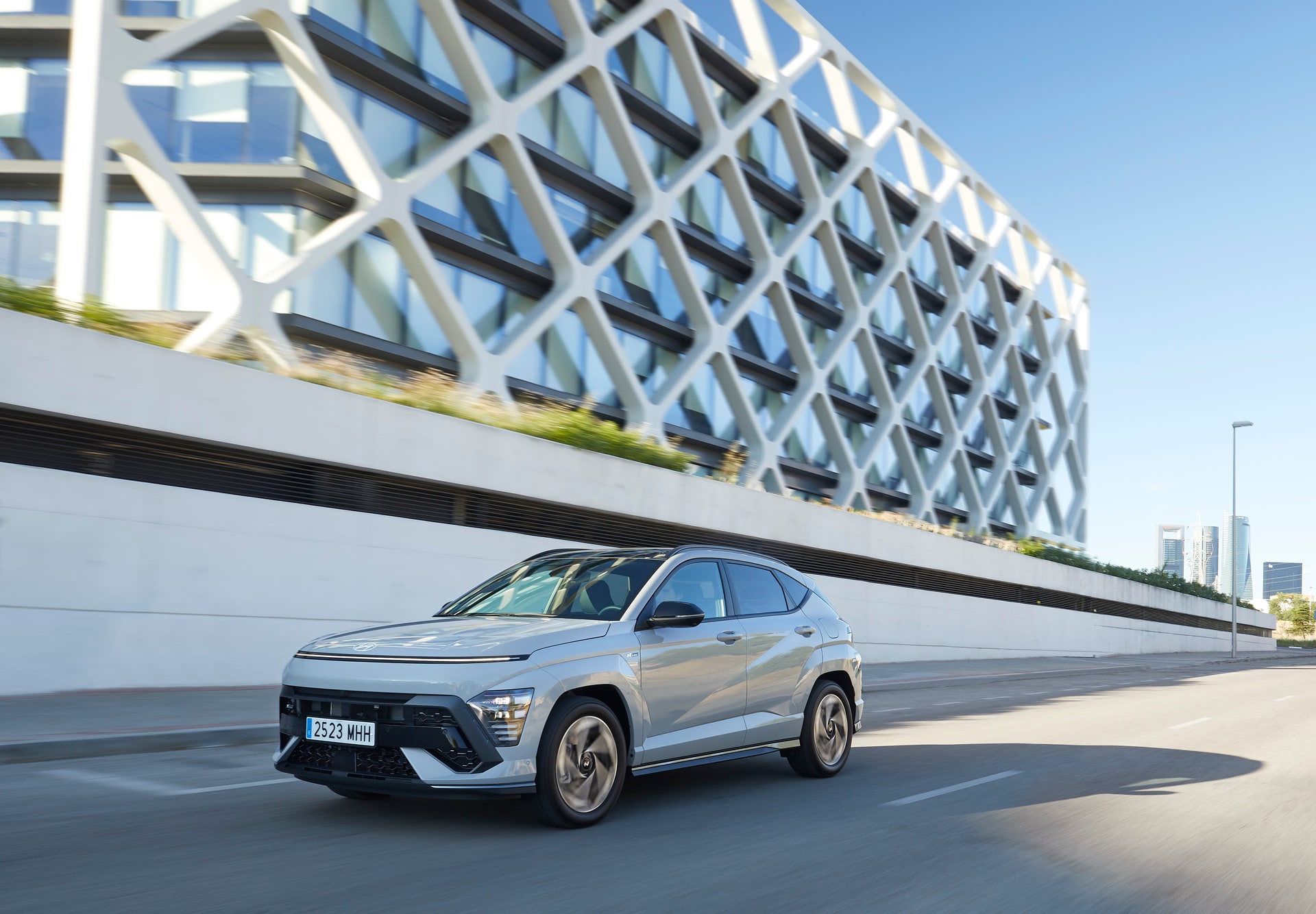
Some cars earn their reputation through design, and others through how far they go on a tank of fuel. The Hyundai Kona Hybrid clearly belongs to the second group. After several days alternating city driving, secondary roads and a stretch of motorway, the impression it leaves is that of an SUV-B that has understood that, in 2026, real-world consumption weighs more in the purchase decision than any catalogue figure.
Design and presence: the Korean SUV-B that makes a statement
The Kona keeps that angular, almost futuristic body that sets it apart from the other urban SUV-Bs. The front light bar is already a signature of Hyundai, and in the version we tested there is evident work on panel fit and exterior materials that places the car a step above its previous generation.
Interior and space: technology without sacrificing room
The curved dual screen dominates the dashboard and handles everyday use well. The boot is not the largest in the segment, but rear seat space is surprising for an SUV-B: two adults travel without discomfort on journeys of over two hours, something not all rivals manage as well.
HEV 1.6 GDI + DCT mechanics: the real key to consumption
Here lies the central argument of this review. The Kona Hybrid mounts a 1.6 GDI engine combined with a dual-clutch gearbox (DCT), an uncommon solution compared with the CVTs that dominate the HEV segment. Why does it matter? Because the DCT transmits power more directly, without the “accordion” effect of sustained revs that characterises many CVTs on climbs or overtaking. The result is noticeable mainly on country roads and motorways, where the engine does not need to hold a high rev range to sustain speed.
Real-world consumption in town, on country roads and on the motorway
In urban cycle, the hybrid system behaves as one would expect from a well-calibrated full hybrid: electric pull-away, regeneration under braking and a combustion engine that cuts in only when needed. Where it really stands out is on sustained motorway stretches, terrain historically hostile to CVT hybrids. For the exact WLTP homologated consumption figures of this generation, the correct step is to consult the official technical sheet published by Hyundai Spain, which is the valid reference source for this data.
Why the DCT makes the difference against its rivals’ CVT
The Toyota Yaris Cross, a historic benchmark of the segment for efficiency, resolves its transmission with a planetary gear system without fixed gears. It works, and works well in town. But on the motorway, that constant-revs pattern can translate into slightly more irregular consumption than that offered by a gearbox with real gears like the Kona’s. It is a difference of philosophy, not just of figures.
Hyundai Kona Hybrid versus its direct SUV-B segment rivals
The Spanish hybrid SUV-B landscape in 2026 is more crowded than ever. The Ford Puma hybrid offers a more dynamic driving proposition, with a suspension that prioritises control over comfort. The Renault Captur E-Tech full hybrid, meanwhile, stands out in urban cycle thanks to very finely tuned electric management, although it loses some punch on the open road. The Jeep Avenger, although in its mild hybrid version it does not reach the same efficiency level as these three, competes on equipment and on an off-road image that the Kona does not seek to match.
Dynamic behaviour and comfort
The Kona does not aim to be sporty, and it is right not to pretend otherwise. The steering is light, comfortable in town, and the front axle conveys confidence through corners without jolts. That said, on poorly surfaced roads the ride is felt somewhat more than in the Puma, which filters small irregularities better.
Equipment, technology and safety
The version tested includes the usual level 2 assistance package from Hyundai: emergency braking, blind-spot warning and adaptive cruise control. Nothing revolutionary compared with the competition, but a standard level that does not require moving far up the range to have the essentials covered.
Price of the Hyundai Kona Hybrid in Spain
Hyundai Spain has not published, for this article, a closed and verifiable figure for the RRP of the hybrid variant reviewed, so we refer the reader to the manufacturer’s official sheet for the updated price, always as the recommended RRP and excluding offers, dealer discounts and aid such as the Plan Auto+, which may alter the final outlay.
Necessary clarification: the electric Kona is not the model analysed
It is worth cutting through any confusion here. The figures of 135 CV / 99 kW, 380 km of range, a 48.6 kWh battery and a price from ≈38,100 € that circulate associated with the Kona correspond exclusively to the Kona EV 135 49kWh Black Line variant, a fully electric model completely different from the hybrid we have tested here. Mixing both data sheets is a common error in quick comparisons, and it should be avoided.
| Model | Power | Top speed | Range | Battery | Fuel | Price from |
|---|---|---|---|---|---|---|
| Hyundai Kona EV 135 49kWh Black Line | 99 kW / 135 CV | 162 km/h | 380 km | 48.6 kWh | Electric | ≈38,100 € |
Summary comparison table
| Model | Engine | Strong point | Highmotor score (1-10) |
|---|---|---|---|
| Hyundai Kona Hybrid | Hybrid (1.6 GDI + DCT) | Stable motorway consumption | 8.3 |
| Toyota Yaris Cross | Hybrid (CVT) | Efficiency in town | 8.1 |
| Ford Puma | Hybrid | Driving dynamics | 7.8 |
| Renault Captur E-Tech | Full hybrid | Urban electric management | 7.9 |
| Jeep Avenger | Mild hybrid | Equipment and SUV image | 7.2 |
Who is the Hyundai Kona Hybrid for?
If your daily use combines city driving with frequent motorway trips, the Kona Hybrid has a solid case that few rivals match right now. For those who only drive in town, the Yaris Cross remains hard to beat.
Highmotor verdict
The Hyundai Kona Hybrid is neither the cheapest nor the sportiest SUV-B in its segment, and it does not need to be. Its merit lies in having solved, with a mechanical solution different from most, one of the chronic problems of urban hybrids: losing efficiency as soon as the journey gets longer. That alone is a weighty reason to keep it on the 2026 shortlist.
Frequently asked questions
How much does the Hyundai Kona Hybrid really consume on the open road?
The official WLTP figure should be checked in the technical sheet of Hyundai Spain, but the DCT gearbox design favours more stable behaviour on the motorway compared with equivalent CVT systems.
Is the Hyundai Kona Hybrid the same as the Hyundai Kona EV?
No. They are two different powertrains. The figures of 135 CV / 99 kW, 380 km of range and a 48.6 kWh battery belong only to the Kona EV 135 49kWh Black Line variant, not to the hybrid version.
Which rival is closest to the Hyundai Kona Hybrid in consumption?
The Toyota Yaris Cross is the closest benchmark in the segment in terms of efficiency philosophy, although with a CVT transmission instead of the Kona’s DCT.
Does the price of the Hyundai Kona Hybrid include aid such as the Plan Auto+?
No. The RRP is the manufacturer’s recommended price, excluding dealer discounts and public aid. To find out the current amount of the Plan Auto+ it is advisable to consult the official programme website.
Technical specifications of this car

 Kia offers an electric range of 10 models, 50 versions and 400 possible combinations
 The seven finalists for the 2027 European Car of the Year (COTY) are exclusively electric
 Peugeot E-208 GTi: a battery-powered toy that revives the spirit of the 1980s sports cars
Deja un comentario