Review Hyundai Santa Fe 2026: why the most disruptive design in its segment redefines the seven-seat family SUV
 Dani Montesinos
4 August 2026
6 min.
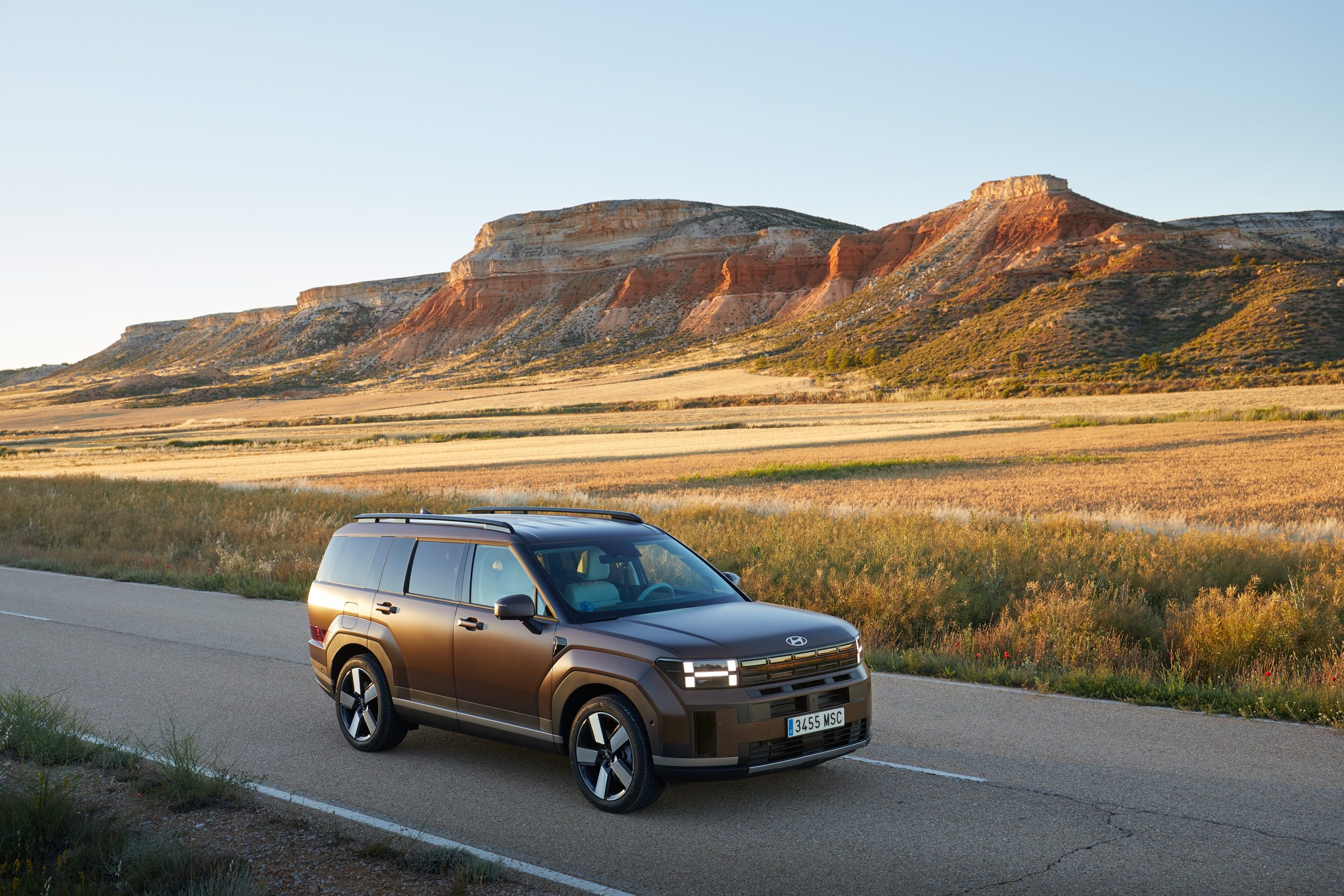
We analyse the Hyundai Santa Fe 2026 HEV with 240 CV: boxy design, a usable third row and a hybrid proposition that shakes up the D-SUV segment
Some cars evolve and some cars break the mould. The Hyundai Santa Fe 2026 belongs to the second group, and it does so with an aesthetic conviction not seen in a conventional family SUV for years. The fifth generation abandons the soft lines of the past to embrace a square, almost architectural silhouette that recalls a Land Rover Defender more than the Santa Fe many remember parked outside the school gate.
A design that breaks with everything before
The first visual contact is disconcerting. H-shaped headlights, vertical tail lights integrated into the tailgate, flat surfaces and a very generous wheelbase. The new Santa Fe does not flirt with European minimalism or Asian baroque: it proposes its own language, boxy and functional, which in our view suits it remarkably well. It is one of those designs that doesn’t quite make its case in photos, but on the street it commands attention.
The boxy bet: when functionality takes the lead
Hyundai justifies this silhouette with an argument that is hard to refute. A flat roof and contained overhangs allow it to gain centimetres where it matters: in the heads of second- and third-row passengers. Compared with rivals whose roofs slope down for aesthetic reasons, here real use comes first.
Liveability: the third row that actually works
Access and real space in the third row
Here comes the surprise. The Santa Fe’s third row is not the usual symbolic punishment for adults. With the second row slid to its midpoint, a 1.75 m passenger travels without brushing the roof and with knees at a dignified angle for hour-long journeys. For a weekend with a large family, it does the job. That said, for trips longer than two hours in a row, adults will prefer the second row.
Boot and modularity
With seven seats in use, the boot shrinks to a handkerchief — common across the segment. Folding the third row, capacity grows to figures worthy of a large estate, and the low floor with a double compartment houses the HEV system’s cabling without stealing usable height.
Interior: two panoramic screens and rethought ergonomics
The dashboard adopts the curved 12.3″ double screen already familiar from the group, but Hyundai has had the good sense to keep physical climate controls and a central console with double wireless charging. The materials sit a step above what the price would demand: soft foams where the hand rests, real aluminium on the grab handles.
Mechanics: the 239 CV 1.6 TGDi HEV
How it behaves on the road
The 1.6 TGDi hybrid unit delivers 239 CV combined and pushes the Santa Fe along with more ease than expected for 1,900 kg. It is not a car for spirited driving — the high bodywork and deliberately light steering discourage it — but on a Madrid–Cádiz run at legal speeds it behaves with notable composure. The six-speed automatic gearbox works well; it only feels slightly slow when you ask for kick-down from cruising speeds.
Real-world consumption and efficiency
Officially it homologates at 6.5 l/100 km and 144 g/km of CO₂. In practice, with calm driving, it is realistic to expect between 6.8 and 7.5 l/100 km in mixed use. In town, electric mode engages generously and drops below 6 l/100 without acrobatics. ECO environmental label from the DGT — an important point for anyone living in a low-emission zone (ZBE).
| Power kW | Power CV | Top speed | Range | Consumption | Label | Fuel |
|---|---|---|---|---|---|---|
| 176 kW | 239 CV | 196 km/h | ≈900 km | 6.5 l/100 km | ECO | Hybrid |
Price and positioning against the competition
The Santa Fe HEV 1.6 TGDi Maxx starts from approximately €49,520. It is not cheap — that must be said — but it offers seven useful seats, an ECO label and a design that looks like nothing else. It is worth remembering that these prices are the manufacturer’s recommended retail price (PVP), without dealer discounts, one-off campaigns or purchase grants.
Context: the rest of the seven-seat hybrid D-SUV segment
In the Spanish market it competes with rivals such as the Kia Sorento HEV (its technical sibling), the Toyota Highlander hybrid, the Skoda Kodiaq and the Peugeot 5008. Each with its own approach: the Czech more rational, the French more aspirational, the Japanese more proven.
Summary table: the Santa Fe against its direct rivals
| Model | Engine | Label | Seats | Price from | Score |
|---|---|---|---|---|---|
| Hyundai Santa Fe HEV | 1.6 TGDi 240 CV | ECO | 7 | €49,520 | 8.8 |
| Kia Sorento HEV | Hybrid | ECO | 7 | €51,863 | 8.5 |
| Skoda Kodiaq | Petrol/Diesel | C | 7 | €46,800 | 8.0 |
| Peugeot 5008 | Hybrid/Electric | ECO/ZERO | 7 | €35,150 | 7.9 |
Compared with the segment’s Japanese benchmark, the Santa Fe’s approach comes close to the philosophy we saw in the Toyota RAV4 vs Honda CR-V duel, but one step up in size and price.
Verdict: is the 2026 Santa Fe the new benchmark for the segment?
In my view, yes — with nuances. It is the most charismatic seven-seat family SUV you can buy in Spain today without crossing into German premium territory. Its third row genuinely works, its HEV powertrain convinces in town and on the road, and its design has the courage to look like nothing else. Is it perfect? No. The steering wants more weight and the entry price is daunting. But as an overall proposition, it redefines what a family D-SUV can aspire to be.
Anyone looking for a more rational approach within the group’s own ecosystem can also review our take on how to choose a family hybrid SUV in 2026.
Frequently asked questions
How much does the Hyundai Santa Fe 2026 HEV cost in Spain?
The Maxx trim with the 239 CV 1.6 TGDi hybrid engine starts from approximately €49,520. The price is indicative, with discounts offered by the brand.
What environmental label does the Hyundai Santa Fe HEV have?
The DGT ECO label, which allows unrestricted access to the low-emission zones in force in Spain’s main cities.
Is the Santa Fe 2026’s third row really usable?
Yes, for adults on short journeys and for children or teenagers on longer trips. The boxy design with its flat roof frees up enough headroom, something many rivals in the segment sacrifice for aesthetics.
What is the real-world consumption of the 240 CV Santa Fe HEV?
It homologates at 6.5 l/100 km. In real use, expect figures between 6.8 and 7.5 l/100 km in mixed driving with calm driving, and below 6 l/100 km on urban journeys thanks to the hybrid system.

 Kia offers an electric range of 10 models, 50 versions and 400 possible combinations
 The seven finalists for the 2027 European Car of the Year (COTY) are exclusively electric
 Peugeot E-208 GTi: a battery-powered toy that revives the spirit of the 1980s sports cars
Deja un comentario