Kodiaq Skoda Tayron Volkswagen Hybrid Cars Comparisons Tests SUV
Skoda Kodiaq vs Volkswagen Tayron: duel of seven-seat family SUVs from the VAG group in 2026
 Iván Navarro
29 November 2026
6 min.

We compare the Skoda Kodiaq mHEV and the Volkswagen Tayron eHybrid, the two seven-seat SUVs from the VAG group on sale in Spain in 2026, with prices starting at €46,800 and €58,000 respectively.
On paper, the VAG group has two different answers to one same question: which large family SUV should I bring home in 2026? One is offered by Skoda with the Kodiaq. The other, by Volkswagen with the Tayron. They share a platform and mechanical genes, yet they target audiences that are not exactly the same —starting with the fact that one can be fitted with seven seats while the other, in its plug-in variant, is limited to five—. This comparison of VAG group family SUVs aims to clarify where the real difference lies, beyond the badge on the front.

Skoda Kodiaq 2026: specs and price from €45,700
The Czech Kodiaq arrives with a clear proposition: a light mild hybrid, no plug, aimed at those who cover many kilometres and don’t want the hassle of cables. In our opinion, the mHEV 1.5 TSI 150 Selection 5p S/S DSG is the most sensible entry point in the range for a family looking for space —with the option of seven seats— without blowing the budget.
| Version | Power | Top speed | Consumption | CO₂ | Fuel | Price from |
|---|---|---|---|---|---|---|
| Skoda Kodiaq mHEV 1.5 TSI 150 Selection DSG | 110 kW / 150 CV | 210 km/h | ≈6.0 l/100 km | ≈138 g/km | Petrol/electric mild hybrid | ≈€45,700 |
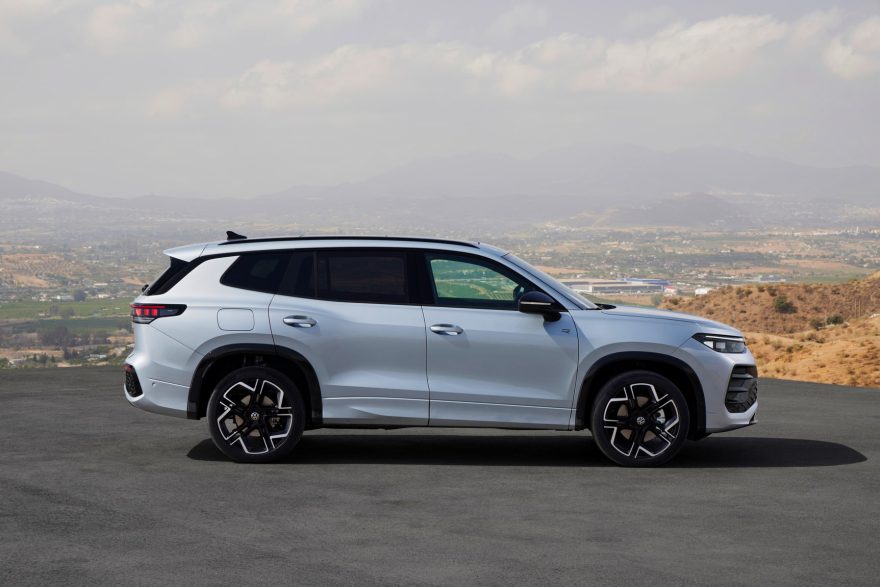
Volkswagen Tayron 2026: specs and price from €58,000
The Tayron plays a different game. It is the large SUV that Volkswagen offers as a plug-in alternative within its range, with an eHybrid powertrain that combines power and, on paper, drastically reduces homologated emissions, although at the cost of giving up the third row of seats available in other versions of its range. The eHybrid 1.5 TSI DSG6 is the reference configuration on the Spanish market.
| Version | Power | Top speed | Electric range | Consumption | Battery | CO₂ | Fuel | Price from |
|---|---|---|---|---|---|---|---|---|
| Volkswagen Tayron eHybrid 1.5 TSI 204 ‘Más’ DSG6 | 150 kW / 204 CV | 210 km/h | ≈120 km | ≈0.4 l/100 km | 25.7 kWh (19.7 kWh usable) | ≈9 g/km | Petrol/plug-in PHEV | ≈€58,000 |

Design and cabin: two interpretations of the same platform
Outside, the Kodiaq adopts a more sober, formal language, almost utilitarian in the best sense: straight lines, a vertical grille, a body that prioritises interior volume over aesthetic gesture. The Tayron, on the other hand, allows itself a more aggressive front end and a slightly sportier body waistline. Inside, the difference shows in the finish: Volkswagen pushes a little harder on soft-touch materials and screen integration, although the Kodiaq doesn’t fall far behind either — Skoda has learned to disguise its “value” brand positioning within the group very well.
Engine and mechanics: Kodiaq mHEV vs Tayron eHybrid
This is, for us, the real point of divergence. The Kodiaq mHEV 1.5 TSI 150 CV opts for simplicity: a 48V mild hybrid that helps with pull-away and energy recovery, but never runs in fully electric mode. It is efficiency without a plug, without range anxiety, without depending on a charging point in the garage.
The Tayron eHybrid 1.5 TSI 204 CV raises the power bar —204 CV versus 150 CV— and adds a 25.7 kWh gross battery (19.7 kWh usable) that allows, according to the manufacturer, around 120 km of homologated electric range. In everyday driving that figure can fall short if you use the air conditioning flat out or drive on the motorway, but for urban and suburban journeys it can cover much of the week without visiting a petrol station.
Consumption, range and environmental label
The Kodiaq’s homologated combined consumption is around 6.0 l/100 km, with emissions of approximately 138 g/km of CO₂. The Tayron, thanks to its plug-in status, declares a WLTP combined consumption of just 0.4 l/100 km and emissions of 9 g/km, which in practice translates into a CERO label versus the ECO that corresponds to the Kodiaq. That label difference is no minor detail: it affects access to certain low-emission zones and can make a difference when claiming aid such as the Plan Auto+, whose amounts should always be checked on the official website before closing the purchase.

Space, seats and boot
There is a key nuance here that is worth being very clear about before deciding: while the Kodiaq mHEV can optionally be configured with seven seats —with a third row designed more for occasional journeys than for adults on a daily basis—, the Tayron eHybrid is only available in a five-seat configuration, since the battery housed under the rear floor prevents fitting the two additional seats (reserved solely for the Tayron’s combustion and mild-hybrid variants). The Kodiaq, in fact, has a well-earned reputation as one of the family SUVs with the best interior packaging in its class, something we already discussed when analysing how to choose a family plug-in hybrid SUV in 2026. The Tayron eHybrid offers a very capable 705-litre boot in five-seat configuration, although it gives up quite a lot of volume compared with the Kodiaq mHEV five-seater’s 910 litres because of the hybrid system.
Price and versions: where the real jump is
The starting price gap between the two is around €12,300: from ≈€45,700 for the Kodiaq (in five-seat configuration) versus from ≈€58,000 for the Tayron, always as recommended RRP without dealer promotions. It is a considerable jump that is only justified if you will actually plug the car in every day —otherwise you are paying for technology you won’t make the most of.
Comparative summary table
| Model | Power | Fuel | CO₂ | Price from | HighMotor score |
|---|---|---|---|---|---|
| Skoda Kodiaq mHEV 1.5 TSI 150 | 110 kW / 150 CV | Mild hybrid | ≈138 g/km | ≈€45,700 | 7.8/10 |
| Volkswagen Tayron eHybrid 1.5 TSI 204 | 150 kW / 204 CV | PHEV | ≈9 g/km | ≈€58,000 | 8.1/10 |

Which to choose? The HighMotor verdict
If you need seven seats or your day-to-day means motorways and long distances without easy access to a charger, the Kodiaq mHEV remains the option with the most practical and economic sense. If, on the other hand, five seats are enough for you, you have a wallbox at home and make short journeys during the week, the Tayron eHybrid pays back its premium with fewer visits to the pump and a better label. It is not a panacea either —120 km of electric range doesn’t cover everything— but within the context of VAG group family SUVs, it is the most coherent alternative for anyone who wants to reduce consumption without giving up power.
Frequently asked questions
What is the price difference between the Skoda Kodiaq and the Volkswagen Tayron in 2026?
The Kodiaq mHEV starts at around €45,700, while the Tayron eHybrid starts at around €58,000, always as recommended RRP without discounts or incentives applied.
Which has more electric range, the Kodiaq or the Tayron?
The Kodiaq is a mild hybrid with no pure electric range. The Tayron eHybrid does offer electric-mode driving, with around 120 km homologated thanks to its 25.7 kWh battery (19.7 kWh usable).
Which model has the better DGT environmental label?
The Tayron eHybrid, being a PHEV with homologated emissions of about 9 g/km of CO₂, qualifies for the CERO label. The Kodiaq mHEV carries an ECO label.
Is it worth paying more for the Volkswagen Tayron over the Skoda Kodiaq?
It depends on your use and the number of seats you need: if five seats are enough, you plug it in every day and make use of journeys in electric mode, the Tayron pays off in consumption and taxation. If you need seven seats or mostly use it on motorways without access to charging, the Kodiaq is the logical and most cost-effective choice in the short term.
Technical specifications of the cars in this article


 Kia offers an electric range of 10 models, 50 versions and 400 possible combinations
 The seven finalists for the 2027 European Car of the Year (COTY) are exclusively electric
 Peugeot E-208 GTi: a battery-powered toy that revives the spirit of the 1980s sports cars
Deja un comentario