Suzuki Vitara: 30 years since the creation of one of the first modern SUVs
 Jaime Gomez
30 May 2017
4 min.
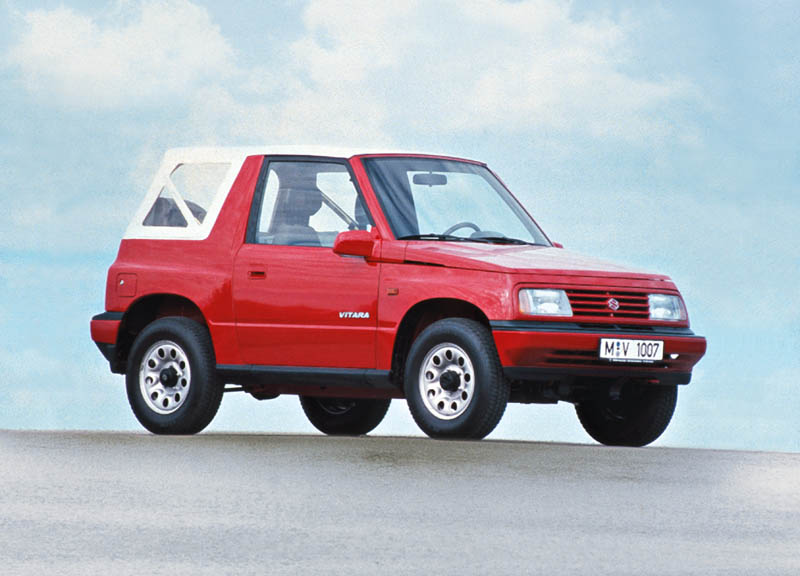
The Suzuki Vitara turns 30 years old since the first generation was launched. We look back at the history of one of the SUVs that set the trend in the segment.
Although SUVs may seem like an invention of our time, the reality is quite different. It has been 30 years since Suzuki decided to create the Vitara, betting on a design and type of vehicle that was absolutely innovative at the time. A year later, in 1988, the Vitara hit the market to become one of the first modern SUVs in history.
From the outset, this crossover already combined the features of today’s market leaders: attractive design, a high and compact body, light weight, impeccable road behaviour, agility in the city, and good off-road capabilities.
First generation (1988-1997): one of the first modern SUVs
During the official presentation of its first generation at the 1988 Tokyo Motor Show, the Vitara surprised with its bold philosophy; its compact three-door body had nothing in common with the bulky 4x4s already on the market. Its identity was based on relaxed lines that gave it an attractive, urban design which at the same time blended with the muscle provided by other more rugged elements of its body, such as its iconic rear tailgate or its roof (canvas or fibreglass) that allowed the rear seats to be left open to the air.
The first generation was sold on five continents and made the Vitara one of the flagship models of Suzuki during its first 9 and a half years of life, in which it exceeded one million units produced.
Second generation (1998-2005): first seven-seat SUV
Like the first, the second generation of the Vitara also remained on the market for many years. The second evolution of this model was renamed Suzuki Grand Vitara. Broadly speaking, its design was refined, with more dynamic lines – without losing its 4×4 essence – and a much more sophisticated interior. In addition, the Vitara’s chassis was reworked to improve its handling and ride quality on asphalt.
As for practical details, the transfer case lever disappeared. Now, the driver could switch from 4×2 to 4×4 with a button in the cabin. These changes and improvements culminated in the arrival in 2001 of the Grand Vitara XL-7, a model with which Suzuki was once again a pioneer by offering an affordable seven-seat SUV for the general public. Based on the five-door Vitara, the XL-7 had a wheelbase 320 mm longer and was 485 mm longer overall. This version conquered the market thanks, among other things, to its powerful 2.7-litre V6 engine.
Third generation (2005-2014): more traction and driving modes
In 2005 the third generation of the Vitara arrived, which continued to push the SUV concept further and moved away from conventional off-roaders. Suzuki introduced several design revisions, a slightly smaller size, emissions control and a wide range of updates to make the Grand Vitara an SUV suited to the new times.
In addition, the new Vitara featured a monocoque chassis with two integrated longitudinal side members and independent suspension on all four wheels. The Japanese crossover incorporated a sophisticated all-wheel drive system with four driving modes, which could be selected from the instrument cluster.
Fourth generation (2014 – present): back to its roots
In 2014 the fourth generation of this iconic model arrived, returning to its roots in philosophy and reinstating the name Suzuki Vitara.
The current Vitara boasts a much more compact, modern and streamlined look. An urban yet aggressive image. It is a car that moves like a fish in water on asphalt and does not tremble when it leaves it.
The Vitara comes loaded with new technologies, with the latest connectivity and infotainment solutions controlled from a large touchscreen. The same applies to safety, where the Vitara boasts a robust body and driver assistance systems, such as the brake assist system and adaptive cruise control. The engine line-up consists of two 1.6-litre engines, both petrol and diesel, which deliver 120 and 140 CV of power, respectively.
The new Suzuki Vitara offers a blend of elements that meets the demands of the sector, and demonstrates that the SUV that pioneered the market is still in top form.
Technical specifications of this car


 Peugeot E-208 GTi: a battery-powered toy that revives the spirit of the 1980s sports cars
 New Lexus ES: luxury grows and goes electric
 First contact with the Dacia Sandero Hybrid 155: power and efficiency from €19,890
Deja un comentario