Porsche Sports Cars Range / versions Historia
These are the most powerful Porsche production models in its history
 Óscar Sanz
20 November 2024
3 min.
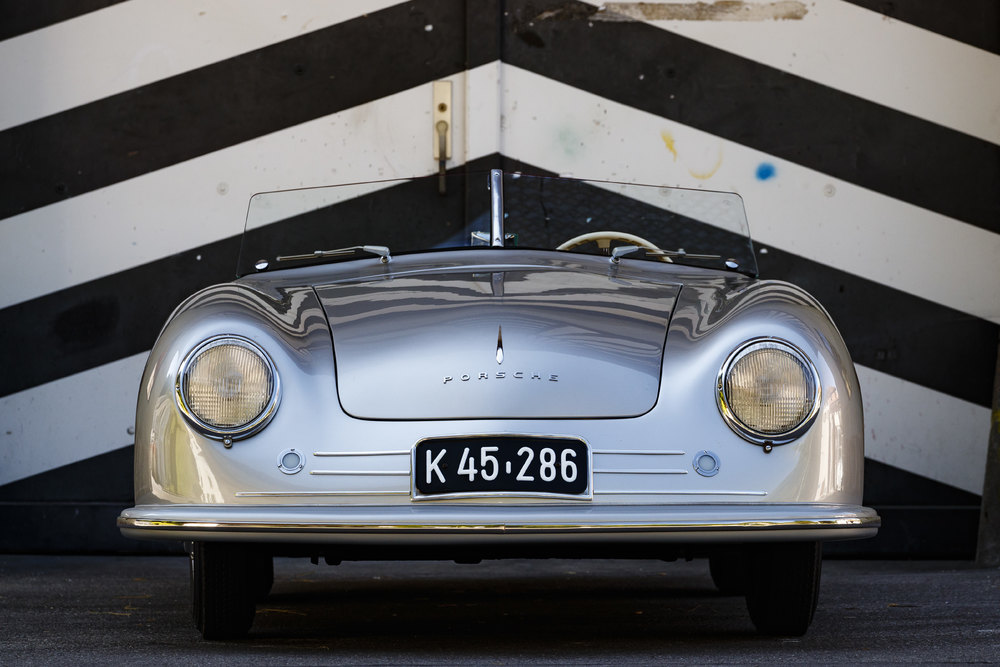
From the 35 hp of the Porsche 356 to the Taycan Turbo GT with over 1,100 hp, discover how Porsche has pushed the limits of power for 76 years
From the birth of the Porsche 356 in 1948 to today’s Taycan electric models, Porsche has maintained an unwavering commitment to performance and innovation. Over its 76 years of history, the brand has produced 21 models that were, at their time, the most powerful in their production line. Below, we review this evolution in different stages, from the first lightweight sports cars to electric supercars.
1950s: The beginnings of the 356
The Porsche 356 was the brand’s first production model, equipped with an engine producing just 35 hp. This car stood out not so much for its power, but for its lightness (585 kilos) and aerodynamics, offering a unique driving experience for its time. Over the years, this model evolved, reaching 100 hp in 1955 with the 356 A 1500 GS Carrera, designed for competition enthusiasts.
1960s: The 200 hp barrier
The leap of Porsche towards higher performance levels came with the 718/8 W-RS Spyder in 1962, a model with an 8-cylinder engine that reached 210 hp. This sports car won prestigious races such as the Targa Florio and the 1,000 km of Nürburgring. Meanwhile, the 356 range continued to improve and the first 911 began writing its own history.
The 70s: The era of the Turbo
In 1974, Porsche presented the 911 Turbo, its first model with a turbocharged engine. With 260 hp and an acceleration from 0 to 100 km/h in 5.2 seconds, this car revolutionized the world of sports cars. It was the first Porsche to demonstrate that competition technology could be successfully applied to road vehicles.
1980s: Technology and all-wheel drive
The introduction of the Porsche 959 in 1986 marked a new milestone. With 515 hp, all-wheel drive and electronic suspension, this model not only led in power for more than a decade, but also became an icon of automotive technology. Its impact was so great that it served as the basis for Porsche’s advances in the following years.
The 90s: Competition supercars
The arrival of the 911 GT1 Strassenversion in 1997 took Porsche’s performance to another level. This model, based on competition cars, offered 544 hp and consolidated the brand as a benchmark in supercars. It was a demonstration of how Porsche could bring track technologies directly to the road.
21st century: The era of supercars
The Carrera GT, launched in 2003, redefined what a Porsche could offer. With a V10 engine of 612 hp derived from competition, it was the brand’s first model manufactured in carbon fiber. Later, the 918 Spyder combined electrification with a V8 engine to reach 887 hp, marking the beginning of a new era of high-performance hybrids.
Today: Electric power
Today, the Taycan Turbo GT with the Weissach package is the most powerful Porsche in history. This electric model reaches 1,108 hp, surpassing the 1,000 hp barrier for the first time in a production car from the brand. It represents the future of Porsche, combining the tradition of extreme power with the sustainability of electrification.

 Peugeot E-208 GTi: a battery-powered toy that revives the spirit of the 1980s sports cars
 New Lexus ES: luxury grows and goes electric
 First contact with the Dacia Sandero Hybrid 155: power and efficiency from €19,890
Deja un comentario