V-hot and V-cold engines: how they work, differences, advantages and disadvantages of each system
 Antonio Roncero @roncero_antonio
18 July 2023
4 min.
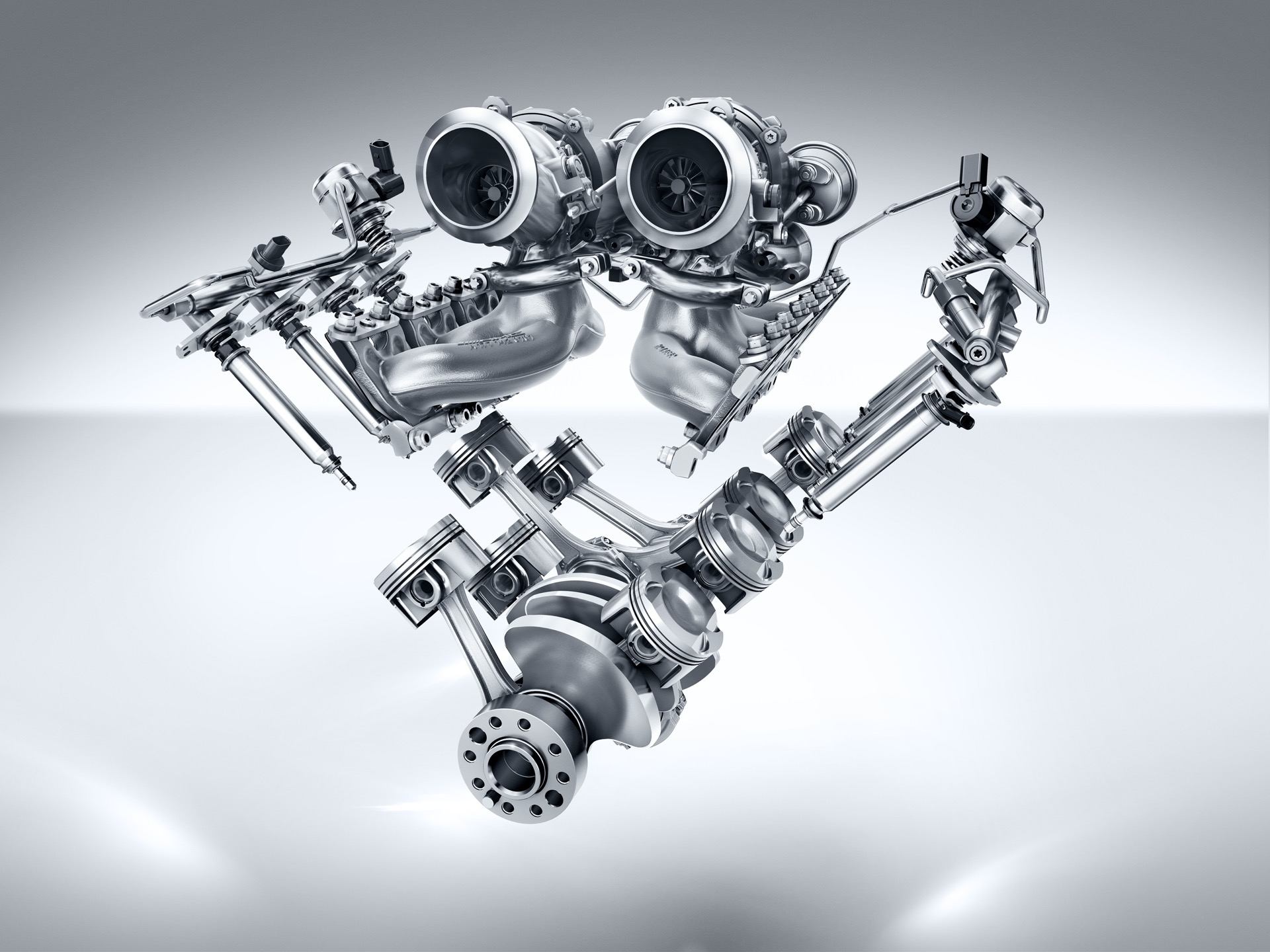
Known as V-hot or Hot inside V, these are the engines whose exhaust manifolds and turbochargers sit inside the V formed by the cylinder banks.
You’ve surely heard of V-hot engines, also known as “Hot inside V” or, in Spanish, “V caliente” engines. And if I tell you that when we talk about the “hot” side of an engine we usually mean the side where the exhaust system is, while the cold side is the intake, I’m sure you’re starting to get the picture.
Differences between a V-hot and a V-cold engine
Indeed, in a V engine, each of the two cylinder banks has its own “hot” side and its own “cold” side. The usual arrangement, especially in naturally aspirated engines, is to pair the “cold” sides on the inside of the V and leave the “hot” sides on the outside. This allows a single intake manifold in the centre of the V, and makes it easy to route the exhaust manifolds from the sides of the V down toward the lower part of the engine.
This “V-cold” layout is not exclusive to naturally aspirated engines; forced induction with turbochargers works perfectly well with it, in which case it is normal to use one turbocharger per cylinder bank, placed on the sides of the engine, outside the V. There are many examples of V engines, both petrol and diesel, that follow this “V-cold” scheme.
I particularly remember the Audi RS 6 (C6 generation, from 2008), no less than with a V10 TFSI. It comes to mind because it was a car that had serious trouble shedding heat when you drove “hard” in high outside temperatures. Although the problem was not directly related to the turbocharger layout outside the V, but to the fact that it was a very bulky engine and everything was very tightly packed in the RS 6’s engine bay.
In fact, in the next generation of the RS 6, presented in 2012, the 5-litre V10 TFSI gave way to a much more compact 4-litre V8, and it adopted a “V-hot” configuration, with the exhaust sides and turbochargers inside the V. But this is by no means an invention of Audi: back in the 1980s it was already used by Ferrari in its Formula 1 single-seaters. And of the first V-hot engines I remember testing, the one in the first BMW X6 xDrive 50i, back in 2008, stands out. It was an engine with two Twin-Scroll turbochargers fed by the exhaust gases from a single manifold. I also can’t forget other “hot” V8s, such as those in the Mercedes-AMG GT or the first Porsche Panamera Turbo. In fact, in this video you can see the V8 of the AMG GT running.
https://www.youtube.com/watch?v=kkNKNYNFflw&t=81s
Why is a “V-hot” engine better?
But why is a V-hot arrangement better when it comes to turbocharged engines? First, because, as you well know, what makes turbochargers work is the engine’s exhaust gases. The closer the turbochargers are to the exhaust manifolds, the shorter the distance the gases have to travel to reach the turbine, so there are fewer losses of pressure, temperature and velocity; in short, of exhaust gas energy. The efficiency of the forced-induction system improves, thereby reducing turbo lag, or the delay in turbo response.
On its own, this would already be a considerable advantage. But there are others of a technical and even industrial nature. A V-hot engine with the turbochargers in the centre of the V is much more compact, which allows greater flexibility in fitting additional modules in the engine bay, or in laying out the steering, the suspension… In addition, the “cold” and “hot” sections of the engine (never a truer phrase) are more clearly separated. On the other hand, it is also easier, mainly because of the aforementioned compactness, for a “V-hot” engine to be used across a wider range of vehicles, compared with a “V-cold” with the turbos on the outside of the “V”, which requires a larger engine bay.
As for the possible problems that this “V-hot” configuration might entail, none of them is beyond solving, as has been shown, with materials capable of withstanding very high temperatures, and with water and oil cooling systems and intercoolers that allow precise temperature control. The other drawback would be the placement of the weight of the forced-induction system higher up, something usually counteracted by using dry-sump lubrication systems.
V-hot and V-cold engines image gallery


 Peugeot E-208 GTi: a battery-powered toy that revives the spirit of the 1980s sports cars
 New Lexus ES: luxury grows and goes electric
 First contact with the Dacia Sandero Hybrid 155: power and efficiency from €19,890
Deja un comentario