Vehicles from Rivian debut a new AI-powered voice assistant
 Javier Cantagalli
13 May 2026
2 min.
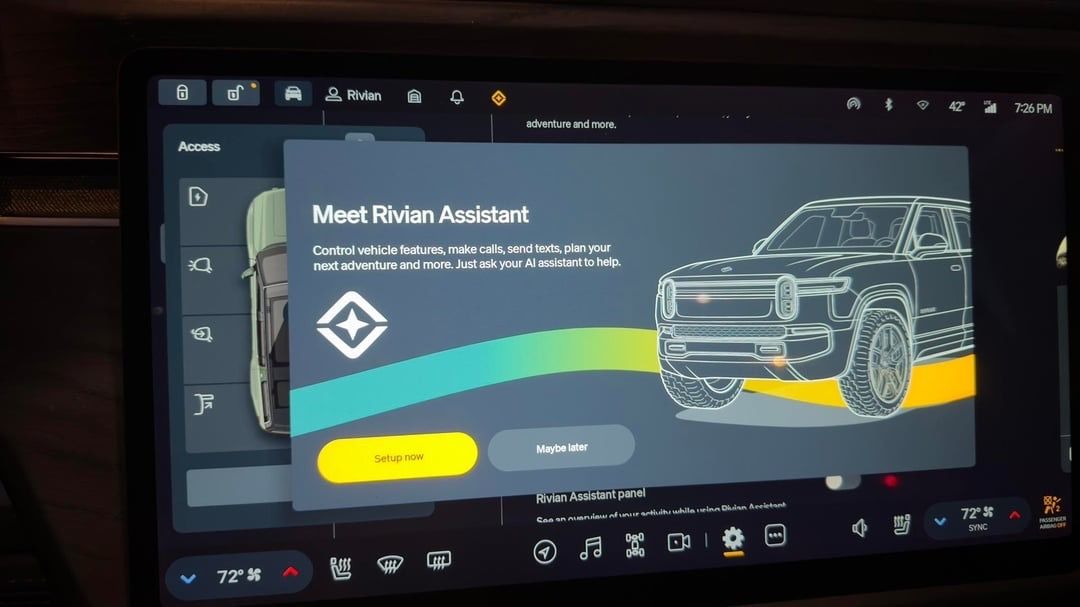
With this launch, Rivian takes an important step toward a more intelligent and human-like interaction between the driver and their electric vehicle, enhancing the everyday driving experience.
Rivian has begun rolling out its new AI-powered assistant across the brand’s entire fleet of vehicles already on the road, via an OTA software update. The company announced this launch last December during its Autonomy & AI Day event and confirmed the feature would arrive in early 2026. Now, as promised, Rivian Assistant is already available to owners of the brand’s vehicles.
The main goal of Rivian with this initiative is to take voice commands to a much more advanced and natural level. Instead of rigid, limited phrases, with Rivian Assistant drivers will be able to converse with the vehicle fluently, as if they were talking to a person. The integration of this type of assistant is increasingly common in the automotive industry. Recently, General Motors, Volvo and Polestar announced the integration of Google Gemini, while the most modern Tesla incorporate Grok, from xAI.
Rivian Assistant stands out for its deep integration with the vehicle’s hardware and software. It does not rely on technology from a connected mobile device, but is integrated directly into the car, which allows it a greater level of control over certain vehicle functions. Rivian says this new assistant combines AI models developed in-house by the company with external ones, with the ultimate aim of delivering more complete and accurate answers to the driver.
Every driver’s interaction with their Rivian reaches a new level
Its capabilities include complex actions that go well beyond traditional assistants. Simply say “Hey Rivian” or press a button on the steering wheel to adjust driving modes, activate the vehicle’s cameras, get information about nearby points of interest, or carry out multi-step commands. For example, you can ask it to send a contact restaurant recommendations along with the estimated arrival time calculated by the navigation system. Moreover, the assistant keeps track of the conversation’s context and can answer general knowledge questions.
Another notable advantage is its role as a “vehicle encyclopedia“. Instead of searching the owner’s manual, drivers can directly ask how to change a tire, how a system works, or any technical detail, and receive a clear and helpful explanation.

 Peugeot E-208 GTi: a battery-powered toy that revives the spirit of the 1980s sports cars
 New Lexus ES: luxury grows and goes electric
 First contact with the Dacia Sandero Hybrid 155: power and efficiency from €19,890
Deja un comentario