Clase V Mercedes Multivan Volkswagen Comparisons Minivans Tests
Volkswagen Multivan vs. Mercedes-Benz V-Class: a duel of premium people carriers for private transfers
 Iván Navarro
8 November 2026
5 min.
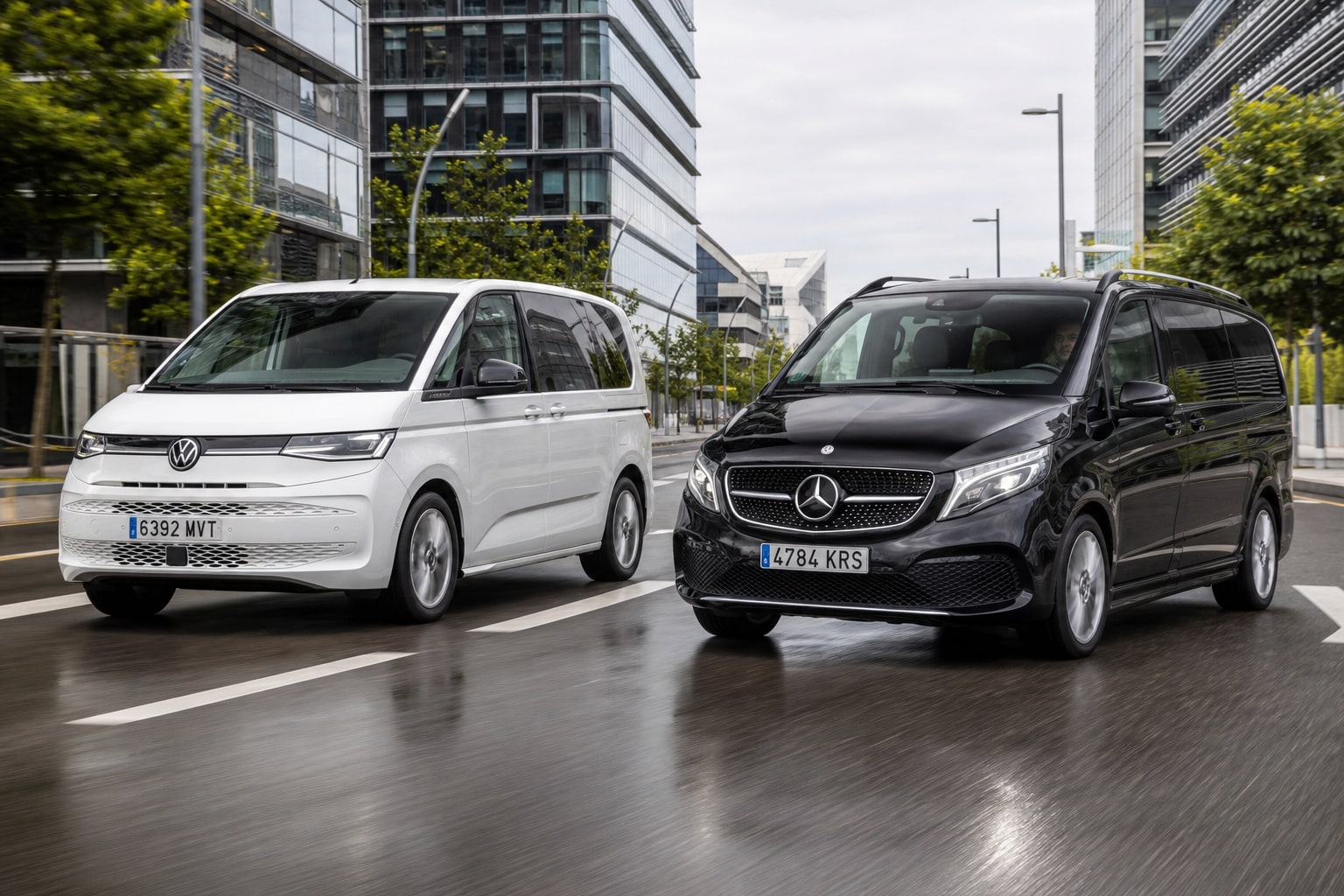
Some fleet decisions cannot be made just by looking at the technical data sheet. When a private transfer company or a VIP chauffeur chooses a vehicle, they are also buying a perception: the one the customer experiences in the back seat. This is where two different approaches meet, that of the Volkswagen Multivan and that of the Mercedes-Benz V-Class, separated by about 14,500 euros of indicative RRP and by a different understanding of what “premium” means in a people carrier.
Volkswagen Multivan 2.0 TDI, from about €61,690: the functional-premium people carrier
The Multivan has been the reference for generations for those who need versatility without giving up a certain level of finish. In its 2.0 TDI 150 hp configuration with 7-speed DSG7 gearbox, it does not seek to dazzle with power; it aims to do its job well, day after day, without surprises. And it achieves this with a homologated consumption of 6.4 l/100 km, a figure that on airport-hotel or intercity routes translates into a fairly modest cost per kilometre for the segment.
In our view, its strong point is not representational image but balance: a modular cabin, good soundproofing for the price, and handling closer to a car than to an adapted van, which is exactly what many of these vehicles were a decade ago.
| Model | Power (kW) | Power (hp) | Top speed | Consumption | CO₂ emissions | Fuel | RRP from |
|---|---|---|---|---|---|---|---|
| Volkswagen Multivan 2.0 TDI 150 DSG7 | 110 kW | 150 hp | 190 km/h | 6.4 l/100 km | 169 g/km | Diesel | ≈€61,690 |
Mercedes-Benz V-Class 220 d, from about €76,200: representation and luxury for the VIP chauffeur
The V-Class plays a different game. Here the goal is not only to transport, but to represent. Mercedes-Benz knows this and designs accordingly: higher perceived upholstery quality, a driving silence that is especially noticeable on motorways, and an exterior presence that commands respect at the door of a five-star hotel. With 163 hp and the 9-speed 9G-Tronic automatic gearbox, the 220 d is not the most economical in consumption —it homologates 7.1 l/100 km, somewhat more than the Multivan— but it compensates with a smoothness of ride that, for this specific use, weighs almost as much as the fuel figure.
The price difference is not entirely convincing when analysed on paper alone, but it should be qualified: in corporate transfers and high-level events, the end customer pays for the brand they see when they open the door. And there the Mercedes-Benz star still carries a weight that few rivals match.
| Model | Power (kW) | Power (hp) | Top speed | Consumption | CO₂ emissions | Fuel | RRP from |
|---|---|---|---|---|---|---|---|
| Mercedes-Benz V-Class 220 d Compact 9G-T | 120 kW | 163 hp | 193 km/h | 7.1 l/100 km | 187 g/km | Diesel | ≈€76,200 |
Volkswagen Multivan vs Mercedes V-Class: technical and price comparison
Side by side, the numbers tell a clear story. The Multivan has around 150 hp against the V-Class’s 163 hp, a small difference that is barely noticeable behind the wheel. Where it does show is in the wallet: about 14,500 euros of difference at entry level is a lot of money for a fleet of several units, and that capital can be allocated to other items —maintenance, renewal, staff— depending on the business model.
Consumption also tilts the balance towards the Multivan, with about 0.7 litres less per 100 km, which in a vehicle that accumulates high mileage (as is often the case in VIP transfers) becomes a relevant figure at year end. That said, it should be remembered that these are manufacturer’s recommended retail prices, without dealer promotions or fleet discounts, so actual negotiation can narrow that gap considerably.
Which people carrier suits a private transfer company?
There is no single answer here, and it would be a mistake to pretend otherwise. If the operation focuses on high-volume executive transfers —airport, station, corporate offices— where the customer values punctuality and discretion over ostentation, the Multivan more than meets the need and leaves room for profitability. If, on the other hand, the business involves weddings, representative events or clients who expect a visible level of luxury from the first second, the V-Class justifies its price with a brand perception that the Multivan, though very good, does not quite match.
For those who also value rear space and comfort on long journeys, we have already analysed how to choose a large people carrier or SUV for transporting passengers on long trips, with criteria that apply directly to this type of fleet.
Summary table: Volkswagen Multivan vs Mercedes V-Class
| Model | Power (hp) | Consumption | RRP from | Functionality score (1-10) | Representation score (1-10) |
|---|---|---|---|---|---|
| Volkswagen Multivan 2.0 TDI 150 | 150 hp | 6.4 l/100 km | ≈€61,690 | 8.5 | 7 |
| Mercedes-Benz V-Class 220 d | 163 hp | 7.1 l/100 km | ≈€76,200 | 7.5 | 9.5 |
Frequently asked questions
Which is cheaper, the Volkswagen Multivan or the Mercedes V-Class?
The Multivan 2.0 TDI starts at an indicative RRP of about €61,690, compared with approximately €76,200 for the V-Class 220 d. Both figures are manufacturer’s recommended prices, without dealer discounts or offers.
Which people carrier consumes less?
The Multivan homologates 6.4 l/100 km compared with the V-Class’s 7.1 l/100 km, a difference that adds up in fleets with high annual mileage.
Which is better for a VIP transfer company?
It depends on the positioning of the service: the Multivan is more profitable for high-volume operations, while the V-Class offers a superior level of representation for high-end events.
Are there public grants for buying these people carriers?
As they are diesel models, they usually do not fall within the most favourable cases of the Plan Auto+, which is mainly aimed at electrified vehicles. It is advisable to check the official plan website for the current conditions.


 Kia offers an electric range of 10 models, 50 versions and 400 possible combinations
 The seven finalists for the 2027 European Car of the Year (COTY) are exclusively electric
 Peugeot E-208 GTi: a battery-powered toy that revives the spirit of the 1980s sports cars
Deja un comentario