70 years of the Fiat 600: from popular icon to urban electric
 Óscar Sanz
25 November 2025
5 min.
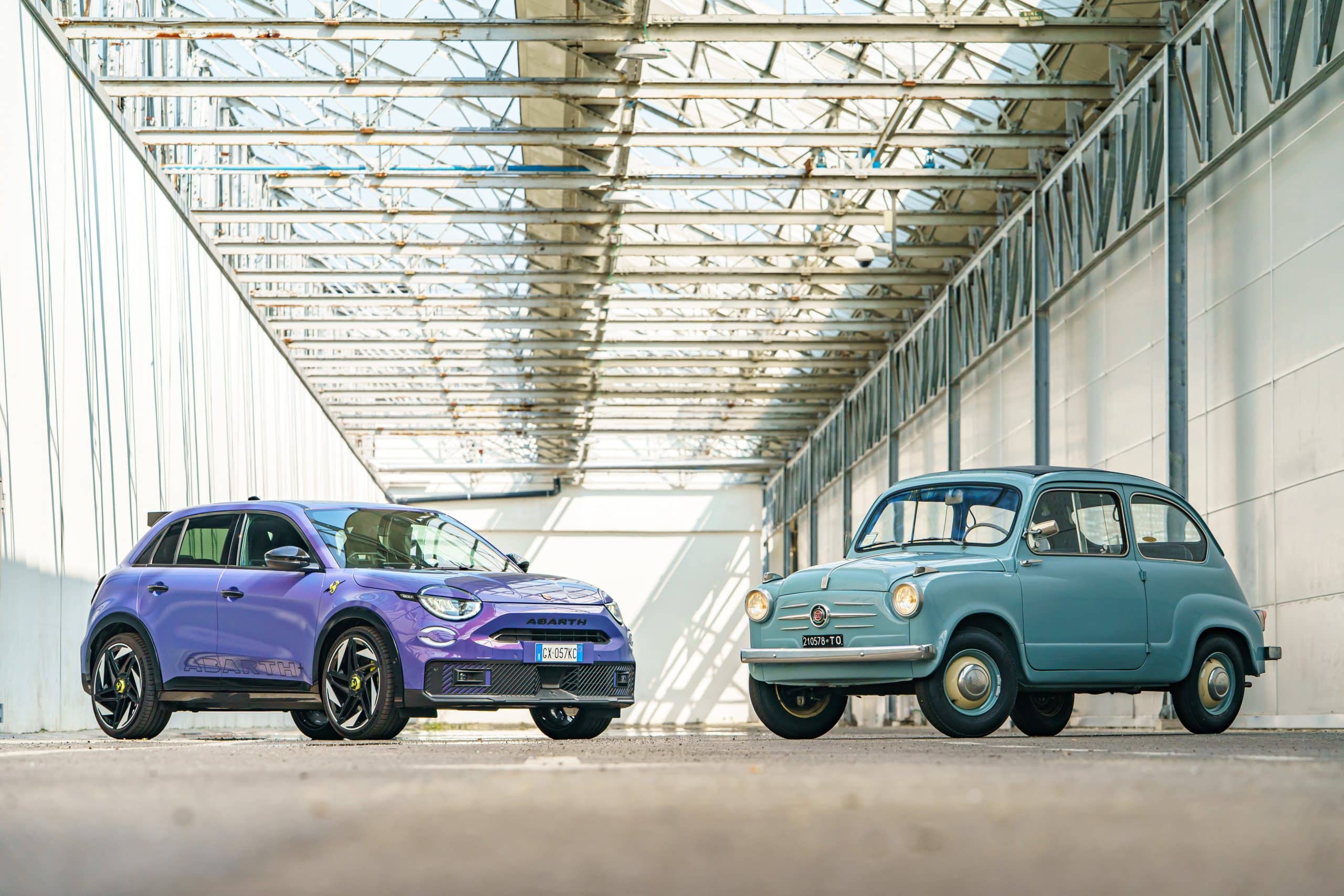
The Fiat 600 was the gateway to freedom for millions of families. Today, its name returns to show that classics can be reinvented without losing their soul
Seventy years after its debut, the Fiat 600 remains much more than a small post-war city car. Its story, tied to economic growth, urban mobility and the everyday life of millions of people, remains surprisingly relevant. That compact model, unveiled in 1955, not only won over the public; it redefined what an affordable car could offer on a continent beginning to rebuild.
When Fiat presented the 600 at the 1955 Geneva Motor Show, it did so with the aim of offering an affordable, practical vehicle capable of transforming everyday life. Without grand artifice, but with clever engineering, the new model quickly convinced those who needed efficient and economical transport.
The rear-mounted engine, the lightweight body and the efficient use of space made it an ideal tool for an era marked by economic recovery. That balance between simplicity and usefulness was the foundation of a success that crossed borders and endures to this day…
It grew far beyond expectations
The industrial trajectory of the Fiat 600 shows how deeply it connected with society. More than 4.9 million units built in Italy and Latin America speak for themselves. But the phenomenon was not merely numerical. In Spain, its adaptation as the SEAT 600 marked a before and after: it symbolised the country’s modernisation, brought the car within reach of families who had never owned one, and became the protagonist of a decade that changed mobility forever. That is where the original vision of Fiat — producing a car “for everyone” — found its fullest expression.
The technical proposition of the 600 stood out for its functional logic. With a small, reliable engine that was simple to maintain, this model democratised not only access to the car but also its everyday use. Driving was simple; repairs were simpler still.
To this were added especially ingenious variants, such as the 600 Multipla, which expanded interior capacity without altering the concept of a compact urban car. Its bold styling anticipated solutions that decades later would be recognised as forerunners of modern MPVs.
Preserving the Fiat spirit in an age of electrification
The new Fiat 600 — now in electric and hybrid form — is not simply a commercial revival; it is a conscious exercise in preserving identity. In an industry immersed in technological transition, Fiat has worked to ensure that the reinterpretation of the model does not lose what defined the brand: closeness, optimism, functionality and a design that aims to be friendly rather than aggressive.
The rounded front, the compact proportions, the urban focus and the friendly character that always accompanied Fiat have been reinterpreted for the 21st century. Even the interior keeps a close, practical philosophy: smart storage solutions, an intuitive layout and a style that avoids the technological coldness dominating many of today’s electric cars.
Fiat has understood that its cars have always been designed to accompany everyday life, not to dominate it. That is the common thread linking the classic 600 with the modern one:
remaining accessible, remaining useful and remaining recognisable.
Not a nostalgic replica, but a natural evolution of an idea that has accompanied several generations.
A 600 for the 21st century
The new generation of the Fiat 600 is, in essence, a contemporary reading of the philosophy that gave life to the original model: a car designed to move with ease around the city, efficient in consumption and accessible to a broad audience. But now it does so relying on technologies that define today’s mobility.
The range opens with mild-hybrid versions that combine a 1.2-litre petrol engine with 48-volt electric assistance. The result is around 100 CV and offers agile driving, with acceleration of roughly 10.5 seconds for 0-100 km/h and very modest consumption of around 4.8 litres per 100 kilometres. For those seeking more punch, Fiat offers a variant of approximately 136 CV, equipped with a dual-clutch automatic gearbox, which adds a more dynamic character without giving up the efficiency demanded by the urban market.
The most advanced proposition is, naturally, the fully electric version. With a 54 kWh battery and a range close to 400 kilometres on the WLTP cycle, the 600e positions itself as a fully functional option for everyday use, capable of combining zero emissions with practical, realistic mobility. Fast charging allows much of the range to be recovered in competitive times, making it an urban electric car with solid credentials.
Overall, the new Fiat 600 grows in size and ambition compared with its predecessor — it slightly exceeds 4.1 metres in length and nears 1.78 metres in width — yet it keeps intact its vocation: to be a car made to accompany everyday life. It does not seek to imitate the historic model, but to update its spirit. And it achieves this by offering a modern, well-equipped range coherent with the city of the 21st century.


 Kia offers an electric range of 10 models, 50 versions and 400 possible combinations
 The seven finalists for the 2027 European Car of the Year (COTY) are exclusively electric
 Peugeot E-208 GTi: a battery-powered toy that revives the spirit of the 1980s sports cars
Deja un comentario