Active Road Noise Control, an ingenious new system devised by Hyundai
 David Lopez @espacionblanco
29 November 2019
3 min.
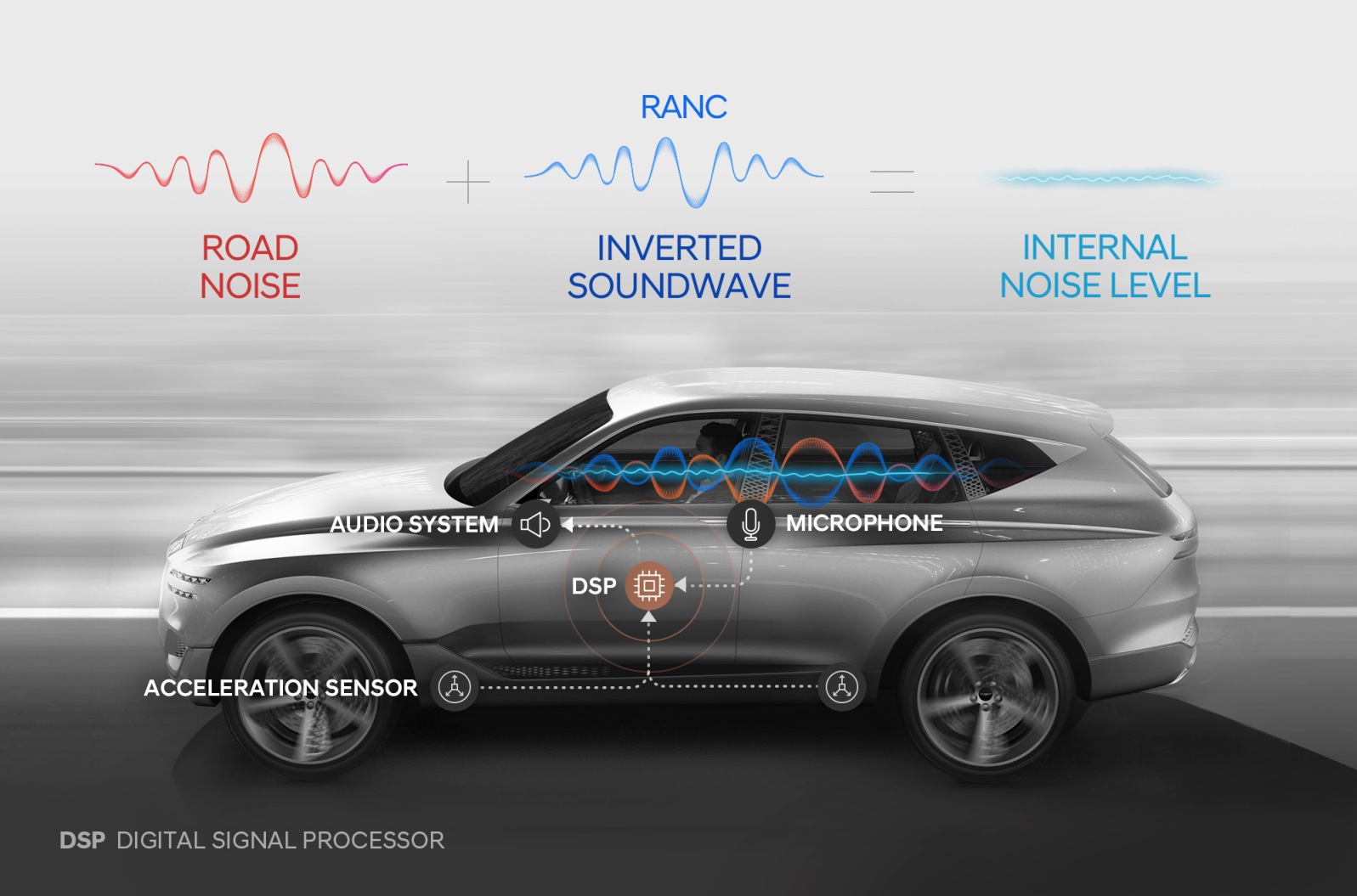
In its drive to improve its noise cancellation systems inside the cabin, Hyundai presents the new Active Road Noise Control
Over time, vehicles have become increasingly quiet for their own occupants, something especially noticeable in diesel vehicles and their characteristic sound, which is increasingly less perceptible when we drive one of these vehicles. But with the growing arrival of electric vehicles, hardly any noise can be perceived, with it being practically reduced to the sound of tyres rolling on asphalt, something that Hyundai want to eliminate as much as possible.
At present, Hyundai uses in some of its models a technology it calls Active Noise Control (ANC), which emits sound waves inverted relative to the incoming noise in order to minimise it. This technology uses software capable of analysing the sound inside the cabin to reduce engine and tyre noise, using elements such as acoustic insulation, dynamic dampers, microphones and controllers that make us perceive less noise than normal inside the vehicle.
However, although ANC technology is efficient and achieves its purpose, it remains quite limited, since road noise takes only 0.009 seconds to reach the occupants, and the technology for measuring and analysing road noise can only be used when the noise is constant and its occurrence predictable. For this reason, Hyundai has continued researching and developing this technology, and now presents the Active Road Noise Control system or RANC, which substantially improves the amount of noise that reaches the interior.
With the new RANC system it is possible to analyse the different types of road noise that can be produced while driving, such as resonant sounds created between rims and tyres or even sounds coming from the road itself. To analyse all of this, Hyundai uses an acceleration sensor, while the RANC system calculates the vibration transmitted from the road to the vehicle, and a computer analyses the road noise, a sequence that takes place in just 0.002 seconds, and an inverted sound wave is generated by a device they call Digital Signal Processor or DSP; in addition, a microphone analyses in real time the state of road noise cancellation and sends that information to the DSP.
In this way the RANC system is able to analyse noise almost instantaneously, and it does so independently for each seat in the vehicle. This technology developed by Hyundai has six years of research behind it and has already been tested in real-world situations and, according to the brand, they have managed to reduce cabin noise by up to 3 decibels, which translates into reducing the noise level by almost half compared with the current ANC system. Moreover, the introduction of this technology in future vehicles will also make them more efficient, since they will be able to weigh less by not needing so many acoustic insulation parts and noise dampers.


 Peugeot E-208 GTi: a battery-powered toy that revives the spirit of the 1980s sports cars
 New Lexus ES: luxury grows and goes electric
 First contact with the Dacia Sandero Hybrid 155: power and efficiency from €19,890
Deja un comentario