Astara Team at the 2023 Dakar: competing in the desert sustainably
 Antonio Roncero @roncero_antonio
17 November 2022
3 min.
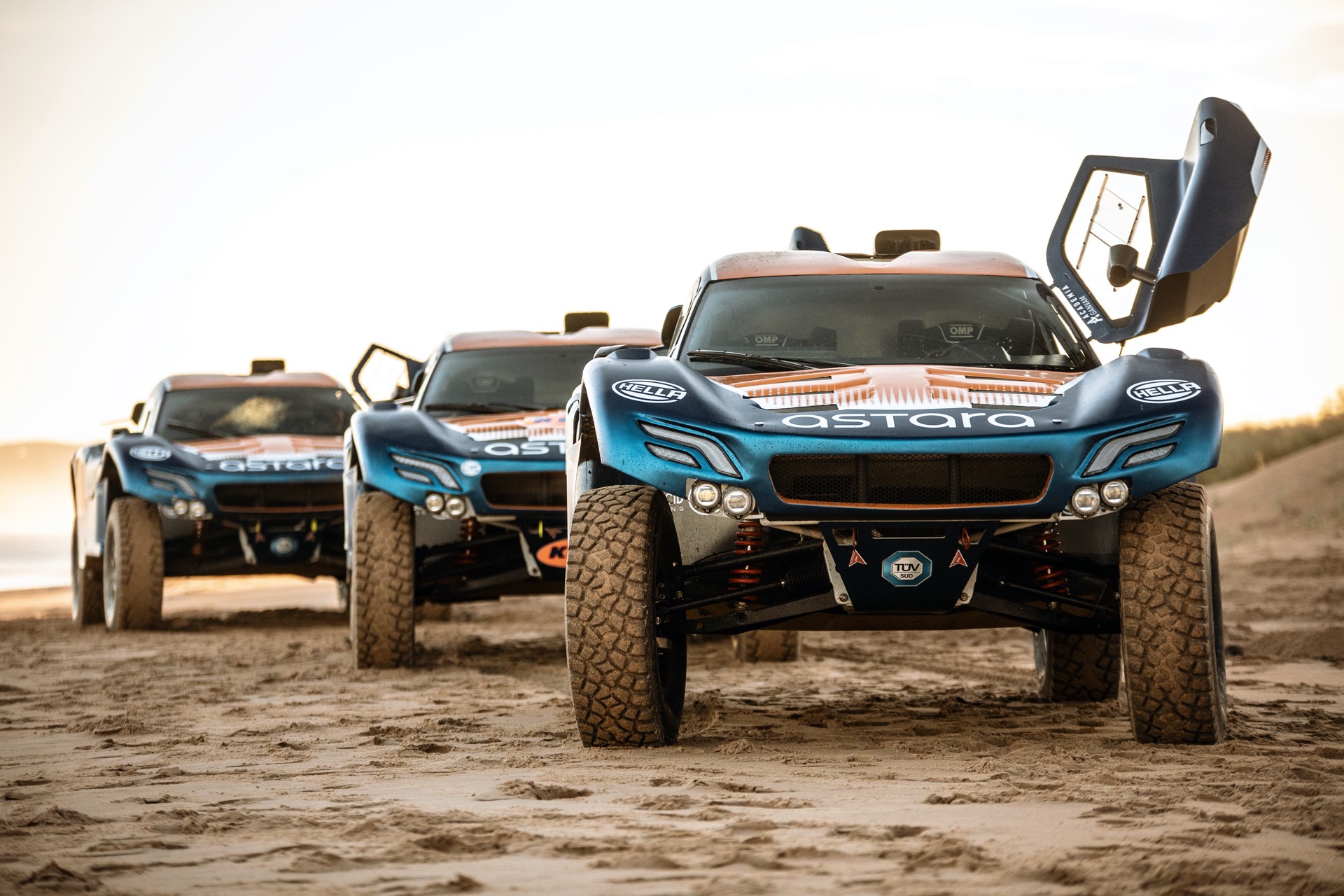
Astara returns to the Dakar with two goals. The first, like anyone taking part in a competition as demanding as the Dakar, is to reach the finish… and, needless to say, to finish as high as possible in the standings. The second is to repeat the example set in the previous edition, when Astara Team proved to be the most sustainable team in the race, competing with a car that runs on eFuel and offsetting its carbon footprint. We will go into a little more detail later on how this is achieved.
But for now, let’s talk a little about the car that will be piloted by the teams formed by Laia Sanz and Maurizio Gerini, Carlos Checa and Marc Solà, and Óscar Fuertes and Diego Vallejo.
The car: Astara 01 Concept, a 2WD buggy powered by eFuel
This year’s car is an evolution of the prototype used in 2022, a rear-wheel-drive buggy with a tubular chassis and carbon fibre bodywork that competes in the T1.3 category. Among its most notable technical features is its weight: 1,590 kg unladen, which makes it the lightest in its class. The engine is a powerful 7-litre V8 producing 370 kW (around 503 CV) at 4,700 rpm and a maximum torque of 720 Nm at 2,900 rpm. Power is delivered to the rear axle through a six-speed sequential gearbox with a triple-disc clutch.
But without a doubt, the most remarkable aspect of the Astara 01 Concept is that it runs on a fuel that is 90% eFuel, or ecological petrol. This fuel has a very high energy density: 10.7 kWh per litre. Thanks to its two 180-litre tanks, the Astara 01 Concept can start each stage with full tanks and has an energy capacity of 3,870 kWh.
Compared with last year’s car, some changes include an adapted rear subchassis to house a third spare wheel, modified mounts for the automatic tyre inflation system, and adapted injection and engine electronic management for the new eFuel, which allows CO2 emissions to be reduced by up to 90% compared with operation on conventional petrol.
Ecological fuel and carbon footprint offsetting
The proportion of eFuel that Astara Team will use increases this year to 90%, compared with 70% in the previous Dakar. The production of this ecological fuel involves subjecting a synthesis gas to chemical transformation processes using renewable energy. The result is a liquid hydrocarbon that is easy to store and has a high energy density, with an energy yield roughly 12% higher than that of petrol.
As with conventional fuels, eFuel can be transported and stored under pressure at ambient temperature, and is compatible with any type of internal combustion engine. It can therefore also be applied to maritime or air transport, either fully replacing conventional fuel or blended in any proportion.
To compete with minimal environmental impact, Astara Team will once again measure and report the carbon footprint generated during the race, according to standardised measurement protocols, which will be reviewed by an independent body. Of the three possible scopes established by this protocol (GHG Protocol, ISO 14064 standard), all three will be included this year instead of the first two, so the measurement of the team’s carbon footprint during the event will be more reliable. Astara will offset this footprint after the race, as a demonstration of its commitment to sustainable mobility.
Astara Team – Image gallery


 Peugeot E-208 GTi: a battery-powered toy that revives the spirit of the 1980s sports cars
 New Lexus ES: luxury grows and goes electric
 First contact with the Dacia Sandero Hybrid 155: power and efficiency from €19,890
Deja un comentario