Bosch develops the stereo video camera for driver assistance systems
 Francisco Javier
6 May 2015
3 min.
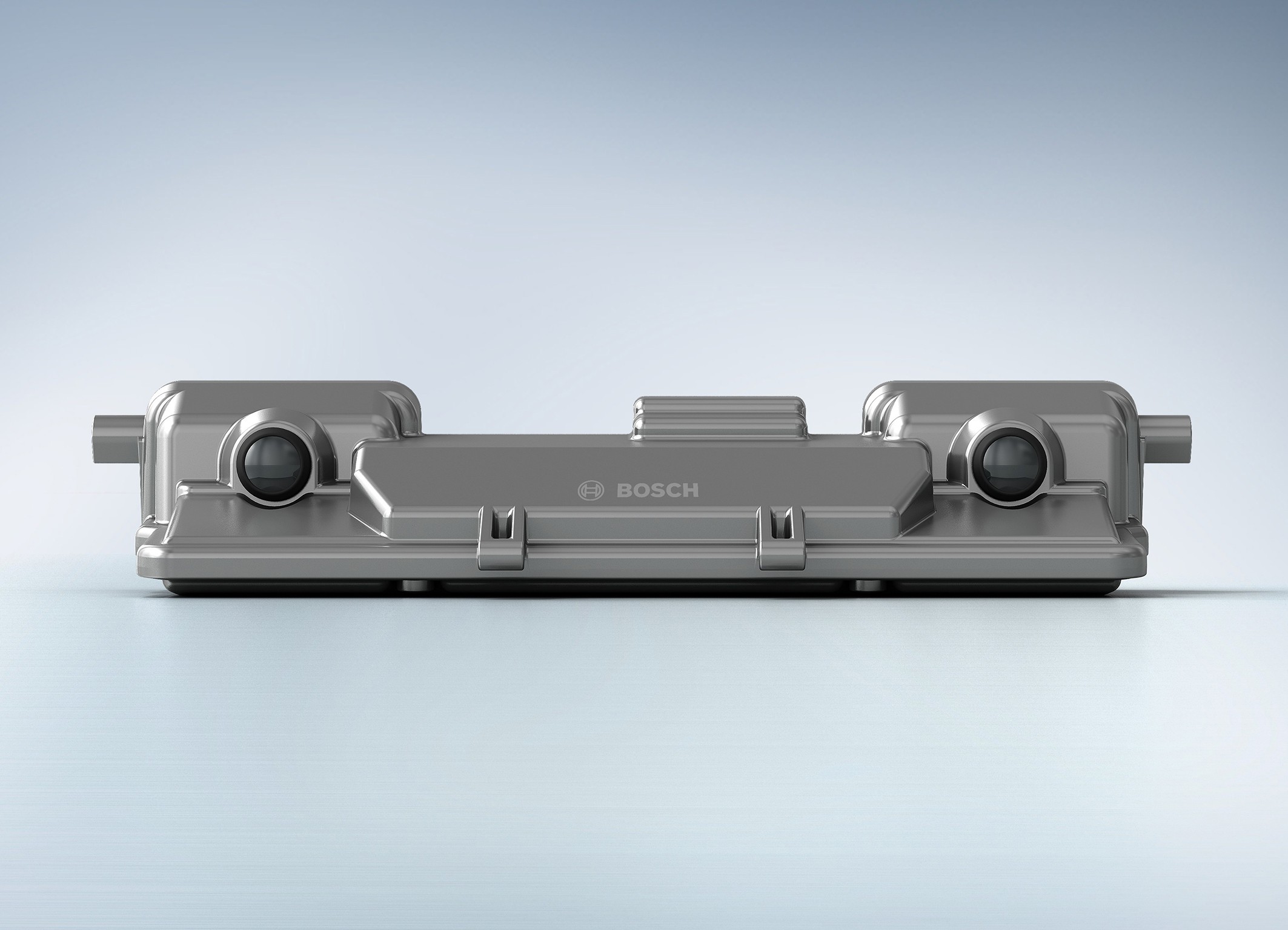
Bosch Stereo Video Camera
More and more systems, both active and passive safety, are being developed to protect the safety of the driver and passengers in the event of an accident, either mitigating the consequences or preventing it from happening altogether.
Bosch presents an innovative solution for emergency braking systems. Until now, a radar sensor or a combination of radar and video sensors was required, but in this case only one is used, which makes several assistance functions affordable for all vehicle classes.
As standard, Land Rover, offers the stereo video camera together with Bosch’s emergency braking system in the new Discovery Sport, which they developed jointly. In the Euro NCAP test, it proved its effectiveness and achieved one of the best results in the “Safety Assist” category.
Emergency Braking System
From 2016 onwards, and in order to obtain a higher score in the Euro NCAP tests, vehicles must also be equipped with a predictive pedestrian protection system. For this, Bosch’s stereo video camera can also be used as a basis.
The operation is very simple. When it detects a car travelling in the same lane that becomes an obstacle, the emergency braking system prepares to act. If it detects that the driver does not react, the system initiates full braking.
The automatic traffic sign recognition or the unintentional lane departure warning system are other driver assistance functions offered by Land Rover in its Discovery Sport, some of which are also based on Bosch’s stereo video camera.
Bosch Stereo Video Camera
The highly sensitive lenses and video sensors, equipped with colour recognition and CMOS technology (complementary metal-oxide semiconductor), can cover a horizontal field of view of 50º and can take 3D measurements at a distance of more than 50 metres. This ability to generate 3D images is an important element for automated driving.
It has a resolution of 1,280 by 960 pixels and is also capable of processing high-contrast images. Both the control unit for digital image processing and the control function are located directly in the camera housing.
It incorporates a high-performance microprocessor that enables the integration of other programmes and measurement functions, so it can be adapted to market needs. Thanks to its compact size, the smallest in its class, it can be mounted on the rear-view mirror with barely any reduction in the field of view.
Source | Bosch


 Peugeot E-208 GTi: a battery-powered toy that revives the spirit of the 1980s sports cars
 New Lexus ES: luxury grows and goes electric
 First contact with the Dacia Sandero Hybrid 155: power and efficiency from €19,890
Deja un comentario