Bugatti Chiron Veyron Supercars
Bugatti looks back at its history: EB110, Veyron and Chiron
 Redacción
3 April 2020
3 min.
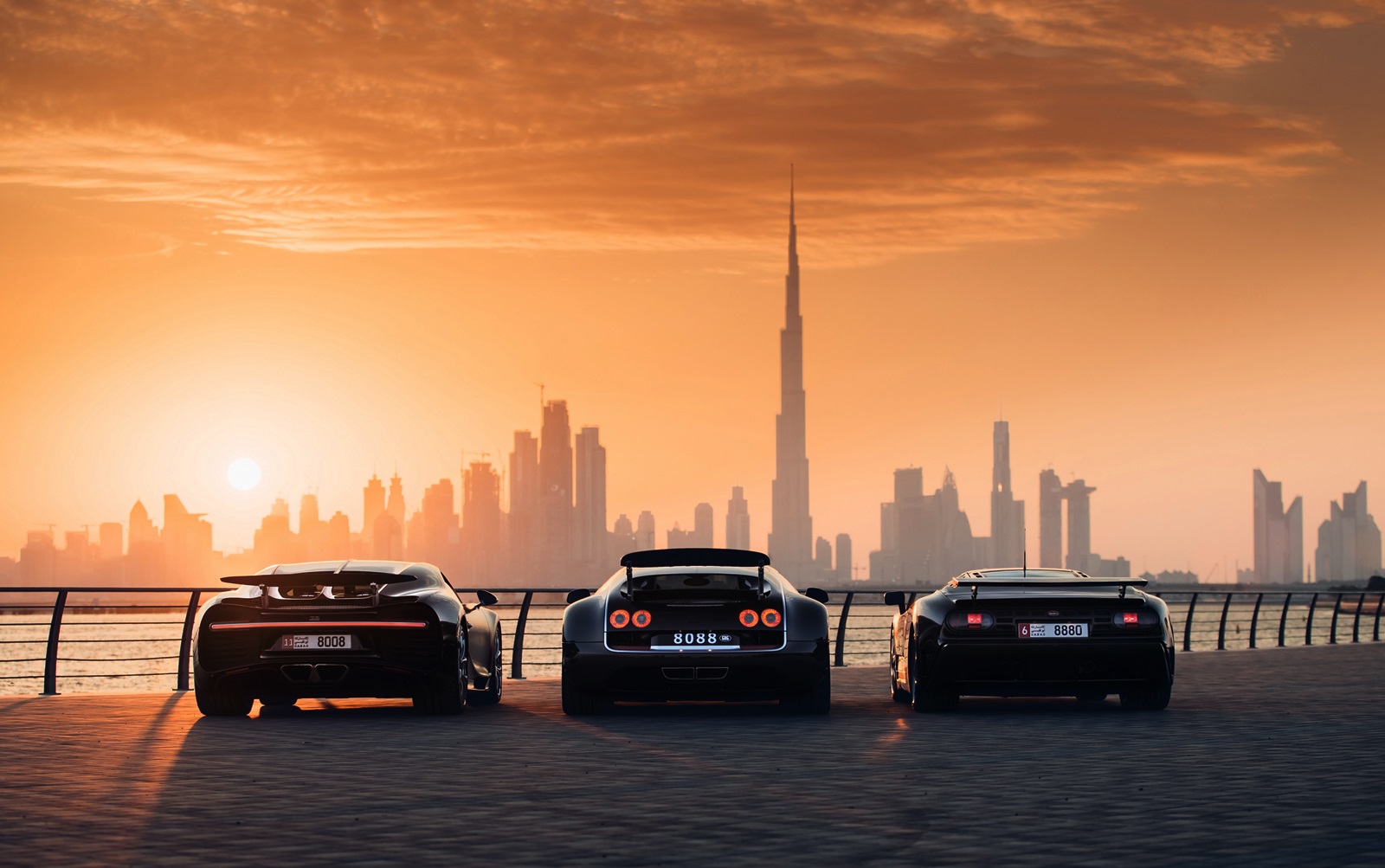
Bugatti looks back at its history through the three reference models of the last three decades. The EB 110, the Veyron and the Chiron posing together.
Fans of Bugatti dream of owning one of these three models someday. Luckily, the wealthiest do own some of them, but very few, very few, have the complete collection of these French models. Bugatti has catalogued them as the “Holy Trinity”.
Bugatti EB110 Super Sport
This model is the grandfather, the old one, the longest-serving in this range. The Bugatti EB110 was the first supercar of the modern era. The car, designed by Romano Artioli and presented in 1991, arrived to mark the 110th anniversary of Ettore Bugatti. As a birthday gift, the French firm unveiled a model with almost unprecedented performance.
It was the first production car built from carbon fibre, and its lightweight monocoque weighed just 125 kg. But the most astonishing thing about Bugatti is always its engine: that block hidden beneath the bodywork which, with every new model, surprises us the most. In the case of the EB 110, it was powered by a central 3.5-litre V12 engine with four turbos, and a rev counter needle that swept up to 8,250 rpm.
This model set four world records: fastest acceleration (3.26 seconds), fastest series-production sports car (351 km/h), fastest sports car powered by natural gas, and fastest series-production car on ice. In 1995, 96 units of the EB 110 GT were built, as well as 40 of the more powerful variant, the Super Sport. Both had 670 CV.
Bugatti Veyron 16.4 Super Sport
The Veyron was presented in 2005 and marked the start of a new century that completely changed the way the concept of a supercar was understood. The Bugatti Veyron was the first true hypercar in the world, delivering 1,000 CV and a top speed of more than 400 km/h.
Its completely new 8.0-litre W16 engine initially delivered 1,001 CV and 1,500 Nm of torque. This allowed it to reach 200 km/h in just over 7 seconds and accelerate to 100 km/h in 2.5 seconds. In 2010, the improved Super Sport version was unveiled, producing 1,200 CV, and its regulated top speed was 415 km/h. That same year, the Veyron became the fastest car in the world after recording a top speed of 431 km/h.
Bugatti Chiron
This model replaced its predecessor in 2016. The Chiron’s maximum output is an outrageous 1,500 CV and a tremendous 1,600 Nm of peak torque. This French hypercar accelerated 0-100 km/h in 2.4 seconds, 0-200 km/h in 6.1 seconds and 0-300 km/h in 13.1 seconds.
In 2019 it set a new speed record never before achieved by a series-production car. The Bugatti Chiron reached 490 km/h. This model has a price, before taxes, of 2.65 million euros.


 Peugeot E-208 GTi: a battery-powered toy that revives the spirit of the 1980s sports cars
 New Lexus ES: luxury grows and goes electric
 First contact with the Dacia Sandero Hybrid 155: power and efficiency from €19,890
Comentarios cerrados