Electric cars with solar panels: do they have a future?
 Antonio Roncero @roncero_antonio
25 March 2022
5 min.
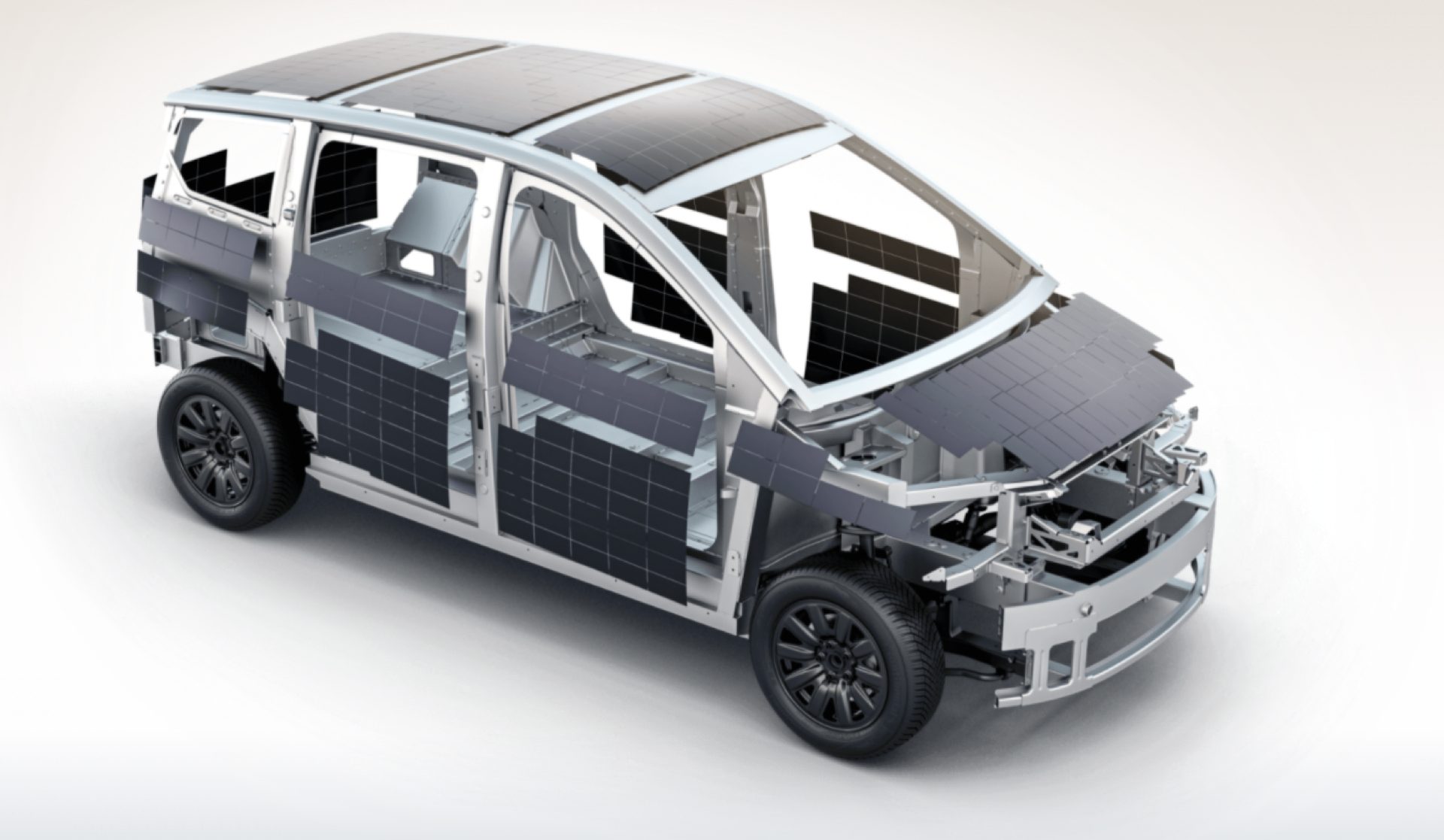
More and more manufacturers are turning to photovoltaic solar panels fitted to their electric cars to increase range. We explain how they work, their advantages… and their limitations
With the arrival of the electric car, manufacturers are leaving no stone unturned when it comes to finding ways to gain range. Every kilometre counts, and the solar panels on the roof are an alternative that we can already find on some new models.
Just to give one example, as we told you in our road test of the Hyundai Ioniq 5, the South Korean brand’s electric car offers as an option a roof with photovoltaic panels that harnesses the sun’s energy to recharge both the traction battery and the 12-volt battery for the vehicle’s auxiliary systems. According to the brand, under ideal conditions, this roof can recover enough energy to cover around 5 km a day.
A similar figure is quoted by Toyota for the solar panels, which can add up to Prius Plug-In Hybrid. With a power output of 180 W, they are capable of generating between 0.10 and 0.23 kWh. The Tesla Cybertruck was also announced with a solar panel system as an option.
Are photovoltaic solar roofs worth it?
Although the gain may seem small, it is by no means insignificant. Beyond a certain level, gaining 5 km of range in an electric car may require very drastic changes to the aerodynamics, even affecting other aspects such as comfort or interior space.
And over the course of a year, we are talking about solar panels providing around 1,000 km of extra range for “free”. That said, these figures are only possible if the car is parked in the sun for at least 4 to 5 hours a day on average over around 200 days a year. In other words, the gain from roof-mounted solar panels amounts to around 1 km of electric range per day for every hour the car is parked in the sun.
Another car that boasts about charging from the sun, the revolutionary Lightyear One, considerably increases this figure, adding around 12 km of extra range for every hour of driving under sunlight, thanks to its 5 square metres of solar panels.
But even so, it is clear that paying off an element such as a solar panel roof, if the vehicle does not include it as standard, is very difficult. However, in the short term we will see many brands offering this technology as standard, in order to improve the range of their electric cars.
Mercedes-Benz, for example, has already previewed this with the Vision EQXX prototype presented at CES in Las Vegas in 2022, equipped with this system, which it plans to offer on its new electric cars from 2024 as a standard solar roof that will add around 25 km of extra range during a long-distance journey.
Why are there not more solar cars?
What does not seem possible in the short or medium term is for us to have solar cars capable of running solely on the energy their photovoltaic panels can generate from sunlight. However much the power of these panels increases in the future, it will be very difficult for them to generate enough electrical energy to meet the demands of the vehicle’s traction battery.
The main difficulty in designing a solar car is related to the energy conversion rate of solar panels, which currently have an efficiency of around 20%. In their current state, it would take a long time with the car parked in the sun to obtain enough energy… even assuming the use of solar panels were extended to other parts of the bodywork.
An example in this regard is the Sion, from Sono Motors, a company specialising in the application of photovoltaic panels in the automotive sector, which also has interesting projects for trucks and buses. In the case of the Sion, which is advertised as “an electric car with a range of 305 km that recharges with sunlight”, it is actually an electric car with a battery that is recharged through an electrical socket, which can add around 112 km of extra range per week thanks to the solar panels it incorporates on the roof, the sides of the bodywork, the bonnet and the tailgate, totalling 248 solar cells.
That is around 15 km a day; which means that, at best, you could cover at most that distance using only the energy recovered by parking the car in the sun, without needing to plug it in.
On the other hand, there is the price factor. At present, the aforementioned Lightyear One, which may be one of the cars with solar panels with the longest range when it comes to covering distances with solar energy, costs twice as much as a Tesla Model S.
Finally, we must bear in mind that if we want to multiply the efficiency of a solar car, the application of solar cells must be extended beyond the roof, with the design problems this entails in terms of adapting the material to the shapes of the bodywork, weight, durability, and vulnerability in the event of an impact…


 Peugeot E-208 GTi: a battery-powered toy that revives the spirit of the 1980s sports cars
 New Lexus ES: luxury grows and goes electric
 First contact with the Dacia Sandero Hybrid 155: power and efficiency from €19,890
Deja un comentario