Hybrid Cars Comparisons Tests SUV
Ford Puma Hybrid vs Peugeot 2008 Hybrid: the European urban hybrid SUV put to the test
 Iván Navarro
17 May 2026
4 min.
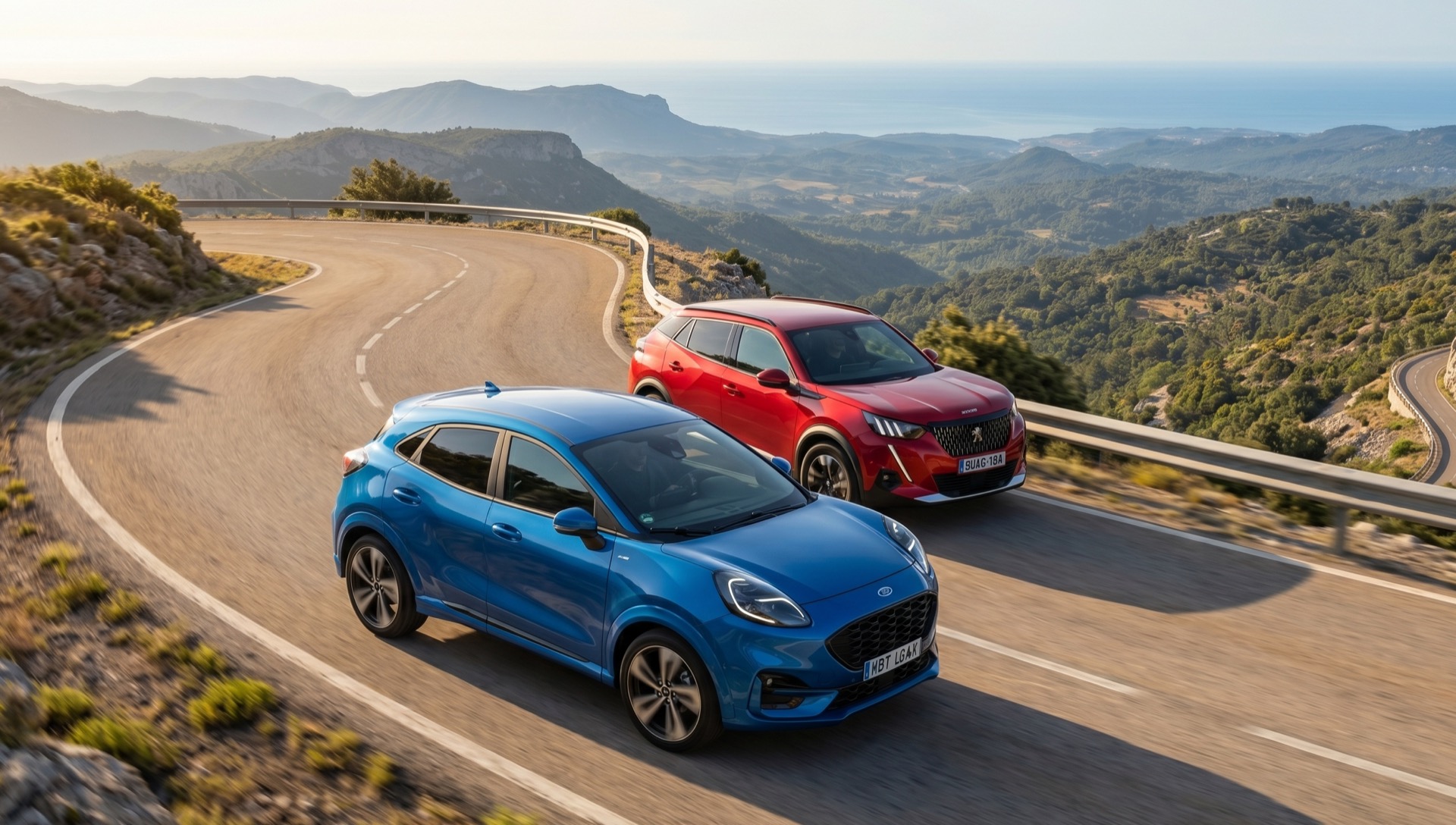
We compare the Ford Puma Hybrid and the Peugeot 2008 Hybrid face to face, the two best-selling European B-SUV hybrids in Spain. Mechanics, consumption, technology and price in detail.
The B-SUV segment has become the fiercest battleground in the Spanish market, and within it, partial electrification makes the difference between merely correct and truly outstanding. Two European references are competing for the wallet of the urban buyer who wants an ECO label without giving up versatility: the Ford Puma Hybrid and the Peugeot 2008 Hybrid. Both share a philosophy — compact SUV, electrified petrol, family orientation — but they diverge on almost everything else, starting with the hybrid architecture.
Context: why do these two B-SUV hybrids dominate Spain?
The Puma has spent years on the podium of national registrations, and the 2008 is the small SUV from the Stellantis Group with the greatest potential following its facelift. This SUV hybrid urban comparison is not theoretical: both models share the same dealerships, price bracket and target customer, yet they offer very different driving experiences.
Ford Puma Hybrid 2024 — from €26,500
The Ford Puma Hybrid 2024 uses the well-known 1.0 EcoBoost mHEV three-cylinder engine producing 155 CV, paired with a 48V mild-hybrid system. Micro-hybridisation does not allow 100% electric driving, but it assists the combustion engine during acceleration, recovers energy during deceleration and smooths out the operation of the Stop&Start system. The result is an agile car, fun to drive and with a driving feel that remains the most dynamic in its segment.
The boot, with the characteristic MegaBox under the floor, offers 456 litres. The 12-inch SYNC 4 screen and the 12.8-inch digital instrument cluster raise the technology bar following the restyling.
| Power kW | Power CV | Top speed | Range | Consumption | Label | Fuel |
|---|---|---|---|---|---|---|
| 114 kW | 155 CV | 205 km/h | ~850 km | 5.4 l/100 km | ECO | Hybrid (MHEV 48V) |
Peugeot 2008 Hybrid — from €27,300
The Peugeot 2008 Hybrid takes a technically more ambitious approach: the new 1.2 PureTech 136 CV combined with a 21 kW electric motor integrated into the e-DCS6 gearbox, a six-speed dual-clutch transmission with the electric unit on board. It is a full hybrid (new-generation full hybrid) capable of driving in 100% electric mode at low speeds, in urban manoeuvres and pull-aways, something the Puma cannot offer.
The interior features the latest i-Cockpit, with a compact steering wheel, a raised 3D instrument cluster and a 10-inch central screen. The boot offers 434 litres.
| Power kW | Power CV | Top speed | Range | Consumption | Label | Fuel |
|---|---|---|---|---|---|---|
| 100 kW | 136 CV | 200 km/h | ~900 km | 4.9 l/100 km | ECO | Hybrid |
Mechanics: 48V mild-hybrid vs e-DCS6 full hybrid
Here is the key difference. The Puma uses electrification as assistance; the 2008 uses it as genuine propulsion. In dense city traffic, the French car runs on electric power up to 50% of the time according to Peugeot, which translates into lower urban consumption. The Ford, on the other hand, offers more linear and sporty delivery on open roads thanks to its 155 CV and a sharp chassis.
Real urban consumption: who wins in the city?
On the WLTP cycle the 2008 is homologated at 4.9 l/100 km versus the Puma’s 5.4. In real urban use the gap widens: the Peugeot can easily drop below 5 litres, while the Ford ranges between 5.8 and 6.3 l/100 km. If your life is 80% city, the winner is clear.
Interior space and boot
The Puma wins on total capacity (456 vs 434 l) and, above all, on versatility thanks to the MegaBox. The 2008 offers slightly more comfortable rear seats and better sound insulation.
Technology: i-Cockpit vs SYNC 4
The Ford’s SYNC 4 is more intuitive and faster; the Peugeot’s 3D i-Cockpit is visually more striking but requires adaptation to the small steering wheel. Both integrate wireless Apple CarPlay and Android Auto.
Summary table and score
| Model | Price from | CV | Consumption | Boot | Technology | Dynamics | Score /10 |
|---|---|---|---|---|---|---|---|
| Ford Puma Hybrid | €26,500 | 155 | 5.4 l | 456 l | 9 | 9 | 8.5 |
| Peugeot 2008 Hybrid | €27,300 | 136 | 4.9 l | 434 l | 8 | 7.5 | 8.4 |
Purchase recommendation by profile
- Pure urban driver: Peugeot 2008 Hybrid. Its ability to run on electric power makes the difference.
- Versatile family use: Ford Puma Hybrid. MegaBox, larger boot and better value for money/equipment.
- Dynamic driver: Ford Puma Hybrid, no question. Chassis, steering and 155 CV.
Final verdict
If the question is which is the best European hybrid SUV in the B segment in absolute terms, the 2008 Hybrid is technically more advanced. But the Puma remains the more complete car: fun, practical and better tuned. A technical tie with nuances.
Frequently asked questions
Which is better, the Ford Puma Hybrid or the Peugeot 2008 Hybrid?
It depends on use. The Peugeot 2008 Hybrid is superior in urban consumption thanks to its full hybrid with e-DCS6 gearbox. The Ford Puma Hybrid wins on dynamics, boot space and driving fun.
Is the Ford Puma Hybrid a plug-in hybrid?
No. It is a 48V mild-hybrid, it cannot be plugged in and it does not run in 100% electric mode. It carries the DGT ECO label.
How much does the Peugeot 2008 Hybrid really consume in the city?
In real urban driving it can sit between 4.8 and 5.3 l/100 km thanks to its sections in pure electric mode.
Which has the better boot, the Puma or the 2008?
The Ford Puma Hybrid with 456 litres and the MegaBox system, versus the 434 litres of the Peugeot 2008 Hybrid.


 Kia offers an electric range of 10 models, 50 versions and 400 possible combinations
 The seven finalists for the 2027 European Car of the Year (COTY) are exclusively electric
 Peugeot E-208 GTi: a battery-powered toy that revives the spirit of the 1980s sports cars
Deja un comentario