Goodyear heads to Geneva with the restored Golden Sahara II, the first prototype to incorporate autonomous driving
 Javier López @jlopezbryan96
6 March 2019
2 min.
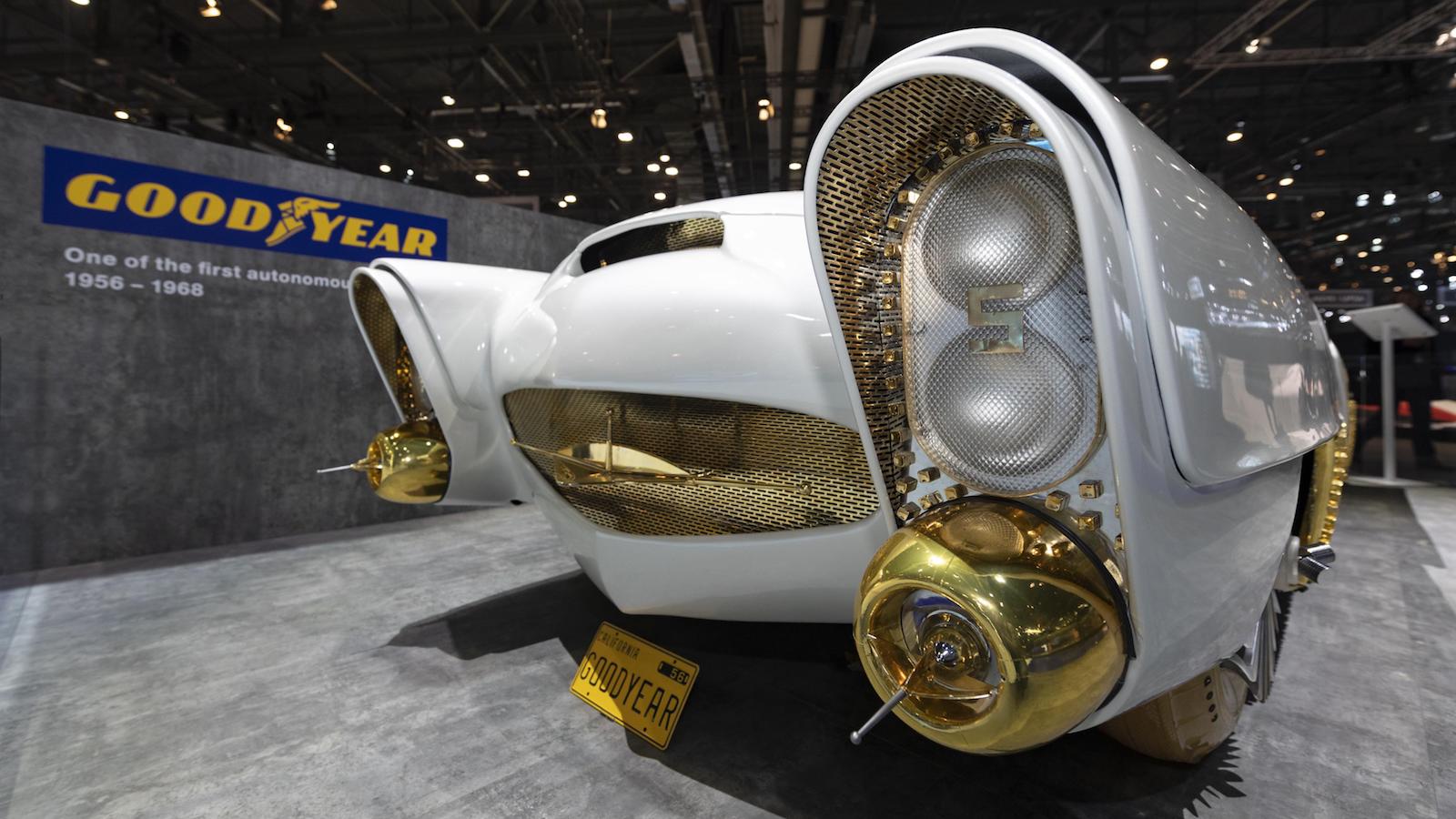
The Golden Sahara II is presented as the first prototype to include autonomous driving, a system that was completed with Goodyear’s illuminated tyres.
Many of today’s technologies are considered feats achieved in recent times, but the reality is that they began to be developed in the mid-1950s, such as autonomous driving. This innovation, which is gradually arriving in the most advanced vehicles of the 21st century, first saw the light in 1956 thanks to Goodyear. It was the tyre manufacturer that took the first steps in this field with the Golden Sahara II, a highly picturesque prototype that foreshadowed a promising future and that it now wants to demonstrate to us firsthand with its presence at this edition of the Geneva Motor Show.
Goodyear has carried out the restoration of this vehicle together with Klairmont Kollections, which has devoted its efforts to bringing the Golden Sahara back to life. With this premise, we are faced with a vehicle that is not only revolutionary even by our standards, but also one that has been remarkably successful in anticipating the steps the automotive sector would take 63 years after its creation.
Its development took place in the 1950s by Jim Street and George Barris, an acclaimed designer of custom cars. Both aimed to offer a vehicle capable of uniting several important innovations at the same time, something they achieved by implementing not only autonomous driving, but also other systems that we enjoy in today’s cars such as automatic braking.
The Golden Sahara II incorporated various sensors capable of detecting obstacles in its immediate surroundings. At the same time, it featured other innovations such as a retractable aircraft-style control yoke, a television, a telephone and automatic tailgate opening; but, without a doubt, one of the most striking aspects was its tyres.
These were manufactured by Goodyear and their main attraction was the feature of lighting up alongside the indicators. To achieve this effect, the tyre company used Neothane, a translucent form of synthetic rubber that allowed spectators to see the light from within when it came on. Another of its main goals was to improve visibility in adverse weather conditions and when the driver applied the brakes, thus allowing other road users to anticipate the reactions of the Golden Sahara.
https://youtu.be/j7gzmQfH9kQ
This is how Goodyear wanted to help such a revolutionary vehicle continue along the path that some current brands still follow today. Given that the Golden Sahara II was a precursor to autonomous driving and that it has become a very tangible technology, it would not be far-fetched to consider that at some point we could be part of the presence of illuminated tyres on our personal vehicle.


 Kia offers an electric range of 10 models, 50 versions and 400 possible combinations
 The seven finalists for the 2027 European Car of the Year (COTY) are exclusively electric
 Peugeot E-208 GTi: a battery-powered toy that revives the spirit of the 1980s sports cars
Deja un comentario